

SHOCKING! AS THE LASH OF A WHIP ACROSS YOUR FACE!
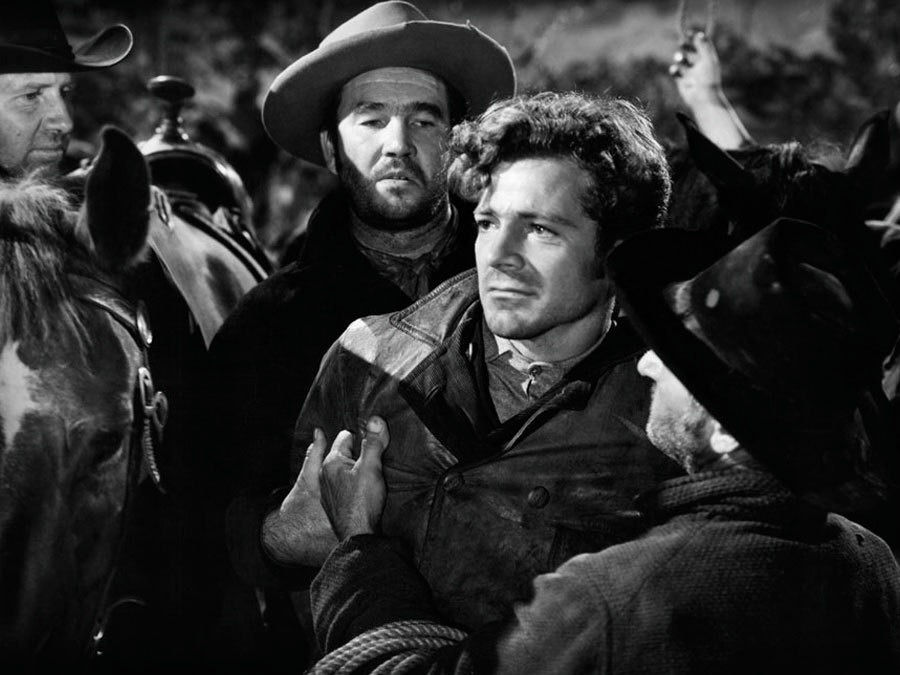
When Henry Fonda was 14, he witnessed something that affected him profoundly. From a nearby building, he and his father saw how a crowd of people lynched a Black man called Will Brown. This was in 1919, in the middle of the Omaha race riots, and it helped Fonda reach his liberal convictions. Many years later, he was frustrated with the type of work that Hollywood gave him. But the last film he made before joining the Navy during World War II became a Western that echoed what he saw when he was 14.
A rancher is found murdered
The story takes place in a small town in Nevada in 1885. Two cowboys, Gil Carter and Art Croft (Fonda, Harry Morgan), show up at a saloon only to learn that the woman Gil has a thing for isn’t there. After a whiskey or three, there’s a brawl, but things take a serious turn when everybody learns that a local rancher has been found murdered. Deciding that the killers must be nearby, the townspeople form a posse to hunt them down.
A lynching is in the air, but Arthur Davies (Harry Davenport) comes along, hoping to make his neighbors understand that any suspects need to have their day in court. Gil and Art also tag along, but find the situation deeply uncomfortable…
A grim message
This became a favorite of Fonda’s, but it wasn’t an easy film to market at the time. After all, its message was grim and the outcome was never going to be a happy one. Still, a few changes were made from the novel, which had even darker moments. It was a message movie before Stanley Kramer made them a must-see in the 1950s and ’60s, teaching us the value of law and order and the danger of group pressure. The Ox-Bow Incident did not make much money, but did receive a Best Picture nomination and has become an important classic.
Its short running time is an example of filmmakers knowing exactly what to do in very little time. The film introduces its lead character at the saloon in a lighthearted way, creates very tense drama out in the wilderness when the posse finally catch three men they believe to be the killers, and wraps everything up back at the saloon with a heartbreaking letter that only emphasizes the downright evil mistake that the people of this town made.
His ultimate fate is handled a little too abruptly by the filmmakers in the end, but Tetley is still an effective presence.
Of course, we in the audience are not certain what to make of the three suspects at first; they were indeed nearby, and even if one of them is an old man the other two (Dana Andrews, Anthony Quinn) might have been up to no good. But that’s what you find out during an investigation and subsequent trial, not during a quick interrogation out in the wild, where it’s obvious that one of the leading figures in the posse is dead set on hanging somebody. That would be Major Tetley (Frank Conroy), a rigid old man who’s always dressed in a Confederate uniform, even though his Civil War merits are doubtful at best. His ultimate fate is handled a little too abruptly by the filmmakers in the end, but Tetley is still an effective presence, a symbol of the non-thinking, cold, cruel authoritarian who will always be a driving force in a situation like this.
Much like another Fonda classic, 12 Angry Men (1957), the film takes expert advantage of the confrontation between the posse and the suspects, exploring things like who’s willing to speak up against the majority, skilfully alternating between different perspectives of the characters out there in the night. The confined nature of their surroundings only serves to build tension. Shame is another key theme near the end, symbolized by Fonda who’s very good as the cowboy who goes through a process of maturity in Ox-Bow Canyon.
The Ox-Bow Incident 1943-U.S. 75 min. B/W. Directed by William A. Wellman. Produced and written by Lamar Trotti. Novel: Walter Van Tilburg Clark. Cast: Henry Fonda (Gil Carter), Dana Andrews (Donald Martin), Harry Morgan (Art Croft), Frank Conroy, Harry Davenport, Anthony Quinn, Francis Ford, Jane Darwell… Margaret Hamilton.
Trivia: The lead role was first offered to Gary Cooper.
Last word: “In real important scenes, [my father] would shoot his men in unusual ways, like having a fight, and all you could see was their feet. Things like that. In The Ox-Bow Incident, the reading of the letter, you don’t see Henry Fonda’s eyes; you only see his mouth. He liked to do those things, and you’ll see those in all of his movies. There’s always rain; there’s always a dog… That was my father’s style and humor. He was interjecting humor into his stories; even in some dramatic places, there’d be some kind of bizarre humor.” (William Wellman, Jr., Film Talk)