
HE SAW THE WORLD IN A WAY NO ONE COULD HAVE IMAGINED.
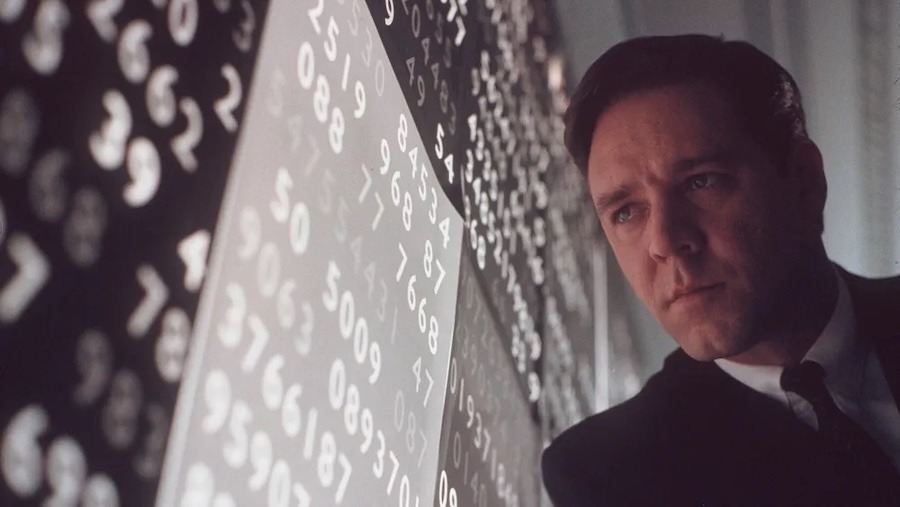
They said the screenplay had little to do with the brilliant mathematician John Nash’s real life. They said director Ron Howard had made the film too mushy and didn’t deserve to win the top Oscar. And Russell Crowe’s acting was targeted perhaps because he was a recent Oscar winner. Guess I’ll have to spend this review explaining why I think the Academy made a pretty good choice.
Proving Adam Smith wrong
The story begins with John Nash moving to Princeton University in 1947. He does bond with his partying roommate Charles (Paul Bettany) and creates a more uneasy alliance with a few other students on campus, but essentially he’s a loner who spends most of his time in the library trying to write a mathematical theory so special it will change the world. What he eventually came up with was an idea that in his mind proved the economist Adam Smith wrong. This won him the Nobel Prize in 1994, finally bringing him the acclaim he deserved after living a life where he was often disregarded or ridiculed. But that required a lot of pain.
After graduating from Princeton in 1950, Nash takes a job at MIT doing research and teaching, and this is when he meets Alicia Larde (Jennifer Connelly), a student. They fall in love and wed, but Nash’s mind is preoccupied by meeting a government agent called William Parcher (Ed Harris). He tells Nash that the Russians are planning a dastardly event and that America needs his brilliant mind to crack the codes that are planted in newspapers and magazines.
Finding out the truth
This is where we have to talk about the “secret” of the film, because the way it is structured and treated in the film is part of its success. John Nash turns out to be schizophrenic. A psychiatrist (Christopher Plummer) helps him realize that Nash’s roommate Charles and agent Parcher are delusions. Nash never did help the government hunt Russians and his life never was in danger – unlike his mind. Director Howard and writer Akiva Goldsman intriguingly make us believe what Nash believes and then take it away from us as brutally as it is taken away from Nash. The second half of the movie turns into a drama where we know the truth and invest our emotions in Nash trying to get better.
There are times when we see him fail utterly as well as moments where he truly begins to understand the flaws of his delusions; tellingly, no matter how many years pass, Charles’s niece stays the same tender age.
Borrowing the mannerisms from the real John Nash, Russell Crowe completely disappears into the part
Harris and Bettany are both terrific as Nash’s imaginary “friends”, but a lion’s share of the emotional strength comes from Crowe and Connelly. She had her true breakthrough as an actress worth taking seriously, and he’s quite moving in a part that looks unusual for this gladiator. Borrowing the mannerisms from the real John Nash, he completely disappears into the part.
Howard effectively divides the film into sections with different themes, showing Nash’s life in terms of light and colors. He has great help from James Horner who’s written an outstanding score that actually gives clues early in the movie to the secret; just look at that car chase and listen to the music and you will realize that something is off. As for the story not being true to Nash’s life… well, rather than trying to capture the protagonist’s entire life, Goldsman focused on a few vital ideas. There’s obviously manipulation, but he makes the story work beautifully.
A Beautiful Mind 2001-U.S. 135 min. Color. Directed by Ron Howard. Screenplay: Akiva Goldsman. Book: Sylvia Nasar. Music: James Horner. Cast: Russell Crowe (John Nash), Jennifer Connelly (Alicia Larde), Ed Harris (William Parcher), Paul Bettany, Christopher Plummer, Adam Goldberg, Judd Hirsch, Josh Lucas.
Trivia: Co-produced by Howard. Robert Redford was reportedly considered for directing duties; Tom Cruise and Rachel Weisz for the leads.
Oscars: Best Picture, Director, Supporting Actress (Connelly), Adapted Screenplay. Golden Globes: Best Motion Picture (Drama), Director, Actor (Crowe), Supporting Actress (Connelly), Screenplay. BAFTA: Best Actor (Crowe), Supporting Actress (Connelly).
Quote: “I still see things that are not here. I just choose not to acknowledge them. Like a diet of the mind, I just choose not to indulge certain appetites.” (Crowe)
Last word: “I thought it was my job to try and put the audience inside [Nash’s] head, and try to offer some insight. I borrowed from a few areas including a biography I was reading about Tesla, which was kind of interesting. He used to be able to visualize his inventions coming together in his mind. He could literally see it click and sometimes he could even see problems in the engineering of his concept, even in his mind. I thought this was pretty remarkable. I talked to a lot of mathematicians about it and some had sort of visual clues for me, others not. I started borrowing on phrases that people used to describe those sorts of break-throughs, those insights. Like, ‘Suddenly the clouds lifted, the light went on, it was like a bolt of lightning, in a flash I saw it – those sort of things.’ I began to use those and try to work with that idea.” (Howard, About.com)