

… A MOTION PICTURE FOR ALL TIMES!
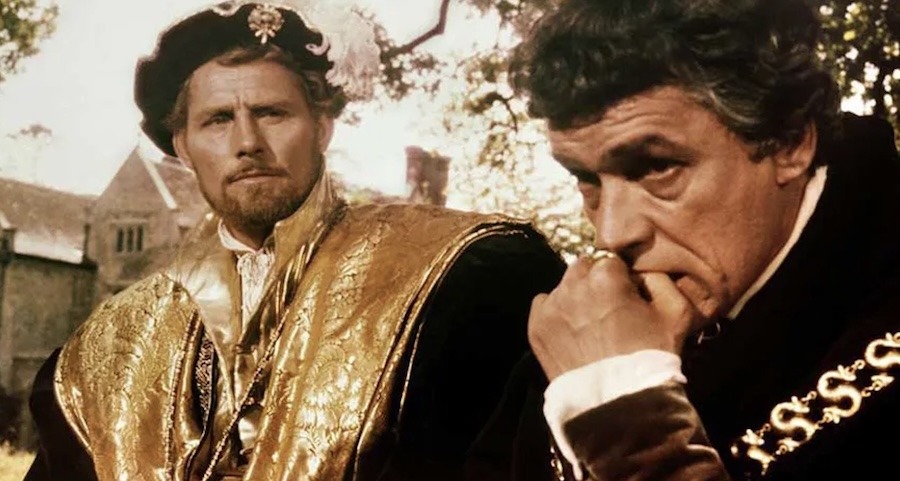
When it comes to the play ”A Man for all Seasons”, and its 1966 film adaptation, there were historical errors that Thomas More biographer Richard Curry Marius could live with. After all, he recognized the need to dramatize certain events in a movie. But one thing made him anything but a fan of Robert Bolt’s lauded work: turning More into a hero worthy of admiration. After all, Marius had read More’s writings and knew how fiercely he hated Protestants, writing of how much he wanted to see them burn like heretics. As Marius pointed out, the Lord Chancellor himself would likely have been outraged at how he was portrayed here.
A battle within the Church
During the reign of Henry VIII (Robert Shaw), a battle within the Church is brewing. Cardinal Wolsey (Orson Welles), the current Lord Chancellor, puts pressure on Sir Thomas More (Paul Scofield), the sole member of the Privy Council to stand in the way of getting the Pope to annul the King’s marriage to Catherine of Aragon. No male heir has arrived, so Henry wants to move on and marry Anne Boleyn instead, which the Catholic Church refuses to allow.
Upon the death of Wolsey, More is appointed new Lord Chancellor and the pressure increases, not only from the King, but also Thomas Cromwell (Leo McKern), who starts out as Wolsey’s aide but soon becomes More’s sworn enemy.
Started out as a radio play
A film in the tradition of Becket (1964), another drama depicting a conflict between an English king and a cleric, also based on a play that was criticized for its historical inaccuracies. Robert Bolt became fascinated with Sir Thomas More as a child and ”A Man for all Seasons” was one of his earliest works, finding its way to the BBC as a radio play in 1954 and then for TV a few years later. The stage premiere took place in 1960 and British critics were positive, even if they failed to see it as a classic in the making. But that’s what happened; the play made the jump to Broadway where it was celebrated by American critics, and it has been revived many times, as well as turned into this Oscar-winning movie.
One of the noteworthy ingredients in Bolt’s play was the Common Man, several characters (including a boatman, a servant and an executioner) representing the Common Man, who serves as a narrator, sometimes breaking the fourth wall. The author wanted this person to show theater audiences how regular people will always be part of history, even when events are dominated by rich and powerful men. For the film adaptation, Bolt removed the character and instead wrote a few new scenes to cover some of the narration previously provided by the Common Man. I can’t help but wonder if preserving this concept would have made the film stand out, even more.
Still, it’s a gripping adaptation, with sharp dialogue, making the point that relying on one’s conscience defines a person; even in the face of death, More refuses to do what’s wrong in his mind. The eternal theme of standing up for your principles and refusing to bow to authoritarianism is what makes a play set in the 1500s relevant in our times as well, regardless if the real Sir Thomas More was much of a hero or not.
Paul Scofield is brilliant as the wise Lord Chancellor.
A Man for all Seasons won Oscars for its cinematography and costumes, technical ingredients that help lend the film its classy look. Scofield is brilliant as the wise Lord Chancellor whose path to the Tower is inevitable, but who refuses to give up on his faith or the logic of his reasoning, embarrassing and confusing his opponents. Shaw is also terrific as the King who makes a brief appearance in the film, but whose influence is omnipotent.
A Man for all Seasons 1966-U.K. 120 min. Color. Produced and directed by Fred Zinnemann. Screenplay, Play: Robert Bolt. Cinematography: Ted Moore. Art Direction: John Box. Costume Design: Joan Bridge, Elizabeth Haffenden. Cast: Paul Scofield (Sir Thomas More), Wendy Hiller (Alice More), Leo McKern (Thomas Cromwell), Orson Welles, Robert Shaw, Susannah York, Nigel Davenport, John Hurt, Corin Redgrave, Colin Blakely, Vanessa Redgrave.
Trivia: Richard Burton and Laurence Olivier were considered for the lead; Alec Guinness, Peter O’Toole and Richard Harris for other roles. Remade as a TV movie, A Man for all Seasons (1988).
Oscars: Best Picture, Director, Actor (Scofield), Adapted Screenplay, Cinematography, Costume Design. BAFTA: Best Film, British Film, Actor (Scofield), Screenplay, Cinematography, Art Direction, Costume Design. Golden Globes: Best Motion Picture (Drama), Director, Actor (Scofield), Screenplay.
Last word: “For the first few days the crew did their usual work very well, the way they would have done on any job, but on the third day, when Scofield made his speech about the majesty of the law, they were suddenly mesmerized by the magic of those words and they remained that way throughout the rest of the filming. So totally did Paul convey the scope of More’s character that for months afterwards I couldn’t help but look at him in awe, as a saint rather than an actor.” (Zinnemann, “A Life in the Movies”)