

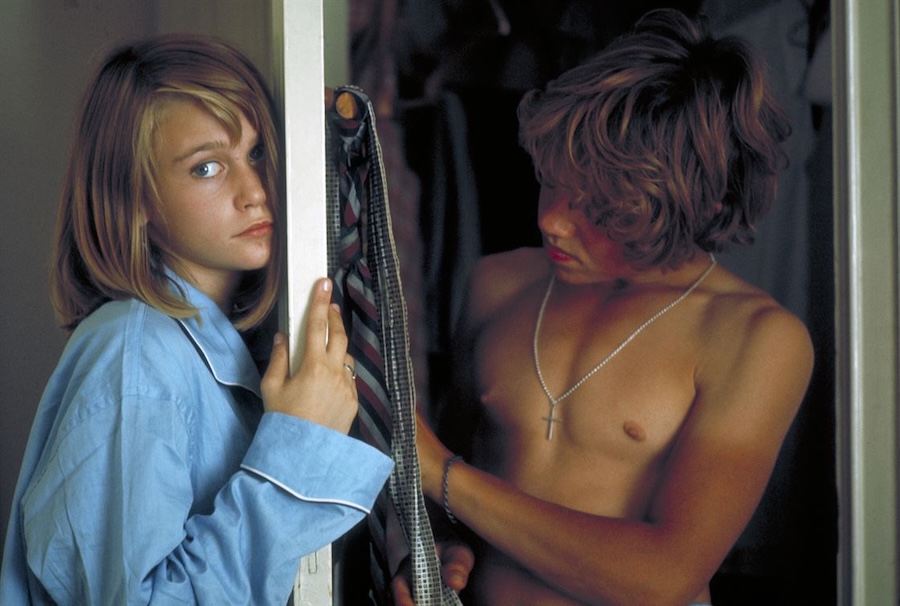
A few minutes into Roy Andersson’s lauded, now classic film debut, there’s a distinct Bo Widerberg touch. In the late 1960s, Andersson worked with the legendary director and the collaboration clearly left its mark. The cast is a mix of professional actors and amateurs. Andersson borrowed cinematographer Jörgen Persson from Widerberg and the beautiful images are familiar from that filmmaker’s work.
Comparing this film with Andersson’s later efforts, including his commercials and Songs from the Second Floor (2000), is interesting. In this project, it doesn’t seem like he’s found his style, but managed to put together a Widerberg movie. You could do worse.
Meeting by chance
The title is very simple, revealing what’s at heart of the film, but not the fact that whoever witnesses this love story gets a deeper experience than expected. Pär (Rolf Sohlman) and Annika (Ann-Sofie Kylin) meet by chance. Both are in their early teens, afraid to look at each other… but their discreet glances say more than words. When they meet again they’re among pals and there’s a better chance to get to know one another – even if messengers in the shape of best friends is still needed. Soon, they’re a couple, touchingly illustrated by Andersson in a scene where we see the teens walk with their mopeds, Annika catching up with Pär and putting her hand on his pillion.
Walking off into the mist
As much as this is a portrait of young love, it also captures the adults, and that’s not a pretty sight. Early in the film, we see an elderly man, in despair, tell his relatives that this world is no longer for him. Annika’s aunt (Anita Lindblom) still mourns the fact that she never became an air stewardess. She’s now dating a very unpleasant man. And the film ends with a party that turns embarrassing because of alcohol, conflicts, abuse, and a final tragicomic sequence where Annika’s father John (Bertil Norström) walks off into the mist, drunk and pissed, in danger of drowning in the lake.
The contrast between adulthood and childhood is obvious. The grownups’ marriages and lives are dark and miserable. But the Swedish summer is so pretty it hurts; teenage love is pure and intense, and there’s hope for Annika and Pär. The love story is heartwarming and Björn Isfält’s music score is one of the reasons for it. This was his first, and it’s quite memorable, even if the editing could’ve been gentler; many scenes cut if off too abruptly.
They were amateurs but their rapport is terrific, most of the time.
Sohlman and Kylin are cute together. They were amateurs but their rapport is terrific, most of the time. I also enjoyed watching Norström and Margreth Weivers, who have been married in real life since 1947. They play Annika’s parents and Norström in particular has a role of a lifetime as an unhappy fridge salesman. Singer Anita Lindblom was a rare sight in films like this, but she makes a strong impression here.
I’m sure Bo Widerberg was proud of his student. What Roy Andersson accomplished with his Swedish love story is what Lukas Moodysson did 30 years later with Show Me Love, a tribute to youth as it is before adulthood comes barging in.
A Swedish Love Story 1970-Sweden. 119 min. Color. Written and directed by Roy Andersson. Cinematography: Jörgen Persson. Music: Björn Isfält. Cast: Rolf Sohlman (Pär), Ann-Sofie Kylin (Annika), Bertil Norström (John), Margreth Weivers, Anita Lindblom, Lennart Tellfeldt.
Trivia: Original title: En kärlekshistoria. Alternative title: A Love Story.
Guldbagge Award: Best Film.
Last word: “I couldn’t find the so-called ‘realism’ or ‘naturalism’ interesting any longer. My first movie, Swedish Love Story – it was good, I think. It’s very good for that style. It has good acting, and it’s very spiritual and very impressive. But I felt that I couldn’t go further with that style. So with Giliap I started the process of finding the style I’m at now. More abstract, more planned.” (Andersson, MUBI)