

AMADEUS. THE MAN. THE MUSIC. THE MAGIC. THE MADNESS. THE MURDER. THE MYSTERY. THE MOTION PICTURE.
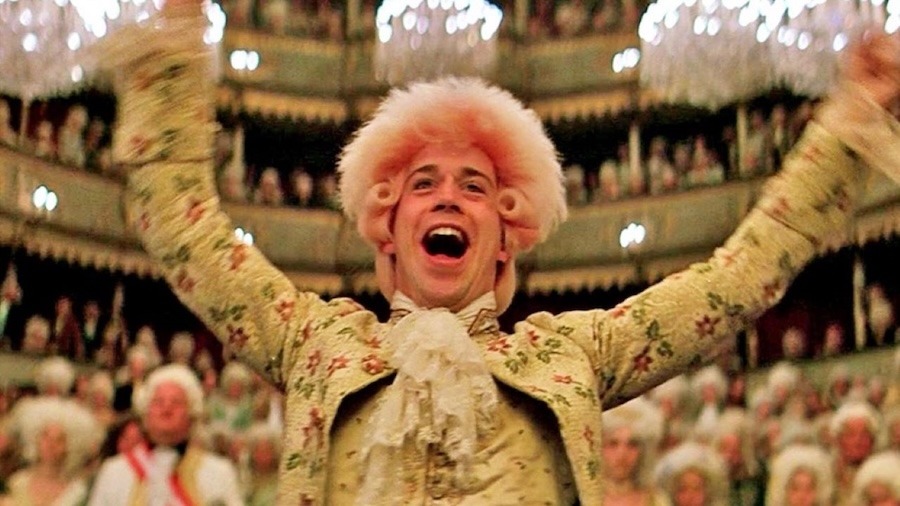
Most of us recognize Antonio Salieri’s feelings. He has worked hard to achieve something, got a good education and managed to become court composer to Austrian Emperor Joseph II. His music is reasonably popular. And yet he is nothing in comparison to Wolfgang Amadeus Mozart. Everything is easy to him; he doesn’t need years of classical training, he can basically fart music that is infinitely more complex and attractive than anything Salieri can produce. Ah, the frustrating, maddening effect of mediocrity; you know you should be able to do better, but you can’t. One could kill for less.
How Salieri destroyed Mozart
Director Milos Forman’s most beloved film (along with One Flew Over the Cuckoo’s Nest (1975)) begins with the old Salieri (F. Murray Abraham) sitting in a lunatic asylum telling a priest the story of his life and how he destroyed Mozart. He first met the young and childish composer (Tom Hulce) in Vienna in the 1780s when the Emperor (Jeffrey Jones) was introduced to this artist everyone was talking about. Salieri couldn’t believe his eyes – how could this smutty, boastful boy, with the most annoying laughter in the world, be so jaw-droppingly talented? Mozart is pleased to meet Salieri, although the young composer can’t help to immediately improve on some of Salieri’s work (much to his jealous anger).
As the Emperor commissions Mozart to write music for him, the young man goes on to marry Constanze (Elizabeth Berridge) and struggle with his disapproving father. Salieri grows increasingly envious of Mozart’s work and turns his back on God for choosing to speak through that man rather than him.
Nothing mediocre about Abraham
Not much is true about this story; it’s the fictional work of Peter Shaffer, but what a story he has come up with. Understanding Mozart is a humbling experience, so it is easy to put oneself in Salieri’s place. History may sometimes seem detached to a modern audience, but Amadeus puts very human emotions and weaknesses in touch with us.
The cast conveys those passions brilliantly. There is nothing mediocre about Abraham’s performance; his eyes are black with envy and he’s utterly convincing as the old Salieri as well, especially in Paul LeBlanc and Dick Smith’s amazing makeup. Hulce shows depth, first as the irresponsible clown and then as the tormented, dying master. An amusing Jones as the undeniably dim-witted Emperor leads a supporting cast brimming with talent. The Prague locations make a long-gone Vienna come alive; the buildings (including the Estates Theatre where two of Mozart’s operas debuted), streets and costume design make us feel like we’ve traveled to the 1700s, sitting there in the candlelight, watching history unfold.
Mozart’s operas and symphonies lovingly envelop the movie.
And then there’s the music. Mozart’s operas and symphonies lovingly embrace the movie; it’s achingly beautiful and frighteningly grand. Its impact only serves to dwarfen Salieri’s efforts to a greater degree.
The story has lulls (especially in the long version), but they are few. One of its lessons is very clear. Much like whenever I feel I could never write a review as well as the people I admire, I’m sure that many young filmmakers feel that they could never walk in Forman’s footsteps. But rather than blame God for our shortcomings, like a bitter Salieri, it’s much better to try once again.
Amadeus 1984-U.S. 158 min. Color. Widescreen. Directed by Milos Forman. Screenplay, Play: Peter Shaffer. Cinematography: Miroslav Ondricek. Editing: Nena Danevic, Michael Chandler. Art Direction: Patrizia von Brandenstein, Karel Cerný. Costume Design: Theodor Pistek. Makeup: Paul LeBlanc, Dick Smith. Cast: F. Murray Abraham (Antonio Salieri), Tom Hulce (Wolfgang Amadeus Mozart), Elizabeth Berridge (Constanze Mozart), Simon Callow, Roy Dotrice, Christine Ebersole, Jeffrey Jones… Cynthia Nixon.
Trivia: Kenneth Branagh and Mark Hamill were considered for the part of Mozart; Meg Tilly was first cast as Constanze but had to drop out. Sir Neville Marriner conducted the film’s music. Also released in a 180 min. version. The play was also adapted as a miniseries, Amadeus (2025).
Oscars: Best Picture, Director, Actor (Abraham), Adapted Screenplay, Art Direction-Set Decoration, Costume Design, Makeup, Sound. BAFTA: Best Cinematography, Editing, Makeup Artist, Sound. Golden Globes: Best Motion Picture (Drama), Director, Actor (Abraham), Screenplay.
Quote: “From now on we are enemies, you and I. Because you choose for your instrument a boastful, lustful, smutty, infantile boy and give me only the ability to recognize the incarnation. Because you are unjust, unfair, unkind I will block you, I swear it. I will hinder and harm your creature on Earth as far as I am able. I will ruin your incarnation.” (Abraham cursing a crucifix)
Last word: “I was in London just for three days, casting Ragtime. By sheer coincidence, my representative, Mr. Robert Lantz, was also in London. One day he called me, when I had a room full of people, and asked if I want to see a play with him that night. And, you know, the London stage is well-known for its quality, so I didn’t even ask what, and I said, ‘Of course.’ Only in the taxi, I learned that it’s a new play about composers. [Laughs.] And I thought, ‘I am going to faint.’ I was prepared for the most boring evening, because I was used to seeing the Russian and Czech films about composers, and they were the most boring films. Communists love to make films about composers, because composers compose music and don’t talk subversive things. But it was the very first public preview [of ‘Amadeus’] in London. Nobody saw it before. And I am sitting in the theater waiting to fall asleep, and suddenly I see this wonderful drama, which would be wonderful even if it was not Mozart and Salieri.” (Forman, A.V. Club)