

HE IS AFRAID. HE IS ALONE. HE IS THREE MILLION LIGHT YEARS FROM HOME.
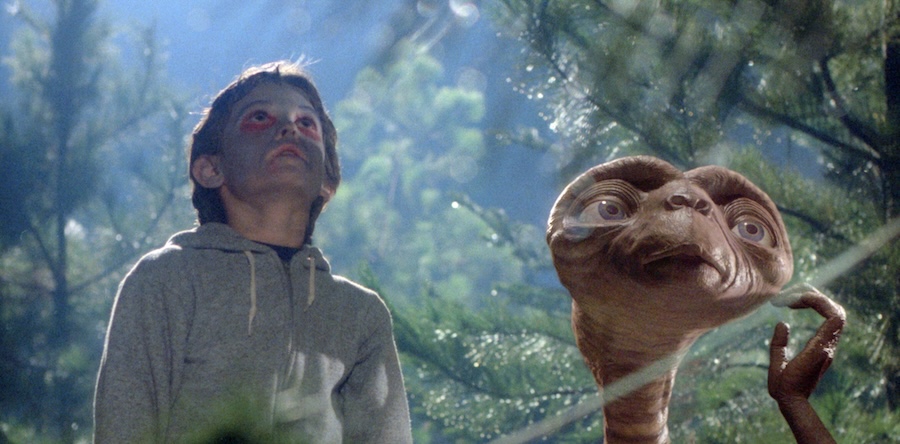
When Richard Attenborough accepted his two Oscars for Gandhi in 1983, he acknowledged the fact that he had just beaten one of the favorites. “I was certain that not only would E.T. win, but that it should win. It was inventive, powerful, [and] wonderful. I make more mundane movies,” he said. There is an abundance of love stories surrounding the arrival of E.T., telling us for instance how critics at the Cannes festival, weary of the official entries, fell in love with the film, and how moved President Ronald Reagan was at the private White House screening. At the heart of this beloved classic is a story about an imaginary friend that Steven Spielberg invented as a kid when his parents got divorced.
Left behind
The film opens with a bunch of aliens on a mission to Earth. When government agents suddenly appear, they abort and depart in their spaceship, leaving behind one of them. The creature has no choice but to venture into a Northern California suburb where he’s discovered by a boy, Elliott (Henry Thomas), who brings him home. The only ones to learn of Elliott’s secret are his siblings, Michael (Robert MacNaughton) and Gertie (Drew Barrymore), who agree to keep the alien hidden from their mother Mary (Dee Wallace).
As Elliott begins to feel a special connection to the creature, he and his brother and sister realize that the extra-terrestrial needs to somehow “phone home” and get back to his own planet. Meanwhile, those government agents are on his trail…
Barrymore’s breakthrough
When I saw Super 8 last week, I realized that perhaps this is the time to revisit good old E.T.. J.J. Abrams’s work borrows heavily from Spielberg’s film, especially that rousing finale and in its depiction of childhood. Thomas is ideal for the part of Elliott who not only conveys heartfelt emotions but also makes a convincing drunk in an amusing sequence that shows the psychic connection between him and E.T.. This was also Barrymore’s breakthrough and she’s adorable as little Gertie who gets a kick out of dressing up the poor alien in a dress, wig and hat (“you should give him his dignity”, Elliott points out).
As for the adults, they’re either clueless (like Elliott’s mom) or cold-hearted government shills (represented by Peter Coyote’s character), scaring the living daylights out of the kids and the alien. The only hope for mankind as far as relations between humans and aliens go is the love of a child, which seems like a natural conclusion for Spielberg after Close Encounters of a Third Kind (1977) where the connection between the species was best made via an adult (in the shape of Richard Dreyfuss) willing to have an open mind toward the unexplained.
It’s impossible not to shed a tear along with Elliott, or should we say the younger Spielberg.
As in that film, Carlo Rambaldi helped design the look of the alien – and this is quite an achievement. After all, there was every chance of this rubbery creature merely generating ridicule… but his demeanor is actually hypnotizing in all its sweet, funny, endearing childishness. When the time comes to say goodbye, Spielberg has so skilfully built our emotional tie to E.T. that it’s impossible not to shed a tear along with Elliott, or should we say the younger Spielberg.
John Williams’s music score is certainly a reason why the finale is so powerful. There is another scene much earlier in the film where E.T. makes Elliott’s bicycle lift from the ground and fly away (one of the movie’s iconic shots courtesy of cinematographer Allen Daviau), boosted immensely by Williams’s music. The same soaring cues return for the finale, and in that context the music simply opens our tear ducts. As E.T. points to Elliott and says “I’ll be right here”, the Christ allegory is complete. Under these circumstances, who could object to those pretensions?
E.T. The Extra-Terrestrial 1982-U.S. 115 min. Color. Directed by Steven Spielberg. Screenplay: Melissa Mathison. Cinematography: Allen Daviau. Music: John Williams. Visual Effects: Carlo Rambaldi, Dennis Muren, Kenneth Smith. Cast: Dee Wallace (Mary), Henry Thomas (Elliott), Peter Coyote (Keys), Robert MacNaughton, Drew Barrymore, K.C. Martel, C. Thomas Howell… Erika Eleniak.
Trivia: Co-produced by Spielberg. Debra Winger contributed to the voice of E.T.. The alien’s face was moulded uponthose of Carl Sandburg and Albert Einstein. Ralph Macchio was considered for a scene; Harrison Ford shot a scene that was later cut. In 2002, the movie was reissued (at 123 min.), with a few technical changes, the most controversial of which was providing agents with walkie-talkies instead of the original rifles; Spielberg latterly regretted that change.
Oscars: Best Original Score, Visual Effects, Sound, Sound Effects Editing. BAFTA: Best Score. Golden Globes: Best Motion Picture (Drama), Original Score.
Quote: “E.T. phone home.” (the alien expressing homesickness)
Last word: “I can’t really say that E.T. dropped out of the sky and hit me on the head without a number of experiences from the time my father made me go with him at two o’clock in the morning to watch a meteor shower when I was six years old and I suddenly realized that the sky up there and the stars are worthy of closer scrutiny, all the way to the time I saw The Wizard of Oz and Peter Pan and every Disney film ever made and all the films of Hitchcock and Kubrick and read all the novels of Steinbeck and Faulkner and all the experiences I ever had in elementary and grammar school and high school and college to bring me to a place in my life where I found myself standing out in the Sahara Desert shooting Raiders of the Lost Ark and, indeed, something did fall out of the sky and hit me on the head in the shape of a small, fat little squashy character named E.T..” (Spielberg, American Cinematographer)