

IT WILL HAVE YOU SITTING ON THE BRINK OF ETERNITY!
1964 was indeed the year of the Bomb. Stanley Kubrick’s absurd Cold War comedy Dr. Strangelove, which was based on a novel by Peter George, was first released. When George found out about Eugene Burdick and Harvey Wheeler’s novel “Fail-Safe” and its very similar theme, he sued the writers. The case was settled out of court, but Columbia ended up releasing screen adaptations of both novels.
This is a very dark film, along the lines of “Daisy”, the infamous nuclear war ad that Lyndon Johnson’s presidential campaign released the same year. This is a movie that urges us to be afraid, very afraid.
A U.F.O. enters American air space
At the same time as a congressman (Sorrell Booke) is visiting the Strategic Air Command in Omaha, Nebraska, a problem arises. There’s an alert showing an unidentified flying object intruding into American air space. As the military leadership tells the congressman, this happens all the time and the U.F.O. is likely nothing at all. However, part of the automatic response to this potential threat is having groups of bombers proceed to so-called “fail-safe” points around the globe. That’s where they will await a “Go code”; should one be issued, the planes will approach their Russian targets and drop nuclear bombs. This time, an electronic malfunction causes a “Go code” to be sent to one group of bombers – and the Russians’ new jamming device keeps disturbing communication between the group and headquarters. As the planes head for Moscow, the President (Henry Fonda) has an embarrassing phone call to make…
Creating a genuine fear
Director Sidney Lumet has done everything to emphasize the darkness of the subject matter. Few other Cold War thrillers managed to create such a genuine fear of the Bomb and every piece of technology connected to it. Even though the filmmakers end their work by pointing out that this could not happen in real life, few of us are naive enough to put our complete trust in the doomsday arsenal of any nuclear-capable country.
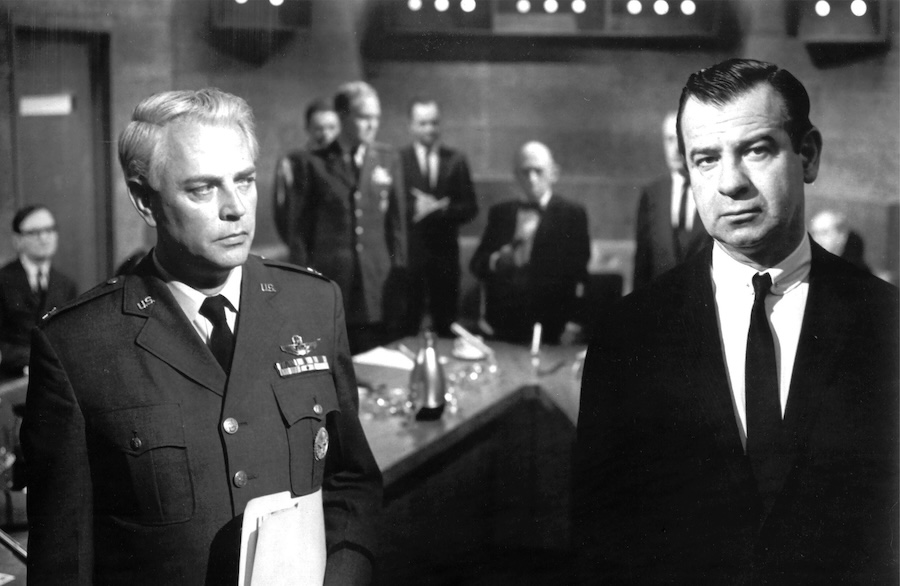
Inspired by his past as a highly skilled television director, Lumet made 12 Angry Men (1957) work so well because of its focus on characters and a claustrophobic setting – and for Fail-Safe, he employed the same kind of method. Shot in very dark black-and-white, with cinematographer Gerald Hirschfeld closing in on the sweaty faces of lead actors, Lumet creates a very tense film that could easily be turned into a play. There’s no music score and the movie is set in just a few locations, including the Strategic Air Command in Omaha and a very sparsely decorated room where the President’s trying to convince the Soviet Premier (aided by Larry Hagman’s bright, young interpreter) that Moscow is about to be annihilated – but not as part of a general U.S. attack on Russia. Watching Fonda and Hagman play this high-stakes game is fascinating.
Strong performances by the cast, including Walter Matthau in an early feature film appearance.
Other parts of the film also underscore a touching willingness among American and Russian military leaders to cooperate in the attempts to stop the bombers from reaching their target; less successful is the simple psychology behind Colonel Cascio’s (Fritz Weaver) breakdown in the latter half of the film. Strong performances by the cast, including Walter Matthau in an early feature film appearance as Professor Groeteschele, the academic who disperses hard-line advice with a chilling enthusiasm on why attacking the Soviets first is a good idea.
Fail-Safe is undoubtedly a product of its era, just like the “Daisy” ad. But unlike Johnson’s attack on Goldwater, Lumet’s work is still moviemaking at its most evocative. The Terminator was right. Never trust a machine.
Fail-Safe 1964-U.S. 111 min. B/W. Directed by Sidney Lumet. Screenplay: Walter Bernstein. Novel: Eugene Burdick, Harvey Wheeler. Cinematography: Gerald Hirschfeld. Cast: Henry Fonda (The President), Walter Matthau (Professor Groeteschele), Fritz Weaver (Colonel Cascio), Dan O’Herlihy, Sorrell Booke, Larry Hagman… Dom DeLuise.
Trivia: Weaver’s feature film debut. Remade as a play for live TV in 2000.
Last word: “I reorganized stuff, wrote a lot of dialogue. As I remember, the dialogue in the book was very wooden, and it wasn’t that important. The basic story remained the same. But I wrote a lot of the President’s stuff. That was mine. I mean, very few actors could do what [Henry Fonda as the President] did, to be confined in that space. He was great working in a small space, and within. He was a very unusual actor that way. It was also a very good movie for Sidney, after all the years of doing television. You know, he felt very much at home, in that kind of [genre]. It wasn’t like he had to do a Western.” (Bernstein, Camera in the Sun)