

THERE ARE TWO SIDES TO EVERY BLADE… ONE FOR THE ENEMY… ONE FOR SUICIDE BY HARAKIRI.
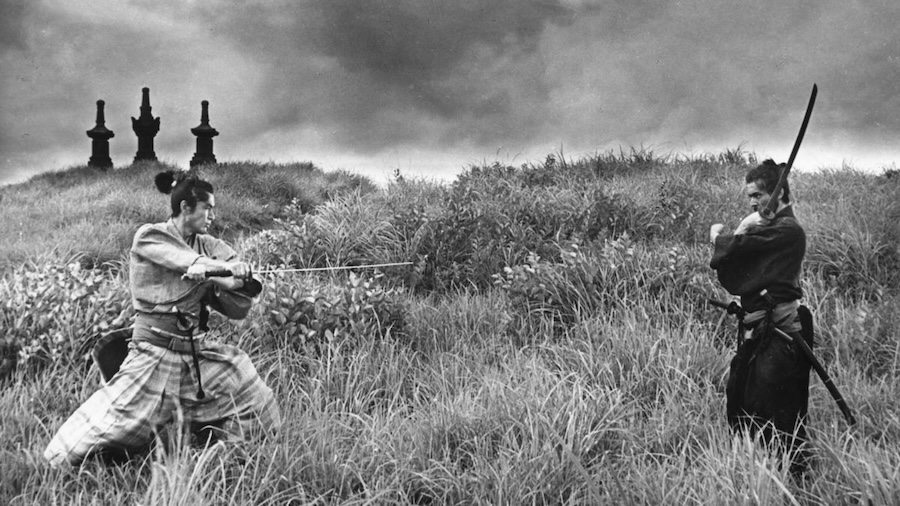
After completing his epic ”Human Condition” trilogy of films in 1961, Japanese director Masaki Kobayashi turned to the samurai. His own family hailed from a samurai and he found the story in Yasuhiko Takiguchi’s original novel another opportunity to examine the hypocrisy of men in power; it’s what he experienced as a soldier in Japan during the war and he had just spent three movies discussing the subject. Harakiri would become perhaps his most famous project.
Telling a story
In 1630, the estate of the Iyi clan receives a visitor, a ronin called Tsugumo Hanshiro (Tatsuya Nakadai) who says that he wishes to commit harakiri in the courtyard. The clan has been here before. Senior counselor Saito Kageyu (Rentaro Mikuni) tells the visitor a story. Some time ago, there was another ronin who came to the clan with the same request. They quickly realized that the ronin, Chijiwa Motome (Akira Ishihama), wasn’t serious – all he really wanted was to receive alms and be turned away. This was a rising trend among the dishonorable ronin and the clan had had enough.
The leadership decided to force Motome to go through with his ”request” or be killed by the samurai of the clan. It turns out that Motome’s swords were made of bamboo; he certainly had no intention to use them on himself. In the end, that’s what the ronin did anyway, in a horrifying procedure. After listening to the story, Hanshiro has one of his own to tell Kageyu…
Turning everything on its head
At first, we’re led to believe everything from the clan’s perspective. Why shouldn’t they punish a dishonorable man who says he will do something as outrageous as commit suicide and then turn out to only be after money? The clan and its samurai are men of honor and there’s an elegance to their habits and quarters. Sure, forcing the ronin to gut himself with a bamboo sword might seem excessively cruel, but didn’t he bring it on himself? The next story, the one told by Tsugumo Hanshiro, who seems to be in exactly the same position as Motome, slowly turns what we know on its head.
The filmmakers take their time, achieving their desired effect: Hanshiro’s perspective brings greater meaning to both his own and Motome’s past and exposes Kageyu and his men. They don’t know it, but he’s always one step ahead of them. In the end, we understand that the clan is little more than a Mafia organization, one that hides its shame, lies and constantly rewrites its history. There’s a scene, during a confrontation between Hanshiro and the samurai, where he grabs ahold of a symbolic suit of armor, propped up as if there’s a man inside. It’s traditionally treated with great reverence, but Hanshiro throws it to the floor. That symbolism escapes no one: the suit truly is empty.
One of the film’s greatest assets is the widescreen cinematography
Kobayashi has a great story to work with and slowly builds tension and emotion the more we learn about the tragedy of Hanshiro and the people he loved. Nakadai is excellent in the lead, showing Kageyu and the clan that he is a pitiable, weak man… only, it’s a game that will cost them dearly; Mikuni is also very good as the counselor who keeps his cool, even as he realizes the mistakes he’s making. One of the film’s greatest assets is the widescreen cinematography; brilliantly composed, there’s beauty and thought to the images.
Kobayashi would return to the same novelist and similar themes in Samurai Rebellion (1967), set a hundred years after Harakiri. There is never a bad time for a Western or samurai movie to depict one man’s quest to take down corrupt and evil leadership.
Harakiri 1962-Japan. 133 min. B/W. Widescreen. Directed by Masaki Kobayashi. Screenplay: Shinobu Hashimoto. Novel: Yasuhiko Takiguchi. Cinematography: Yoshio Miyajima. Cast: Tatsuya Nakadai (Tsugumo Hanshiro), Rentaro Mikuni (Saito Kageyu), Akira Ishihama (Chijiwa Motome), Shima Iwashita, Tetsuro Tamba, Ichiro Nakatani.
Trivia: Original title: Seppuku. Remade as Hara-Kiri: Death of a Samurai (2011).
Cannes: Jury Special Prize.
Last word: “The day before filming the [harakiri scene involving bamboo swords], I still hadn’t come up with the storyboards and I went out drinking. You know, envisioning storyboards is all about concentration and focus, about pondering a question to which you have no solution and suddenly you have a flash of vision. It’s probably a similar process in music as well. Anyway, in order to stab your own stomach with a bamboo blade, you’d have to fix the blade very firmly onto the tatami, practically forcing your body down onto it in order for the blade to puncture you; that was my insight. Once I saw that, the surrounding images came easily. Of course, I had been drinking, which is why I guess I headed off in such a brutal direction.” (Kobayashi, interview by Peter Grilli)