

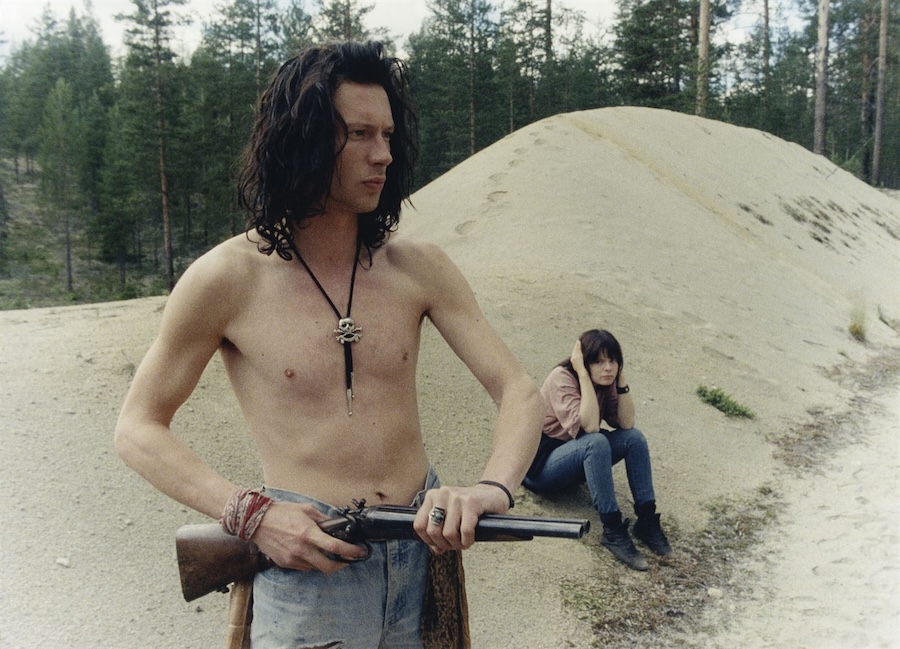
On July 3rd 1988, a married couple and their 15-year-old son were murdered in a small community called Åmsele in northern Sweden. Father and son, who discovered that one of their bicycles had been stolen, were shot in the head with a shotgun. When her husband and kid didn’t come home that night, the mom set out to find them but instead ran into the killers, Juha Valjakkala and his girlfriend Marita Routalammi. She was subsequently found beaten to death, her throat slit.
The grotesque nature of the murders outraged people all over the Nordic countries, until the killers were caught. No wonder that Jan Troell faced great resistance in Åmsele when he decided to craft a portrait of the murderers, albeit a fictional one.
Looking for a purpose
The first time we meet Jari and Minna (Antti Reini, Maria Heiskanen), they come across as two young people in Finland looking for a purpose. Minna is immediately impressed with Jari’s charisma, even if she soon learns that he can be dangerous. At his place, Minna finds out that he’s playing in a band and has a past as a petty thief, but that he’s dreaming of greater things. She’s soon pulled into his life of crime. After a stint in prison, Jari shows up at Minna’s apartment and announces that they’re going to Amsterdam. Minna, who had more or less decided to drop him, can’t resist… and has a feeling that life might be better for them down south.
Willing to sacrifice their reputation
Acclaimed novelist Per Olov Enquist was drawn to this story, perhaps because it is largely set in his part of Sweden and because he wanted to try to understand what motivated the two murderers. The fact that he and Troell, a distinguished filmmaker, were willing to sacrifice their reputation with this movie made it easier to take it seriously, not as some cheap cash-grab. Are they successful in their endeavor? To a large degree, yes. The film, divided into several chapters, is void of sentimentality. Very little time is devoted to the characters’ background, which makes it hard to understand them. Jari was a rotten apple from the start and Minna looks more like one of those women who write letters to serial killers in prison. There are times when Enquist tries to complicate their relationship, but the balance of power is set early. Minna’s great concern for a couple of rabbits who are in the couple’s care is absurdly and effectively contrasted with the ruthlessness of the murders.
The film has the feel of a documentary, its atmosphere mournful and unpleasant.
Reini and Heiskanen were newcomers during the making of the film, but fit very well into how Troell, as a director and cinematographer, captures the isolation of small communities and forests in northern Sweden, showing how detached from a normal life the couple becomes. The film has the feel of a documentary, its atmosphere mournful and unpleasant.
Enquist reaches no great depths here, which is a pity. But this is still a striking illustration of evil, I can’t really use any other word, but also of the kind of power one person can have over the other in a relationship. People in Åmsele may feel deeply unsatisfied with the movie… but it’s nevertheless a commendable attempt to understand the mechanism behind murders that come across almost as if they were committed in wartime.
Il Capitano: A Swedish Requiem 1991-Sweden-Germany-Finland-Denmark. 109 min. Color. Directed, photographed and edited by Jan Troell. Screenplay: Per Olov Enquist, Jan Troell, Göran Setterberg. Cast: Maria Heiskanen (Minna), Antti Reini (Jari), Berto Marklund (Police Officer), Antti Vierikko, Harri Mallenius, Marjut Dahlström.
Trivia: Original title: Il Capitano.
Berlin: Best Director. Guldbagge Award: Best Film.
Last word: “For me [the outrage over the film) felt like a boost. It awakened a desire to fight the strong currents that worked against the film and show that we could do something good. It almost felt like everybody had seen the movie before we had made it. All the criticism probably helped my characterization.” (Reini, Aftonbladet)