

A MIGHTY MOTION PICTURE OF ACTION AND ADVENTURE!
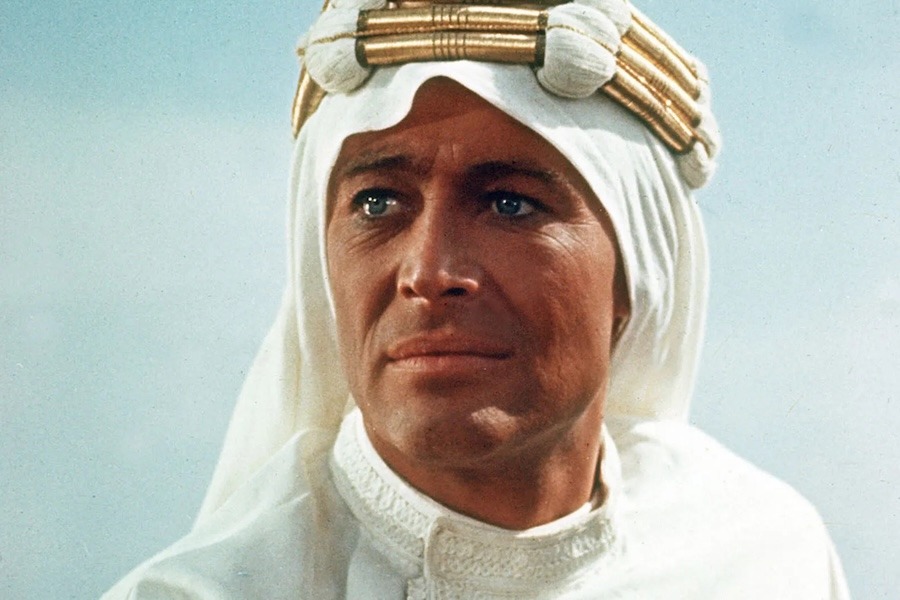
I regret never having seen this film on a big screen, the kind of epic for which the widescreen format was invented. But it is a testament to the beauty and power of David Lean’s work that even if you do see it on a TV set (as long as it is shown in its proper format) you are still likely to find the images evocative. Also remarkable is the fact that the film still feels topical in its depiction of the uneasy relationship between the West and the Middle East.
The death of a motorcyclist
The film begins with the death of a motorcyclist somewhere in the British countryside. The year is 1935 and the man is T.E. Lawrence (Peter O’Toole). After a memorial service attended by various esteemed men, it becomes obvious that no one really knew Lawrence, the man who managed to unite Arab tribes during World War I to fight Ottoman forces in the interest of the British. We’re transported back in time to the beginning of the war when Lieutenant Lawrence was stationed in Cairo. The Arab Bureau, represented by Dryden (Claude Rains), enlists him to find out what Prince Feisal (Alec Guinness) wants to accomplish with his revolt against the Turks (that is, to what extent is he willing to work with the British).
Lawrence finds out that a fellow military adviser (Anthony Quayle) to Feisal wants the Prince to retreat after a defeat, but Lawrence talks him into attacking Aqaba instead. The idea is to reach the city through the punishing Nefud Desert, something the Turks will not anticipate.
Irony is constantly present
Watching Lawrence die in the first scene in the simplest of accidents is ironic. That irony is constantly present in the depiction of his life, not least near the end of the film when it turns out that the people whose independence he’s been fighting for are not really prepared to organize a Western-style society but leave that up to the British. Lawrence’s quest to have a united, independent Arab people that will be good allies to Britain in a time of war becomes the basis for the adventure that dominates most of the film.
One consequence of Lawrence’s fight is that his identity becomes increasingly confused as the battles never end and he’s incapable of handling the challenges, resorting to the kind of cruelty that he initially accuses the Arabs of showing. A key theme shows that an atmosphere of hate and violence destroys its inhabitants, regardless of ethnicity. The story goes on for a long time; nothing feels rushed but perfectly timed. O’Toole got his breakthrough in this part and his credible transformation from confident and optimistic to sad and vicious is fascinating to watch. Omar Sharif also received a great deal of attention as the suspicious, proud Sherif Ali; Anthony Quinn and Guinness are also believable enough as the Arab leaders. The story should not be trusted as an academic study of history, but there are no lulls, the dialogue is intelligent and the production values exceptionally high.
Maurice Jarre’s main theme instantly evokes vivid images of vast sand dunes.
Lean and cinematographer Freddie Young fill each shot with memorable images; the desert has never been a character in itself as clearly as in this film, in turns beautiful, quiet, horrifying and imposing. Maurice Jarre wrote one of his most impressive scores; his main theme instantly evokes vivid images of vast sand dunes.
Lindsay Anderson once said that Lean had a “chocolate-box view of history”. That may be true; he was a filmmaker, not a historian. But Lawrence of Arabia does show us how lessons were learned about the Middle East that ignorant younger generations keep forgetting again and again.
Lawrence of Arabia 1962-U.K. 216 min. Color. Widescreen. Directed by David Lean. Screenplay: Robert Bolt, Michael Wilson. Novel: T.E. Lawrence (“The Seven Pillars of Wisdom“). Cinematography: Freddie Young. Music: Maurice Jarre. Editing: Anne V. Coates. Art Direction: John Stoll. Cast: Peter O’Toole (T.E. Lawrence), Alec Guinness (Prince Feisal), Anthony Quinn (Auda abu Tayi), Jack Hawkins, Claude Rains, Anthony Quayle, Omar Sharif, José Ferrer.
Trivia: Several earlier attempts to make a movie failed; Rex Ingram and Alexander Korda are among those who considered it. Albert Finney, Marlon Brando and Guinness were considered for the part of Lawrence; Laurence Olivier as Feisal. The film was restored in 1989, sponsored by Steven Spielberg and Martin Scorsese. Followed by a TV movie, A Dangerous Man: Lawrence After Arabia (1990).
Oscars: Best Picture, Director, Cinematography, Editing, Original Score, Art Direction-Set Decoration, Sound. BAFTA: Best Film, British Film, British Actor (O’Toole), British Screenplay. Golden Globes: Best Motion Picture (Drama), Director, Supporting Actor (Sharif), Cinematography.
Quote: “No Arab loves the desert. We love water and green trees. There is nothing in the desert and no man needs nothing.” (Guinness)
Last word: “I think it was a miracle that anybody financed Lawrence of Arabia because if you think of it, at that time, we started shooting in 1961 so they were preparing it from 1959. To think that you’re making the film, which is the probably one of the most expensive films in history because it cost $14 million in 1961, which is the equivalent of $200 million now. It’s very expensive. Without any stars because it was our first films, Peter and I, of course we had Alec Guinness and Anthony Quinn in secondary parts. But that’s not a lot for that investment. And it’s about Arabs on camels crossing the desert from left to right and from right to left. There’s no woman, there’s no love story, and there’s no action. How did you expect to make your money back? Four hours of it – it was an incredible gamble or very clever people. But David Lean was coming out after having made Bridge on the River Kwai so they trusted him.” (Sharif, About.com)