

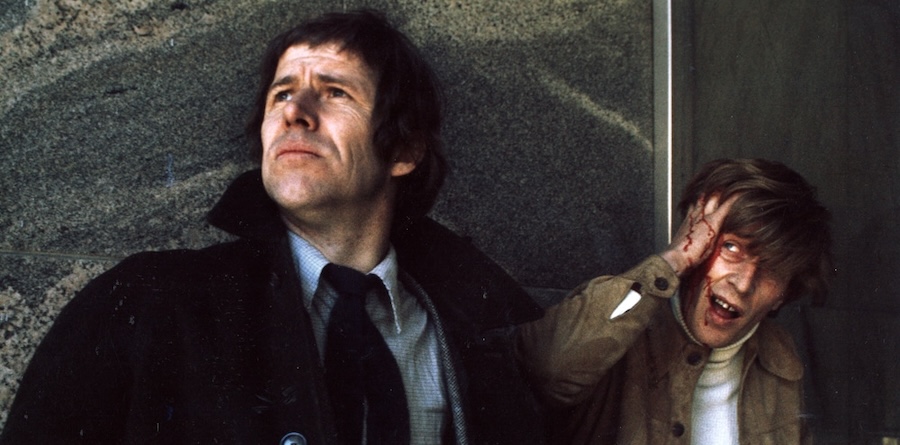
By 1976, American audiences had already familiarized themselves with Martin Beck. He was the Swedish police detective who starred in a series of novels by Maj Sjöwall and Per Wahlöö. An Americanized version of him, played by Walter Matthau, appeared in Stuart Rosenberg’s thriller The Laughing Policeman (1973), but it took a Swedish filmmaker to create a genuinely exciting and realistic movie with Beck. Bo Widerberg was reportedly inspired by The French Connection (1971) and the result is one of the finest cop movies ever made.
Gutted by an anonymous attacker
The story begins in a Stockholm hospital where one of the patients is virtually gutted by an unknown attacker. The victim was a high-ranking police official and Martin Beck (Carl-Gustaf Lindstedt), the detective in charge of the investigation, soon learns that he was a dirty cop who would often use brutal tactics that gave him plenty of enemies. As Beck’s partner Lennart Kollberg (Sven Wollter) informs him, the man was “abominable”. The investigation continues methodically and as Beck and his men come closer to making an identification, the culprit prepares himself for his final act, to cause a bloodbath in downtown Stockholm.
Sophisticated technology, uglier criminality
This is not Agatha Christie; in this story, learning who the killer is may be interesting but not terribly important. The authors of the novel gained fame primarily for depicting a country and police force that were moving into a new era where the technology became more sophisticated and the criminality uglier. Director Widerberg has been careful to make everything look as realistic as possible. All the blood in the early scene is real pig’s blood; a junkie at the police station is played by a real homeless drug addict; and the chopper that crashes near the end is definitely not a model. As usual, the director included many amateurs in the cast.
We truly get a sense of how tired and jaded the cops are, the bureaucratic nature of their work and how difficult it is for them to just be there for their families; Beck’s marriage looks like it died a long time ago. It comes as no surprise that both the victim and the killer are disillusioned cops.
The second half of the film is a terrific and terrifying thrillride .
The slow-moving investigation comes to an abrupt conclusion when the killer ensconces himself on a roof near Odenplan in Stockholm and starts taking people out with a rifle, cops in particular. The second half of the film is a terrific and terrifying thrillride where one attempt after another by the police force to try and stop the sniper fail miserably. He even manages to hit the aforementioned police helicopter so badly that it crashes in the middle of a crowd, miraculously avoiding any civilian casualties. The action sequences are surprisingly effective, no doubt helped by the director’s daredevil approach to shooting them; they’re not Hollywood smooth and he risked his life getting a special shot of the chopper crashing.
Martin Beck steps aside for a while here and his colleagues, Kollberg and Gunvald Larsson (Thomas Hellberg), end up in the line of fire. They’re an amusing couple to follow, Larsson in particular, clad in a big towel wrapped around his head after being grazed by a bullet.
The cast may have amateurs, but the leads are played by professionals. No one has portrayed Beck better than Lindstedt, showing audiences that he could do a lot more than just comedies; Hellberg and Serner are also very good as the arrogant Gunvald and the utterly humorless Rönn. A final word on the music: it’s discreet, unusual and strangely chilling.
Man on the Roof 1976-Sweden. 110 min. Color. Produced by Pelle Berglund. Written and directed by Bo Widerberg. Novel: Maj Sjöwall, Per Wahlöö (”The Abominable Man”). Music: Björn J:son Lindh. Cast: Carl-Gustaf Lindstedt (Martin Beck), Håkan Serner (Einar Rönn), Sven Wollter (Lennart Kollberg), Thomas Hellberg (Gunvald Larsson), Eva Remaeus, Birgitta Valberg, Ingvar Hirdwall, Gus Dahlström, Torgny Anderberg, Harald Hamrell.
Trivia: Original title: Mannen på taket. Wollter’s young son is played by Johan Widerberg, the director’s son, who would subsequently have a successful career as an actor in Swedish films.
Guldbagge Awards: Best Film, Actor (Serner).
Last word: “I like the novel a lot – ‘The Abominable Man’ – and I very much like how Sjöwall-Wahlöö write. It’s almost as if they’re writing for the movies. I turned the novel into a screenplay and it was very simple, all I needed to do was condense the text a bit. All the images were there, they had already thought of that. The dialogue didn’t need any work. Their way of depicting real life is natural but emphatic in a way that helped me a lot while making this movie.” (Widerberg, Aftonbladet)