

THE WHOLE WORLD HAILS HER TRIUMPHANT RETURN!
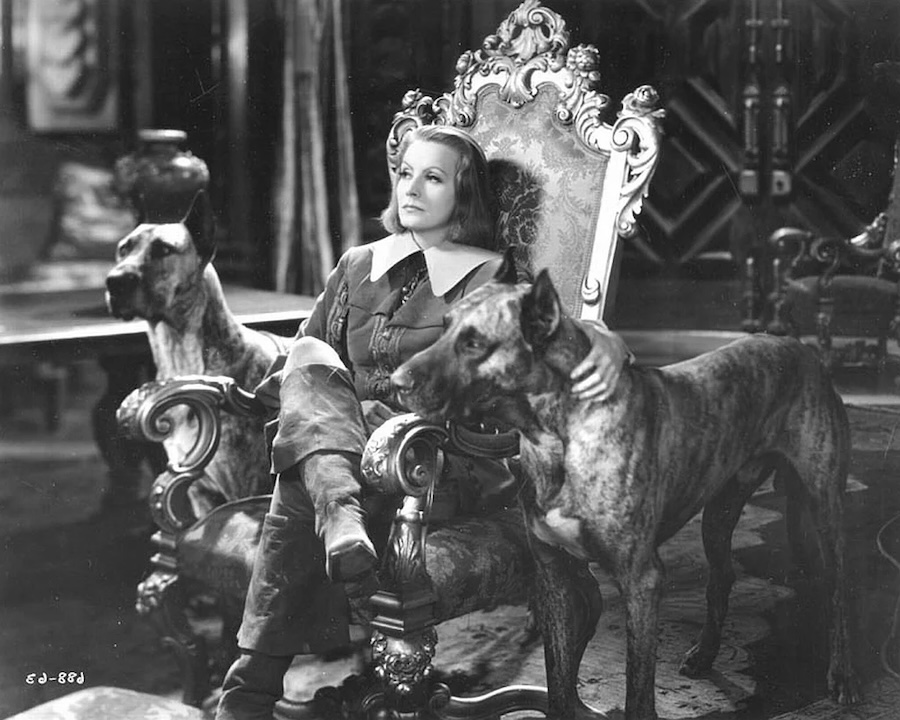
In January 1934, Greta Garbo’s latest picture had not yet opened in her native country. Queen Christina depicted a Swedish 17th-century queen who abdicated the throne, but Garbo knew the film would be controversial in Sweden. In a letter to a friend, she wrote ”Just imagine Christina abdicating for the sake of a little Spaniard”. When the film premiered in Sweden a few months later, the reception was cold. One tabloid accused the film of setting a world record in tastelessness.
You might say Queen Christina was the Braveheart of its day: a beloved historical drama, stirring in many ways, but complete nonsense as a history lesson.
Ruling as a man
In 1654, Queen Christina (Garbo) has seen the end of the Thirty Years’ War that killed her father, the King, in battle. Raised as a boy, she has learned the art of ruling as a man and directs all her attention to the duties of a monarch… except one. Her job is after all also to produce an heir, but she shows little interest in courting a man, even if her advisors are trying their best to present her cousin Karl Gustav (Reginald Owen) as an option.
Feeling restricted, Christina escapes together with a servant and ends up at an inn where she meets Antonio Pimentel de Prado (John Gilbert), a Spanish envoy who’s headed for Stockholm to meet the Queen and suggest a marital alliance between her and his king. Things take a turn, shall we say…
Sharing a room
The most playful part of the movie begins, as Christina has dressed up as a young man and the envoy suggests they share a room because of a winter storm that delays their journeys. Once Christina has revealed her sex (but not who she really is), there’s a famous scene where she memorizes every detail of the room so she’ll always be able to remember when she was at her happiest. It’s some kind of post-orgasmic bliss – call it corny, call it sweet, either way, it has become a classic moment of cinematic romance. Garbo and Gilbert are lovely together; even though he had faded as a star after the death of silent cinema, she made sure that he was cast, and the old rumor that his voice was too high-pitched for the talkies was put to shame. It is one of Garbo’s best roles on screen, equally convincing as a benevolent ruler who wants what’s best for her people, as a woman who finally falls in love and realizes that the throne isn’t worth having if she can’t keep the love of her life.
For this movie to work, you have to view it as a romantic fantasy, and it certainly delivers on that level.
There is zero credibility in how the filmmakers craft their portrait of the Queen; in fact, the real-life circumstances were far more complex and interesting, as the reason for her abdication had nothing to do with love but everything to do with the conflict between Catholics and Protestants, which still haunted Europe years after the end of the bloody war. The film invents a romantically tragic end for the love between Christina and Antonio; in real life, they remained friends years after she left Stockholm and moved to Rome. For this movie to work, you have to view it as a romantic fantasy, and it certainly delivers on that level, while also addressing xenophobic fears over who has the right to join a royal family – and perhaps even predicting the scandal that would rock the British monarchy in 1936.
Director Rouben Mamoulian and his cinematographer William H. Daniels create a few scenes that are visually memorable, including Christina all alone, pondering her future in the dark on the Silver Throne. And then there’s that last shot that has gone down in history, where they dared do as little as possible, just slowly zoom in on Garbo’s face. An unforgettable way to end the film.
Queen Christina 1933-U.S. 99 min. B/W. Directed by Rouben Mamoulian. Screenplay: H.M. Harwood, Salka Viertel, S.N. Behrman. Cinematography: William H. Daniels. Cast: Greta Garbo (Christina), John Gilbert (Antonio Pimentel de Prado), Ian Keith (Magnus Gabriel de la Gardie), Lewis Stone, Elizabeth Young, C. Aubrey Smith, Reginald Owen.
Trivia: Laurence Olivier was considered for the part of Antonio. The story was told partially more correctly in The Abdication (1974).
Quote: “Spoils. Glory. Flags and trumpets. What is behind these high sounding words ? Death and destruction. Triumphals of crippled men. Sweden victorious in a ravaged Europe. An island in a dead sea. I tell you, I want no more of it!” (Garbo)
Last word: “Garbo asked me: ‘What do I play in this scene?’ Remember she is standing there for 150 feet of film – 90 feet of them in close-up. I said: ‘Have you heard of tabula rasa? I want your face to be a blank sheet of paper. I want the writing to be done by every member of the audience. I’d like it if you could avoid even blinking your eyes, so that you’re nothing but a beautiful mask.’ So in fact there is nothing on her face: but everyone who has seen the film will tell you what she is thinking and feeling. And always it’s something different. Each one writes his own ending to the film; and it’s interesting that this is the scene everyone remembers most clearly.” (Mamoulian on the final shot, Sight and Sound)