
ABOVE AVERAGE
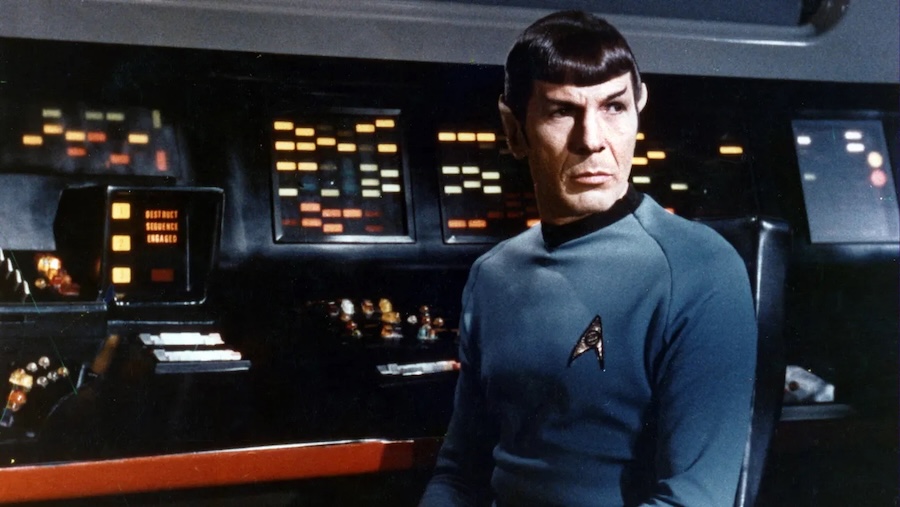
Sometimes it feels like there’s a before and after Star Trek when it comes to our cultural history. Few other, if any, TV shows have had such a profound influence. If you know your Bible, you quickly learn to spot countless references in literature, movies, TV and music; the same is true of Star Trek. When the concept first saw the light of day in 1964, even then it must have been hard to imagine that Lucille Ball would be the one who made Star Trek happen.
Reaching new planets
The show was set 200 years into the future. Nations on Earth became less important as groundbreaking new technology (warp power) made it possible to reach other planets and cultures throughout space. The United Federation of Planets had been formed, an interstellar body with their own space force called Starfleet. Stories usually took place on one of Starfleet’s grand starships, the USS Enterprise, captained by James T. Kirk (William Shatner). The Enterprise was on a mission to explore strange new worlds, always coming in peace, but nevertheless ending up in conflict with enemies known (such as the Klingons) and unknown.
A bumpy start
Ball wasn’t directly involved in the creation of Star Trek, but it was her production company, Desilu, who bought the rights to Gene Roddenberry’s idea, which had its roots in 1950s TV westerns and Horatio Hornblower. The show got off to a bumpy start, with its pilot rejected by NBC who nevertheless saw potential and paid for a second pilot, as long as major changes were made. That included the cast, where basically only Spock, the pointy-eared Vulcan who was Enterprise’s science officer, remained; in came Kirk and McCoy, the no-nonsense physician who was also a man of science but hated Spock’s lack of human emotions. It was a case of perfect casting, with Shatner a likable hero and Leonard Nimoy gaining worldwide fame (and a cult following) as the stoic alien; the banter between the three men helped ease tension, and the supporting cast aboard the Enterprise (representing different cultures on Earth) contributed to the feeling that this was a family.
Many of the stories on Star Trek addressed what it means to be a human and what we as a civilization stands for; many of the threats facing the Enterprise had some kind of alien life form infiltrating the ship and its crew. There were also episodes dealing with time travel, but the different scenarios (including the Wild West and Nazi Germany) often turned out to be alternative dimensions.
Watching the show now is striking from a technical viewpoint.
Star Trek balanced utter silliness (which included effects, sets, costumes and characterizations typical of the era) with surprisingly profound and intriguing ideas, even if it was hard to avoid a sense of déjà vu at times. Watching the show now is striking from a technical viewpoint; for instance, the communication devices that Kirk and his fellow officers use look more or less like the phones and wireless earbuds that would be a vital part of our lives decades later.
Hardly a major hit during its original run, Star Trek quickly became a cultural phenomenon, its legions of devoted fans called ”trekkies”. In time for its 40th anniversary in 2006, the series was rereleased in HD with improved visual effects, most of it tastefully done, emphasizing a lasting relevance as a sci-fi classic.
Star Trek 1966-1969:U.S. 79 episodes. Color. Created by Gene Roddenberry. Theme: Alexander Courage. Cast: William Shatner (James T. Kirk), Leonard Nimoy (Spock), DeForest Kelley (Leonard “Bones” McCoy), James Doohan, Nichelle Nichols, George Takei, Walter Koenig (67-69).
Trivia: Lloyd Bridges was considered for a lead role, but declined. In the rejected pilot, Jeffrey Hunter played the lead role, Enterprise captain Christopher Pike (who would appear in later shows and films). Followed by several new TV series, including an animated one (1973-1974), Star Trek: The Next Generation (1987-1994), Star Trek: Deep Space Nine (1993-1999), Star Trek: Voyager (1995-2001), Star Trek: Enterprise (2001-2005), Star Trek: Discovery (2017-2024), Star Trek: Picard (2020-2023), Star Trek: Strange New Worlds (2022- ) and Star Trek: Starfleet Academy (2025- ). Also followed by two film franchises, starting with Star Trek – The Motion Picture (1979) and Star Trek (2009).
Quote: “Space, the final frontier. These are the voyages of the starship Enterprise. Its 5-year mission: to explore strange new worlds, to seek out new life and new civilizations, to boldly go where no man has gone before.” (Shatner’s opening narration)
Last word: “I always enjoyed Jonathan Swift, the lands he went to and the characters he invented. It always seemed to me that the type of writing I was doing was like what Swift did. Swift used his characters to point out stupidities in our own systems of thinking. When you see the Lilliputians fighting and double-crossing each other, you are watching humanity through Swift’s eyes. I’ve been sure from the first that the job of Star Trek was to use drama and adventure as a way of portraying humanity in its various guises and beliefs.” (Roddenberry, The Humanist)