
ANTOINE KNOWS WHAT HE WANTS TO DO… HIS PROBLEM IS DOING IT.
The opening shot places the film firmly in its time, capturing a moment that is long forgotten. We’re shown the French Cinémathèque at the Palais du Chaillot where a ”Closed” sign has been affixed to the gates. This is a reference to a political struggle that director François Truffaut (and other French filmmakers) won that year, a showdown with the government, which had fired the head of the Cinémathèque. In the end, the protests forced the government to reverse its decision. This shot doesn’t really have much to do with the film, except as an example of the times when the story is set. Much of the film is significantly more timeless.
Doinel’s third chapter
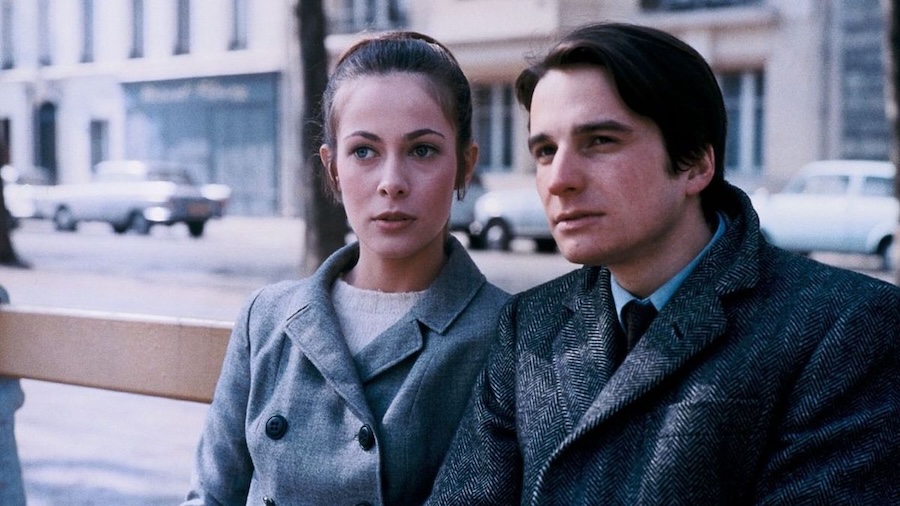
We last saw Antoine Doinel (Jean-Pierre Léaud) in 1962, when he was 17; the occasion was a short film by Truffaut called Antoine and Colette, which followed his romantic misadventures with a girl. When we meet him in this third Doinel chapter (The 400 Blows was the first), Doinel is kicked out of the army, deemed unfit, and he tries to reconnect with Christine Darbon (Claude Jade), a violinist he’s been writing while serving in the military. After meeting again while Antoine is working as a hotel clerk, it looks like they might be headed for a romance. But Antoine finds it difficult to keep a job and when he becomes a private detective and goes undercover as a shoe-store employee, things are getting complicated. Especially since he’s attracted to Fabienne Tabard (Delphine Seyrig), the owner’s sexy, older wife…
A deeply personal film
Balzac plays a part in this film, one of Truffaut’s best-reviewed. In one of the first scenes, Antoine is seen reading ”The Lily of the Valley”, a novel by Balzac depicting a romance in the shadow of actual, important early-nineteenth-century events in French society. Truffaut is however not trying to capture any huge political or historical incidents in Stolen Kisses, which might be fortunate for him considering the fact that France was about to go through a very tumultuous period that would have overshadowed anything Truffaut put in the film.
As in the case of The 400 Blows, the film is deeply personal; Antoine is still mirroring Truffaut and the director also fell in love with Jade. It’s a pleasure watching Léaud as Antoine, who’s just as compelling now as in the first film, adding tons of charm as a lovable ne’er-do-well, unable to get a career going, unable to get things right with Christine. He may not be an ideal man… but at the same time, who is at the tender age of 23? Obviously, his youth is alluring to Madame Tabard, who finds her husband boring (just like everybody else, as we learn in a funny scene where Michael Lonsdale’s character talks about how no one really likes him; a mystery to him, not so much to the audience). This intrigue keeps things interesting throughout the film.
Several scenes are amusing sight gags.
Several scenes are amusing sight gags, like the one where Antoine takes out a much taller woman on a date, and especially the sequence where he, as a detective, tries to follow a woman, doing such a hilariously poor job that he soon attracts the attention of the police.
Truffaut also makes sure to add layers to this boundlessly vital movie; it’s not all about slapstick. Critics have noted how cleverly the movie depicts different stages of a relationship, leading up to a memorable final scene where Antoine is confronted with himself in the shape of a stranger that Christine, now finally his fiancée, calls ”insane”; Antoine has no honest choice but to agree. He’s found a safe harbor.
Stolen Kisses 1968-France. 91 min. Color. Directed by François Truffaut. Screenplay: François Truffaut, Claude de Givray, Bernard Revon. Music: Antoine Duhamel. Cast: Jean-Pierre Léaud (Antoine Doinel), Delphine Seyrig (Fabienne Tabard), Claude Jade (Christine Darbon), Michael Lonsdale, Harry-Max, André Falcon.
Trivia: Original title: Baisers volés. Co-produced by Truffaut. Followed by Bed & Board (1970).
Last word: “I usually start with more solid material. I like having two or three reasons to make a film, a coming together of a book I want to adapt or an atmosphere I want to show with an actor that I want to film, and perhaps a third reason. Here, I admit, I just wanted to work with Jean-Pierre Léaud again. I more or less set a specific date by which I wanted to make a film with Léaud, with my friends Claude de Givray and Bernard Revon. I’d worked with Claude before. I’d known him for many years. We sat down and said, ‘What are we going to do with Léaud?’” (Truffaut, Cinéastes de Notre Temps)