

THE EPIC OF THE AMERICAN DOUGHBOY!
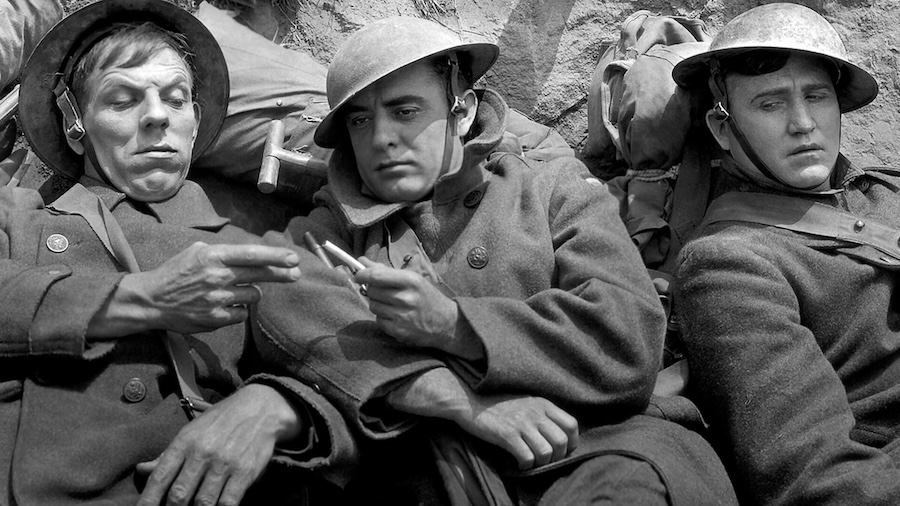
The story of this film begins with the play ”What Price Glory”, which opened on Broadway in 1924. Written by Maxwell Anderson and Laurence Stallings, it was set in France during World War I and depicted a rivalry between two American officers. The play was a hit and the fact that its salty language caused a stir must have helped box-office numbers. Also, Stallings’s own experiences from the war and how they informed the play was a significant factor.
The same year he wrote an autobiographical story, about his time fighting in the Great War, titled ”Plumes”. That’s what inspired MGM and King Vidor to make The Big Parade in 1925 – which became one of the greatest hits of the silent era.
Swept along in a patriotic fervor
The film begins in 1917 where we meet Jim Apperson (John Gilbert), the lazy son of a successful businessman (Hobart Bosworth) who has no intention of ever accomplishing anything. But everything changes when the United States enters World War I and Jim is swept along in a patriotic fervor, deciding to enlist. Suddenly, his parents find a reason to be proud of their son. During training, Jim makes friends with working-class people he would normally never meet, Slim and Bull (Karl Dane, Tom O’Brien). They’re all shipped out to France and billeted at a farm in a small village. That’s where Jim meets a pretty girl, Melisande (Renée Adorée). Fighting for her attention, with Slim and Bull as competitors, Jim slowly wins her heart. Chewing gum has something to do with it.
Focusing on doughboys
It’s worth mentioning the chewing gum, because it’s one of the most famous scenes in the movie, an example of the charm that builds between Gilbert and Adorée. The film made stars out of them both, especially Gilbert who was handsome and made the audience like his initially unsympathetic character; he also had another great hit that year, The Merry Widow, that helped cement his star status.
In ”What Price Glory?”, the main characters were officers, but The Big Parade focuses on the doughboys, working-class troops, and teaches Jim the value of camaraderie among soldiers. Much time is devoted to the love story, perhaps too much time for my taste, but there’s no denying that it’s an important and heartfelt part of the film. Then comes the combat. In 1925, audiences hadn’t quite seen the horrors of war on the big screen and it had a profound effect. Vidor studied footage from the Signal Corps, incorporated some of it in the film, and made sure that the violence wasn’t hidden away; Stallings had described it all in his story and the realism of it should be honored, Vidor reasoned. Some of the scenes are starkly memorable, including soldiers defiantly marching forward in spite of snipers and German machine guns; there was a theater on Broadway that recreated the sounds of war during screenings, assisted by 18 men using various instruments.
The battle sequences are intense, creating a ghostlike impression.
The battle sequences are intense, creating a ghostlike impression, and inspired films like All Quiet on the Western Front years later. Also, Vidor and his team don’t chicken out when it comes to the tragedy of Stallings’s experiences. He lost a leg as a result of an injury in the war and Jim gets his share of pain as well.
Ultimately, it is a story about the journey to maturity, for one individual and perhaps also for the United States. Obviously, the same can be said about the American motion picture industry, making great leaps forward thanks to films like The Big Parade.
The Big Parade 1925-U.S. Silent. 151 min. B/W. Directed by King Vidor. Screenplay: Harry Behn. Story: Laurence Stallings (”Plumes”). Cinematography: John Arnold. Cast: John Gilbert (James ”Jim” Apperson), Renée Adorée (Melisande), Hobart Bosworth (Mr. Apperson), Claire McDowell (Mrs. Apperson), Claire Adams, Robert Ober.
Trivia: Released in 1930 in a sound version, featuring a music score by William Axt and several songs.
Last word: “Gilbert never read the script of The Big Parade, and there were other actors of the period like that. They had faith and confidence in you… I actually remember moments when I didn’t say a thing. I’d just have a quick thought and Gilbert would react to it.” (Vidor, Silentology)