
SCREAM… NO ONE WILL HEAR YOU! RUN… AND THE SILENT FOOTSTEPS WILL FOLLOW, FOR IN HILL HOUSE THE DEAD ARE RESTLESS!
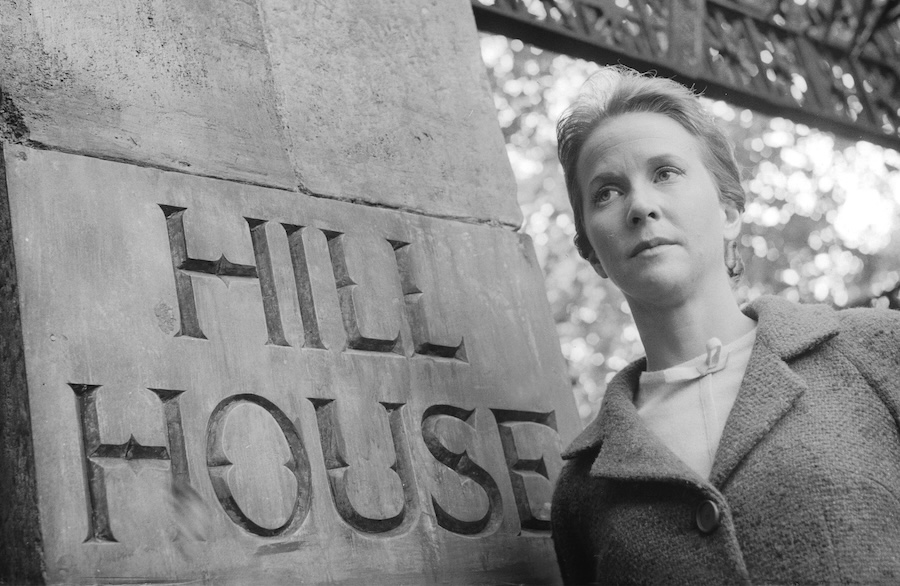
Shirley Jackson’s novel, on which this classic film was based, is often described as one of the finest horror stories of the twentieth century. Martin Scorsese became terrified enough to label Robert Wise’s adaptation the scariest film of all time. Fine praise indeed. Very few people watching The Haunting in 2012 will find it all that frightening, I’m sure… but it still remains an example of superior filmmaking.
Built for his wife
Dr. John Markway (Richard Johnson) is investigating paranormal phenomena and has found the perfect place to conduct an experiment – Hill House, an intimidating mansion built 90 years ago by Hugh Crain as a home for his wife. Unfortunately, she was killed in an accident on the way to the house; years later, Crain’s second wife died after falling down the stairs. Her daughter lived a wretched life in Hill House where she also eventually died; the nurse, who had ignored the old woman’s cries for help, inherited the house… and ended up hanging herself. This horrifying history hangs like an ominous cloud over Hill House.
Markway decides to spend a few nights there and brings three companions – the deeply skeptical Luke Sannerson (Russ Tamblyn), a psychic called Theodora (Claire Bloom), and Eleanor Lance (Julie Harris), a spinster who’s spent her entire life caring for her mother who recently died.
Lack of straight lines
Wise once said that shooting The Haunting was one of his best filmmaking experiences. It is certainly a source of inspiration. Along with cinematographer Davis Boulton, Wise turns the stand-in for Hill House, Ettington Park (near Stratford-upon-Avon), into a dark, mysterious place. Early in the film, Dr. Markway talks about the lack of straight lines and exact angles in Hill House, and the filmmakers do their best to make Ettington look like that; the camera is often askew and there are many close low-angle shots that create a feeling of claustrophobia. The two most famous scenes, when the ghosts are banging at the door and Eleanor thinks that the comforting hand she’s holding in the dark belongs to Theodora, take place at night; especially the latter is effective. In those scenes, psychology plays an even greater part than the modest special effects. The terror we can imagine is greater than what we’re actually witnessing. This was an important part in Jackson’s novel and remains so in this version. The audience is invited to share Eleanor’s thinking and we understand how this weak person is easily seduced by the power of Hill House.
There are times when Robert Wise and writer Nelson Gidding focus perhaps too much on trying to explain the ghosts.
At the same time, Markway’s constant analyzing of what’s going on becomes a minor liability. There are times when Wise and writer Nelson Gidding focus perhaps too much on trying to explain the ghosts rather than chilling our spines. Harris is terrific as poor Eleanor, reportedly embracing the introvert nature of this character on set so much that Bloom felt hurt by not being able to connect with her co-star.
All in all, this is a great haunted-house tale. And you kids who’ve grown up on more modern but hopelessly clumsy horror movies – The Haunting has flaws, but at least it won’t insult your intelligence.
The Haunting 1963-U.S. 112 min. B/W. Widescreen. Produced and directed by Robert Wise. Screenplay: Nelson Gidding. Novel: Shirley Jackson (“The Haunting of Hill House”). Cinematography: Davis Boulton. Cast: Julie Harris (Eleanor “Nell” Lance), Claire Bloom (Theodora), Richard Johnson (John Markway), Russ Tamblyn, Lois Maxwell, Fay Compton.
Trivia: Susan Hayward was reportedly considered for the lead. Remade as The Haunting (1999). Later the subject of the first season of The Haunting in 2018.
Last word: “Val Lewton’s favorite theme was the greatest thing that people had was fear of the unknown. What’s that in the shadows back there? That noise? That’s what he played on. So when I did The Haunting, it was a kind of a tribute to him. I have had so many people say to me about The Haunting that it is ‘the scariest film I have ever seen.’ But I didn’t show anything. It was just suggestions. There is nothing in it. It was shot in black and white, and I had a marvelous cinematographer.” (Wise, The Los Angeles Times)