

BRAZIL, 1977, A TIME OF GREAT MISCHIEF.
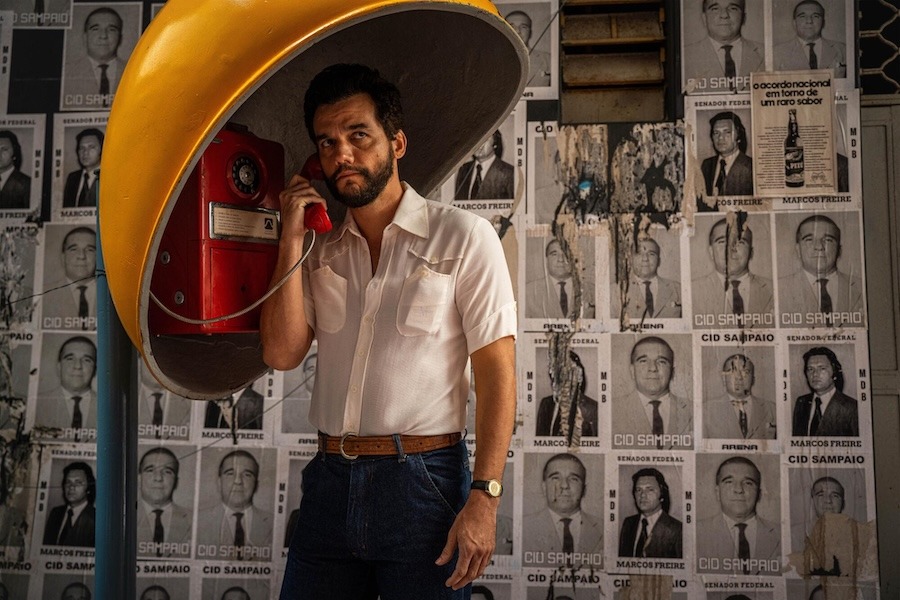
The Brazilian dictatorship, loathed by the millions who suffered under it and celebrated by modern fascists like former president Jair Bolsonaro, is going through a cinematic revival in much-hyped films like I’m Still Here (2024) and now The Secret Agent. I suppose it’s a way for Brazilians to deal with the bad old times. The former was an emotional gut punch in a way that the latter avoids. But to some degree, The Secret Agent is a more interesting cinematic experience.
Arriving in Recife
In 1977, former professor Armando Solimões (Wagner Moura) arrives in Recife where his son Fernando is staying with his maternal grandparents. Armando’s wife is dead, but he spends some time with Fernando before moving to a place run by Dona Sebastiana (Tânia Maria), who sympathizes with people who are resisting the military dictatorship. He takes the name Marcelo, gets a job at the local identity card office (appropriately enough) and befriends a corrupt police chief (Robério Diógenes), who’s currently investigating a human leg found in the belly of a tiger shark. What Armando doesn’t know at this point is that he’s hunted by hitmen…
Mired in film
I’m pretty sure one reason why critics love this movie is because it is mired in film. A key location is a cinema where underground activities take place; in one scene, The Omen is shown in the background. Fernando is also obsessed by Jaws, a film he can’t see because he’s too young, but he’s using the poster as inspiration for his drawings and The Secret Agent reconnects with his childhood love affair when we learn what happened to the old cinema that played such a key role in 1977. The leg found in the tiger shark is obviously also a nod to Jaws, one of several subplots and ideas that don’t necessarily serve as anything but distraction from the main plot.
Convincing period details and a cinematography that takes us to a sunbaked Recife at a time when danger lurks.
That’s an important theme in the director’s work. In an interview with Indiewire, Kleber Mendonça Filho talked about the difference between the logic of life and the logic of film. The latter takes us through a neatly structured story, but that’s rarely what happens in real life. The logic of real life is telling a story where mistakes are made, other things happen that steal your attention, and perhaps there’s no satisfying conclusion at the end. That’s a little bit what it feels like watching The Secret Agent, which is all over the place at times. Much of it works beautifully, with convincing period details and a cinematography that takes us to a sunbaked Recife at a time when danger lurks if you oppose the regime.
There are memorable moments, even tension in a sequence where a hitman finds Armando at the identity card office. And it’s a superior cast, led by Moura who plays not only the professor but also Fernando as a grownup in a scene that takes place today; I also want to highlight Maria who’s such a character as the aging but spirited Dona Sebastiana. The excessive running time and a somewhat emotionally flat closing scene are examples of when the film is less successful.
The most absurd distraction in the film is a partly animated sequence where the leg found in the shark starts attacking cruising gays in a park. Amazingly enough, it was inspired by an actual newspaper report at the time, meant to distract from police violence and homophobia. Wild stuff… but one digression I didn’t mind.
The Secret Agent 2025-Brazil-France-Germany-The Netherlands. 161 min. Color. Widescreen. Written and directed by Kleber Mendonça Filho. Cinematography: Evgenia Alexandrova. Cast: Wagner Moura (Armando Solimões/Marcelo/Fernando Solimões), Carlos Francisco (Alexandre), Tânia Maria (Dona Sebastiana), Robério Diógenes, Gabriel Leone, Roney Villela, Udo Kier.
Trivia: Original title: O agente secreto. Kier’s last film role.
Golden Globes: Best Motion Picture (Non-English Language), Actor (Moura). Cannes: Best Director, Actor (Moura).
Last word: “If you express yourself in a time when democracy is running on fumes, the attacks can be pervasive, brutal and cruel. They’re not low level at all. I could have shown Wagner’s character being taken to the police precinct and given electric shocks to his genitals all night […] But the dictatorship manifested itself in many ways.” (Filho, The Guardian)