
Let’s go back to 1983 for a while. Who would have thought then that Clint Eastwood, the tough guy who had made a few pretty good westerns but also those movies where he horsed around with a pet orangutan named Clyde, would get up at the Academy Awards ten years later and say thank you for winning the Best Director Oscar? Then again, Unforgiven was not just a pretty good western – it had all the elements of a traditional genre piece but still looked like something we hadn’t seen before.
Outrage at a whorehouse
The film opens with a whore getting her face cut by a customer. It happens in a town called Big Whiskey and its sheriff, the sadistic Little Bill Daggett (Gene Hackman), decides that it’s just a case of damaged property and lets the guilty cowboy and his friend leave town after settling their debt. The outraged women at the whorehouse want the two men killed and let word out that they’re willing and able to pay anyone who’ll do it. A young, cocky but inexperienced gunfighter (Jaimz Woolvett) believes this could be a career-making hit and he enlists help from two veterans who need the money, Will Munny (Clint Eastwood) and Ned Logan (Morgan Freeman).
But Little Bill is not about to let gunfighters run around all over his town and Will Munny is just a shadow of his former self. Killing doesn’t come naturally to him anymore, but then it doesn’t really to anyone in this film and that’s one of the key messages.
Honor, justice and death in the Old West
Unforgiven has been called a revisionist western, but that term has almost become a cliché. It isn’t all that different from what westerns looked like from the 1950s onwards. Perhaps the lack of truly good and evil characters is more obvious here. Surely, the cowboys who cut up the woman deserve to die. But one of them didn’t even do it, and is the damage really serious enough to warrant the death penalty? Surely, Little Bill is a terrible sadist. Yes, but he also wants to protect his town and believes in gun control. Isn’t Will Munny the hero of the story? Well, he is also guilty of murdering a lot of innocent people in the old days.
It’s a rare thing, a script with so many fully fleshed out characters who do and say things we are unable to predict. Writer David Webb Peoples, examines themes like honor, justice and death in the Old West. There’s a scene where Will, Ned and the Kid catch up with the innocent one of the cowboys. Guilt matters not, he still has to die because there’s money and honor involved. The process of killing him becomes painful and difficult. In this scene, Peoples looks into the soul of these three killers and exposes them completely.
Clint Eastwood accepted a challenge he rarely faced in the past.
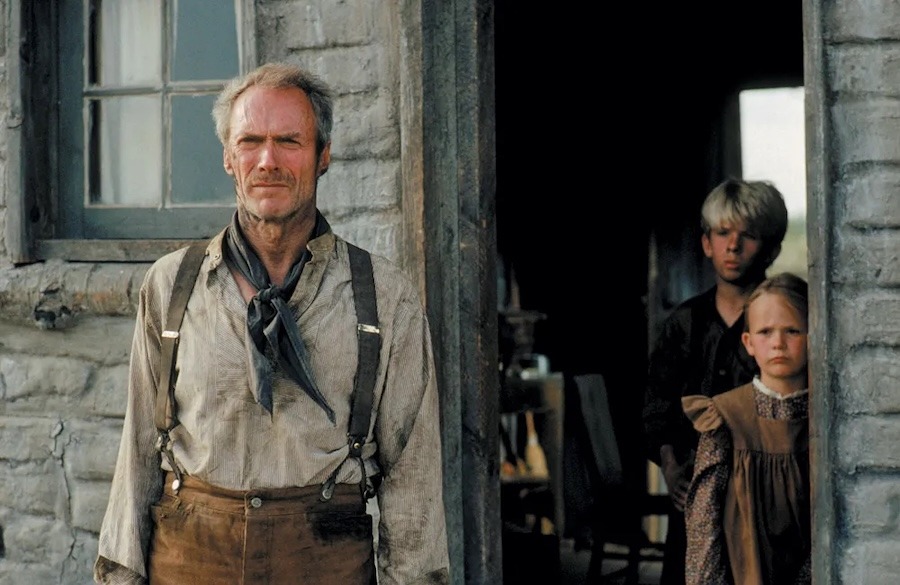
The part of Will Munny is so well-written that it seems to require someone who looks like Clint Eastwood but is a character actor. Still, Eastwood accepted a challenge he rarely faced in the past; he knows how to use his experience in making that character come alive. Hackman had his doubts about playing another violent man, but certainly creates a complex portrait of sheriff Daggett. It is also great fun seeing Richard Harris as English Bob, the boastful killer who’s been living too long on a phony reputation.
A lot of what’s going on in the film is dark and unpleasant, but Eastwood and his crew nevertheless create a beautiful piece of Americana with stunning visuals. The pace is undeniably slow but fits a story about old men getting back in the saddle.
Unforgiven 1992-U.S. 127 min. Color. Widescreen. Produced and directed by Clint Eastwood. Screenplay: David Webb Peoples. Cinematography: Jack N. Green. Music: Lennie Niehaus. Editing: Joel Cox. Production Design: Henry Bumstead. Cast: Clint Eastwood (William Munny), Gene Hackman (Little Bill Daggett), Morgan Freeman (Ned Logan), Richard Harris, Jaimz Woolvett, Saul Rubinek, Frances Fisher.
Trivia: The script was originally optioned by Francis Ford Coppola in the 1970s. The only part of the score that Lennie Niehaus didn’t write was the main theme, which was composed by Eastwood.
Oscars: Best Picture, Director, Supporting Actor (Hackman), Editing. BAFTA: Best Supporting Actor (Hackman). Golden Globes: Best Director, Supporting Actor (Hackman).
Last word: “The film deals with violence and its consequences a lot more than those I’ve done before. In the past, there were a lot of people killed gratuitously in my pictures, and what I liked about this story was that people aren’t killed, and acts of violence aren’t perpetrated, without there being certain consequences. That’s a problem I thought was important to talk about today, it takes on proportions it didn’t have in the past, even if it’s always been present through the ages.” (Eastwood, Cahiers du Cinema)