

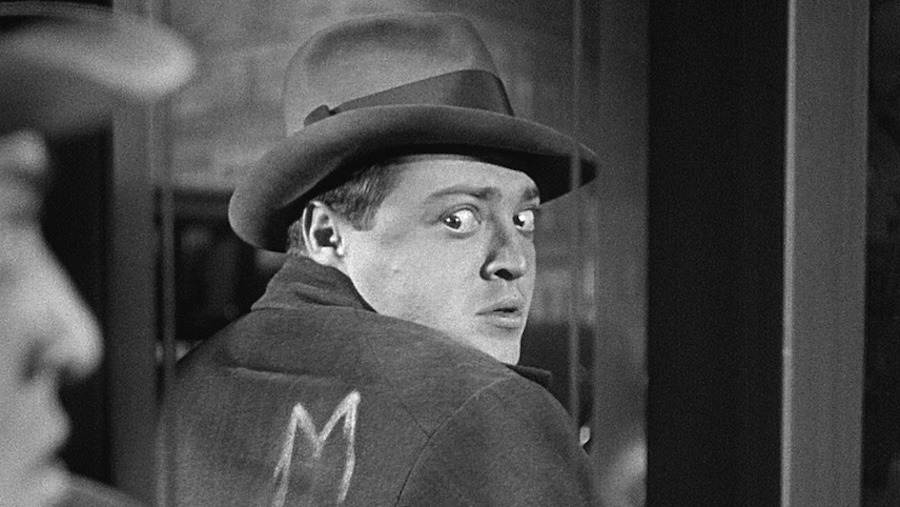
After announcing that his next movie would be a story about a child murderer, acclaimed filmmaker Fritz Lang was informed that he wouldn’t get to use Staaken, the premier studio in the Weimar Republic. The reason? The head of the studio, a member of the Nazi Party, told Lang that the party believed he was going to make a movie about them. After realizing that they were mistaken, the Nazis agreed to let Lang make his movie.
Three years later, the director (whose mother was Jewish) fled the country. When they gained power, the Nazis banned M, but the film wasn’t destroyed. Joseph Goebbels allegedly appreciated it – and there are elements in it that I can imagine Nazis liking.
A man is murdering children
The people of Berlin are living under a shadow. Someone has been murdering children and everybody is afraid that the serial killer will strike again. The latest victim becomes little Elsie Beckmann, who meets a man (Peter Lorre) she doesn’t know. He buys her a balloon from a blind street vendor and walks away with the little girl. After the body of the girl has been found, the man writes a letter to a local paper, saying that the police have refused to give him the attention he wants. The killer warns that he will strike again. The police do their best to obtain fingerprints from the letter and increase their presence among the city’s criminal elements. The pressure becomes so intense that the leaders of the city’s organized underworld gather to make a decision – in order to conduct their business in peace, they will find the killer themselves.
Meeting Peter Kürten
Lang’s first talking picture became one of his masterpieces, a riveting thriller that also shows a genuine interest in what motivates a person as despicable as the child killer. The director allegedly met with several inmates in a mental asylum. Lang denies it, perhaps it’s a myth that one of them was the notorious Peter Kürten, known as the ”Vampire of Düsseldorf”. The final twenty minutes of the film gives the killer an opportunity to explain what drives him; watching Lorre search for his inner darkness as he talks about how his base desires can only be satisfied by murdering children is chilling. It was a star-making performance that later made Lorre a popular choice to play villains in Hollywood. He had a child-like quality that he could add to his sinister characters and it is evident in this film as well.
Fritz Lang and cinematographer Fritz Arno Wagner who find playful and ingenious ways of lighting and shooting the film.
Lorre’s wild-eyed performance is enhanced by Lang and cinematographer Fritz Arno Wagner who find playful and ingenious ways of lighting and shooting the film; several scenes are made memorable thanks to a very expressive, unusually moving camera. Emil Hasler and Karl Vollbrecht’s art direction is equally impressive; Staaken Studios becomes a vivid stand-in for the city outside, in Lang’s view a dark, rainy and claustrophobic place. The film isn’t without a sense of humor either. At one point, Lang and editor Paul Falkenberg cut between two meetings taking place at the same time, one between high-ranking cops and the other between the criminal leadership. They’re not aware of each other, but the meetings have exactly the same agenda, how to capture the child murderer, and the effect is bizarre and amusing.
Later, an extreme low-angle shot of the leading, smug but incompetent cop, Karl Lohmann (Otto Wernicke), provokes derisive laughs; Wernicke was such a hit that he would play the character again in Lang’s The Testament of Dr. Mabuse (1933).
I don’t know if the Nazis saw themselves in the organized criminal underworld and banned M for that reason. It’s still fascinating to watch it now and see that lawless, authoritarian ways of running a society is still attractive to some people. In the case of a child killer, people’s resistance against those dark options is obviously weakened.
M 1931-Germany. 111 min. B/W. Directed by Fritz Lang. Screenplay: Fritz Lang, Thea von Harbou. Cinematography: Fritz Arno Wagner. Editing: Paul Falkenberg. Art Direction: Emil Hasler, Karl Vollbrecht. Cast: Peter Lorre (Hans Beckert), Otto Wernicke (Karl Lohmann), Ellen Widmann (Mother Beckmann), Inge Landgut, Gustav Grundgens, Theodor Loos.
Trivia: Alternative German title: M – Eine Stadt sucht einen Mörder. There are two other versions, one running 99 min. and an English-language 96 min. version. Remade in the U.S. as M (1951) and as a 2019 miniseries in Germany and Austria.
Last word: “I got tired from the big films. I didn’t want to make films anymore. I wanted to become a chemist. About this time an independent man – not of very good reputation – wanted me to make a film and I said ‘No, I don’t want to make films anymore.’ And he came and came and came, and finally I said ‘Look, I will make a film, but you will have nothing to say for it. You don’t know what it will be, you have no right to cut it, you only can give the money.’ He said ‘Fine, understood.’ And so I made M.” (Lang, MovieMaker)