

MOST ENTRANCING LOVE STORY OF ALL TIME – WITHOUT A SINGLE LOVER!
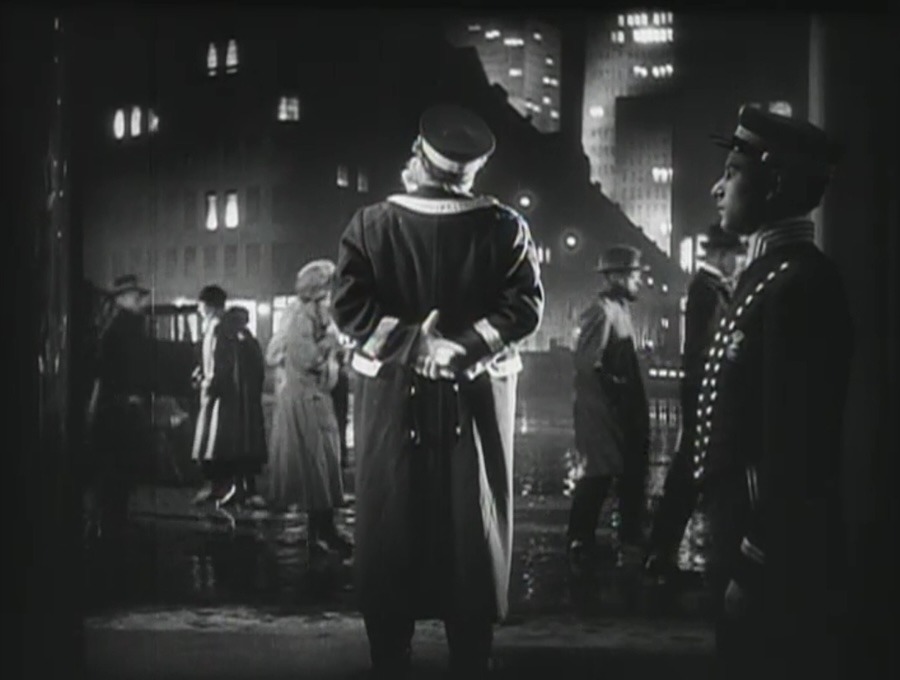
In the early 1920s, Alfred Hitchcock was in Berlin together with director Graham Cutts, working on a film called The Blackguard. That’s how the fledgling filmmaker came to meet F.W. Murnau who had already made a name for himself with the horror film Nosferatu (1922). Murnau was in the middle of making his next picture, The Last Laugh, and Hitch was impressed with what he saw, especially Murnau’s use of an ”unchained camera”. Later in his career, the British master would employ techniques he had learned during his stint in Berlin.
But was he actually studying cinematographer Karl Freund? Freund would later claim that writer Carl Mayer had a greater interest in the technical aspects of filmmaking than Murnau. Others would refute that statement. In any case, there’s no doubt that The Last Laugh is the result of a brilliant collaboration between two massively talented men, Murnau and Freund.
Working at a high-end hotel
We are introduced to a man (Emil Jannings) who’s working as a doorman at a high-end Berlin hotel. He takes great pride in his work, representing this glamorous establishment, shaking hands with wealthy patrons. One day, the manager gives him bad news: he thinks the doorman is getting a little too old for the job, which has its demanding parts, including handling luggage, and demotes him to washroom attendant. Shocked, the man goes home to family and friends. He doesn’t tell them the truth, but eventually it will come out…
Ditching intertitles
This was not the first time that Murnau had made a movie using no intertitles. The idea was to create pure cinema, a style that was independent of the stage or books. That’s one aspect that made The Last Laugh famous, even if there is in fact one title card, coming right before the epilogue. That final part of the film gives the story a happy ending, but acknowledges the fact that it is improbable; the whole film is best viewed as a fantasy, even if there is a degree of realism. Interestingly, the German writer and film theorist Siegfried Kracauer noted the use of the uniform as a symbol of authority, respected by the women in the doorman’s tenant building; when he loses that, he’s ridiculed by everyone. It is perhaps a chilling sign of what was to come in Germany.
Jannings, in one of his greatest roles, plays the doorman with a dose of humor, but also tremendous sympathy. Most people in his presence turn into grotesque caricatures as soon as he’s diminished to an elderly man in the washroom, and we feel for him. Finally, there is someone who takes pity, and that act of compassion is rewarded in the epilogue when the doorman finally gets the last laugh; we may not believe that this is actually what happens, it is more like a dream, but also an amusing, elegant way to end the film. The fact that it doesn’t come off as a cheap stunt is not only because of the filmmakers’ compassion, but their technical prowess.
A pleasure to behold, with obvious creativity and energy in many scenes.
Right from the start, this film is a pleasure to behold, with obvious creativity and energy in many scenes. One example is a scene where the doorman gets drunk and we see the room spinning from his perspective. It’s an example of Murnau and Freund’s ”unchained camera”, but that’s frequently used in other scenes as well, including one where the camera was attached to a wire and sent from a building down to street level, the effect reversed in editing.
In other words, it’s a movie that constantly grabs your attention visually – but it also knows how to tug at your heart. No wonder it inspired so many future filmmakers.
The Last Laugh 1924-Germany. Silent. 90 min. B/W. Directed by F.W. Murnau. Screenplay: Carl Mayer. Cinematography: Karl Freund. Cast: Emil Jannings (the Doorman), Maly Delschaft (The Daughter), Max Hiller (The Bridegroom), Emilie Kurz, Hans Unterkircher, Olaf Storm.
Trivia: Original title: Der letzte Mann. Remade in West Germany as The Last Man (1955).
Last word: “When we wanted to show Jannings drunk, I strapped the camera to my chest, with batteries on my back for balance, and acted drunk … Mayer’s imagination had convinced us that we could do anything!” (Freund, 1947 interview)