

THE GANG THAT SWORE A BLOOD OATH TO DESTROY PRECINCT 13… AND EVERY COP IN IT!
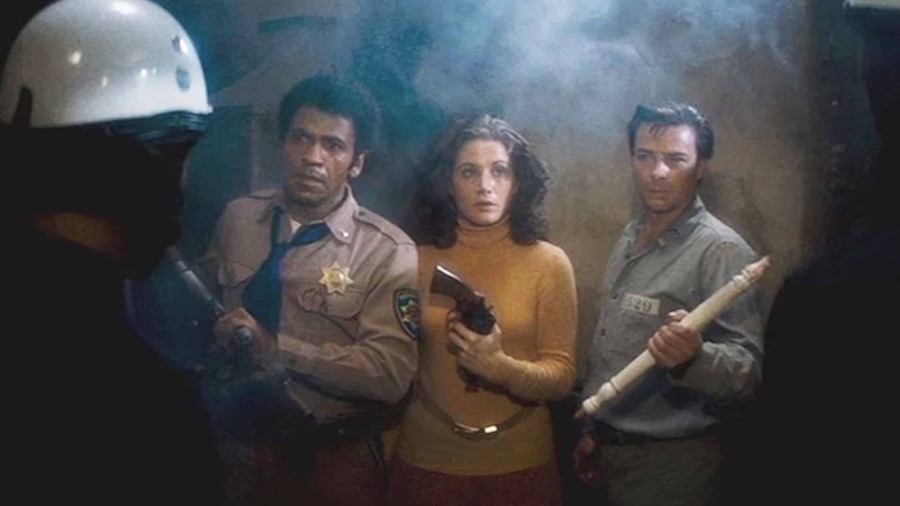
After writing Dark Star (1974) together with John Carpenter, Dan O’Bannon found his friendship with the director deteriorating. He detected a coolness in Carpenter’s attitude that he didn’t like. When attending the premiere of Carpenter’s second film, Assault on Precinct 13, he was disgusted by the violence on screen and told his former friend so. According to O’Bannon, Carpenter showed a disdain for people. He wasn’t the only one who objected against the film, which has a shocking scene where a little girl is gunned down. Still, Carpenter’s work came to be championed by critics throughout Europe and the reputation of the film only grew over the years. Today it stands as one of the director’s best.
Killing six gang members
It begins with an ambush. The LAPD kill six members of the gang Street Thunder who has just come across a cache of weapons. The four leaders of the gang swear a blood oath of revenge and that’s when the mayhem begins. The gang’s main beef should be with the police, but they also begin to cruise the streets of South Central looking for people to kill. Soon they come across an ice-cream truck and murder both the driver and a little girl. The father of the girl starts chasing the killers. After managing to shoot one of the gang leaders, he comes looking for protection at the Anderson police precinct, which is about to close.
There’s only a few people there, including Lieutenant Ethan Bishop (Austin Stoker) and three prisoners. They were being transported to the state prison when one of them got sick and the bus made a temporary stop at the precinct. Now, when the gang isolates the building and begins an assault, all of them must work together to save their own lives.
Could just as easily have been a Western
Carpenter’s breakthrough was a deliberate cross between Rio Bravo (1959) and Night of the Living Dead (1968) and there are many references to the former film in particular. Set in modern times, this could just as easily have been a Western and the character of Leigh (Laurie Zimmer) is more or less a Howard Hawks symbol; not only is the character’s name reminiscent of Leigh Brackett who co-wrote Rio Bravo, but she is also the typical tough-talking ”Hawksian woman”.
The isolation of the Anderson precinct adds to the film’s tension.
As a contrast, Carpenter wanted the members of the gang to look as intimidating and creepy as the zombies in Night of the Living Dead; they should be silent, anonymous and inhuman, more or less a group of animals attacking. Today, racial concerns would prevent us from thinking along those lines, but Carpenter makes the bad guys look generically evil, not like racial stereotypes. Also, casting the African-American Stoker as the hero of the piece, the kind-hearted and resolute Bishop, was significant; that usually didn’t happen in movies outside of the blaxploitation genre. The isolation of the Anderson precinct adds to the film’s tension and it’s easy to view the film as a dark and brutal comment on crime, the government abandoning certain areas and what kind of effect good and bad policing has on a society.
The film may come across as crude and simple in many ways, but Carpenter’s talent is obvious: Assault on Precinct 13 is straightforward, startling and action-packed. As for the director’s music score, it was a sign of great things to come from Carpenter as a composer; made with early synthesizers and drum machines, the theme is a clever variation on Led Zeppelin’s ”Immigrant Song”.
Assault on Precinct 13 1976-U.S. 90 min. Color. Widescreen. Directing, Screenplay, Music, Editing: John Carpenter. Cast: Austin Stoker (Ethan Bishop), Darwin Joston (Napoleon Wilson), Laurie Zimmer (Leigh), Martin West, Tony Burton, Nancy Loomis.
Trivia: Remade as Assault on Precinct 13 (2005).
Last word: “I began with a very serious idea about people being attacked which began to become humorous to me. So it arises out of the situation rather than the decision, well, I’m going to make this funny. The first part of the picture, setting up the characters and the conflict, before they all arrive at the police station, is fairly straight, because I’ve learned that you want to take an audience up to a certain point and set them up, let them know what’s going to happen. Then I begin dropping in the humour, like the girl wailing, ‘Why would anybody shoot at a police station?’ From then on I can carry the absurdity.” (Carpenter, BFI)