
A MONSTER SCIENCE CREATED – BUT COULD NOT DESTROY.
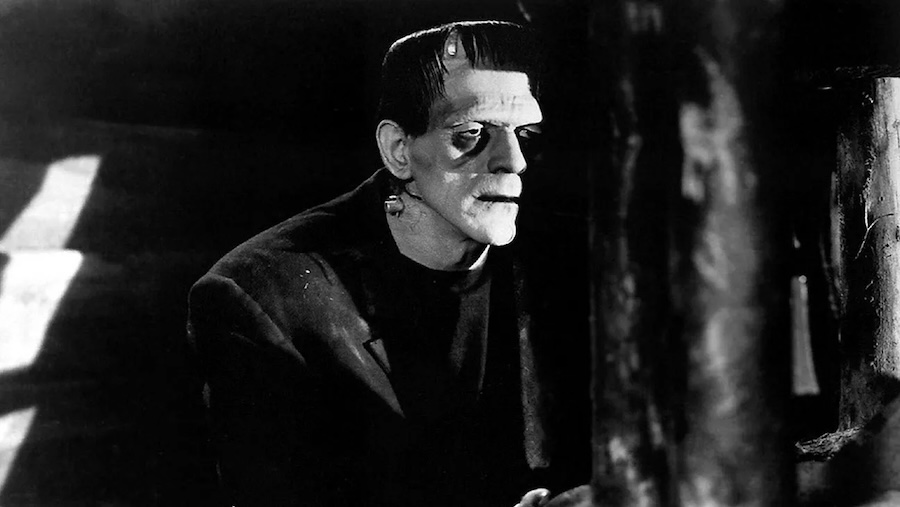
Mary Shelley was only 19 years old when she finished writing the story of Frankenstein. I don’t know what kind of childhood she had that led her to cook up a tale about a scientist who makes a new human being out of body parts from dead people, but a classic she did create. This screen adaptation became a marvel to behold in the early days of talking pictures.
Collecting body parts
The script is closer to Peggy Webling’s stage adaptation from the 1920s than the novel. We’re introduced to Henry Frankenstein (Colin Clive) and his assistant Fritz (Dwight Frye) as they go about collecting various body parts. Unfortunately, Fritz mistakenly lays his hands on an abnormal brain. Henry stitches the creature together, but his fiancée Elizabeth (Mae Clarke), who knows nothing of his experiments, is starting to get worried about the many hours Henry spends in his lab. She enlists the help of his old mentor, Dr. Waldman (Edward Van Sloan), and together they go to the lab to talk some sense into Henry – only to witness him succeed at giving life to his creature.
The Monster (Boris Karloff) is hideous, but Henry has high hopes for him… that are soon dashed when they realize that the Monster’s abnormal brain has given him a low IQ and a vicious temper.
Fast pace compensates for creakiness
The sound is constantly inferior; that some outdoor scenes were shot on a soundstage is painfully obvious and in those that weren’t you can hear the wind blow into the microphone. Still, director James Whale makes the best out of what he’s got in this film that became his breakthrough.
James Whale compensates for the general creakiness with a very fast pace that leaves no dead spots.
The gothic style of the production design is reminiscent of classic 1920s German Expressionism. The final scenes in the windmill where Frankenstein’s creature meets his destiny is a great tragic ending and some of those visuals look far more persuasive than the film as a whole. Whale compensates for the general creakiness with a very fast pace that leaves no dead spots; certain modern action-movie directors have a thing or two to learn from this master. There is no real villain; a girl dies because of the Monster, but blaming him for it inevitably leads to a discussion of what responsibility science has, and that is still a pertinent question. In the 19th century people feared what industrialization might bring and today that debate has evolved into one concerning cloning. How far can we push the limit? Henry claims to know what it feels like to be God, but the film punishes him for it.
Clive is the ultimate symbol of the crazy scientist; his frantic performance is a consequence of his past as a stage performer. The true star is Boris Karloff. He had a long career behind him as a silent-film actor before breaking through as the Monster. In combination with the ingenious makeup design and the filmmakers’ decision to tone down his humanity by listing him in the credits as “?”, Karloff virtually stumbled into immortality in his first scene, a huge creature that looked terrifying but still had a childish quality that left viewers uncertain as to whether they should run away from or pity him.
In the novel everybody hated the Monster, including its creator. In the movie we are supposed to sympathize with both creature and maker. The writers are unable to complete the story in a successful way, but it is obvious what they were thinking about. Whenever we, gods on this planet, make magic we had better take responsibility.
Frankenstein 1931-U.S. 70 min. B/W. Produced by Carl Laemmle, Jr. Directed by James Whale. Screenplay: John L. Balderston, Garrett Fort, Francis Edward Faragoh. Novel: Mary Shelley. Cast: Colin Clive (Henry Frankenstein), Mae Clarke (Elizabeth), Boris Karloff (The Monster), John Boles, Edward Van Sloan, Dwight Frye.
Trivia: The first scene has Van Sloan warning viewers of what they are about to see. Bela Lugosi was considered for the role of the Monster. The scene where the Monster throws the little girl into the lake was censored for many years, but restored in 1987. Followed by Bride of Frankenstein (1935); the original story was also retold in Mary Shelley’s Frankenstein (1994) and Frankenstein (2025).
Quote: “Look! It’s moving. It’s alive. It’s alive… It’s alive, it’s moving, it’s alive, it’s alive, it’s alive, it’s alive. It’s alive!! Oh, in the name of God! Now I know what it feels like to be God!” (Clive)
Last word: “I think Frankenstein has an intense dramatic quality that continues throughout the play and culminates when I, in the title role, am killed by the Monster that I have created. This is a rather unusual ending for a talking picture, as the producers generally prefer that the play end happily with the hero and heroine clasped in each other’s arms.” (Clive, The New York Times)