

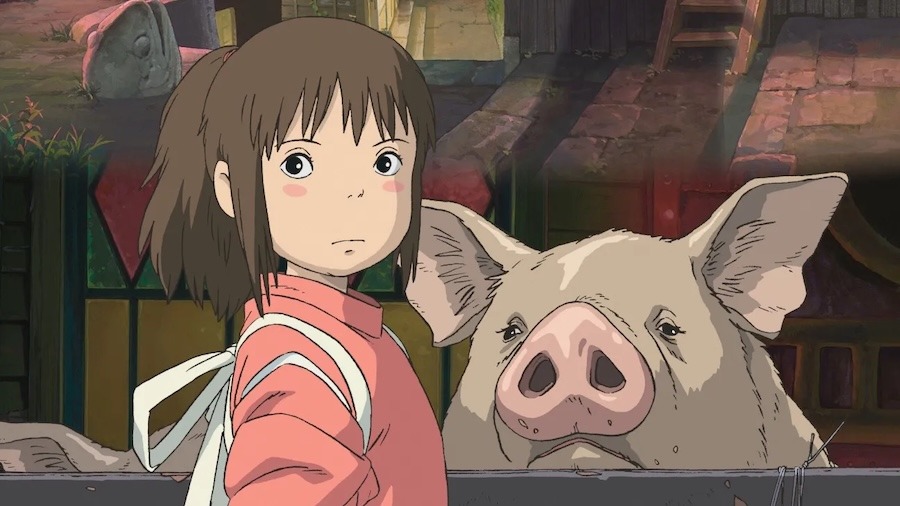
After making Princess Mononoke (1997), director Hayao Miyazaki, one of Japan’s most celebrated artists, looked forward to retiring after a prosperous career. But a guy who’s only pushing 60 is not always ready to leave everything behind. One day he met the daughter of a friend and suddenly got the inspiration to write yet another film. It was to become Spirited Away, the movie that finally made Japan’s Walt Disney famous worldwide, at least for those who never saw My Neighbor Totoro.
With some help from American executive producer and Pixar genius John Lasseter, the film was released with excellent American dubbing to great acclaim, going on to win the second Oscar ever for Best Animated Feature.
Getting lost in the woods
It starts with a family moving to a new home. Ten-year-old Chihiro is not very happy about her parents’ decision and spends the journey sulking in the backseat of the family car. After driving into the woods they get lost, but find a tunnel. Chihiro and her parents get out of the car and reach the other end of the tunnel where they find a desolate theme park and plates of food. The parents start eating, but Chihiro goes for a stroll and runs into a boy, Haku, who warns her to get out of there.
However, when she goes back to her parents, they’ve turned into greedy pigs who can’t stop eating the food. Horrified, Chihiro finds Haku again but realizes that she’s becoming transparent. She learns that the only way fto save herself and her parents is to convince Yubaba, the witch who runs the huge bathhouse that’s at the center of this place, to hire her for a job.
No archetypal sidekicks
For those who had never seen a Miyazaki movie and expected Disney, this must have been a surprise. There are no songs, no archetypal sidekicks. The story is never predictable and doesn’t turn any characters into clichés. Instead, Miyazaki incorporates greed and environmentalism as themes into his script. Sounds heavy, but he gets away with it; those sequences are entertaining and wondrous in their own right because they’re almost dreamlike. One can’t help being fascinated by watching the spirit called No-Face devour creatures who become obsessed with his ability to produce gold at will, or that whole scene where the bathhouse receives a being that is so polluted no one recognizes it as the river spirit. Indeed very amusing (and incredibly imaginative), but those scenes become even weightier because of their symbolic meaning.
You can tell how much thought there is to the location work.
The style is traditional for fans of the director. You can tell how much thought there is to the location work, and Miyazaki is no stranger to using CGI as a way of making things look smoother.
The story is just as bizarre as, and probably also partly inspired by, “Alice’s Adventures in Wonderland”. It’s a long movie, perhaps a tad too long, but audiences are likely to soon become engaged in Chihiro’s plight and struggle to never forget her real name, which Yubaba has taken from her. What I love about Spirited Away is not only the wealth of details in this intelligent saga, but director Miyazaki’s sense of imagination at the age of 60.
Spirited Away 2001-Japan. Animated. 125 min. Color. Written and directed by Hayao Miyazaki. Music: Joe Hisaishi. Voices of Rumi Hîragi (Chihiro), Miyu Irino (Haku), Mari Natsuki (Yubaba/Zeniba), Takashi Naitô, Yasuko Sawaguchi, Tatsuya Gashuin.
Trivia: Original title: Sen to Chihiro no kamikakushi. Daveigh Chase, Suzanne Pleshette, David Ogden Stiers, Lauren Holly, Michael Chiklis and John Ratzenberger contributed their voice talents for the American version. Later a stage play.
Oscar: Best Animated Feature. Berlin: Golden Bear.
Last word: “I felt this country only offered such things as crushes and romance to 10-year-old girls […] and looking at my young friends, I felt this was not what they held dear in their hearts, not what they wanted. And so I wondered if I could make a movie in which they could be heroines… If they find this movie to be exciting, it will be a success in my mind. They can’t lie. Until now, I made ‘I wish there was such a person’ leading characters. This time, however, I created a heroine who is an ordinary girl, someone with whom the audience can sympathize, someone about whom they can say, ‘Yes, it’s like that.’ It’s very important to make it plain and unexaggerated.” (Miyazaki, Nausicaa.net)