

THEIR LIPS MEET FOR THE FIRST TIME!
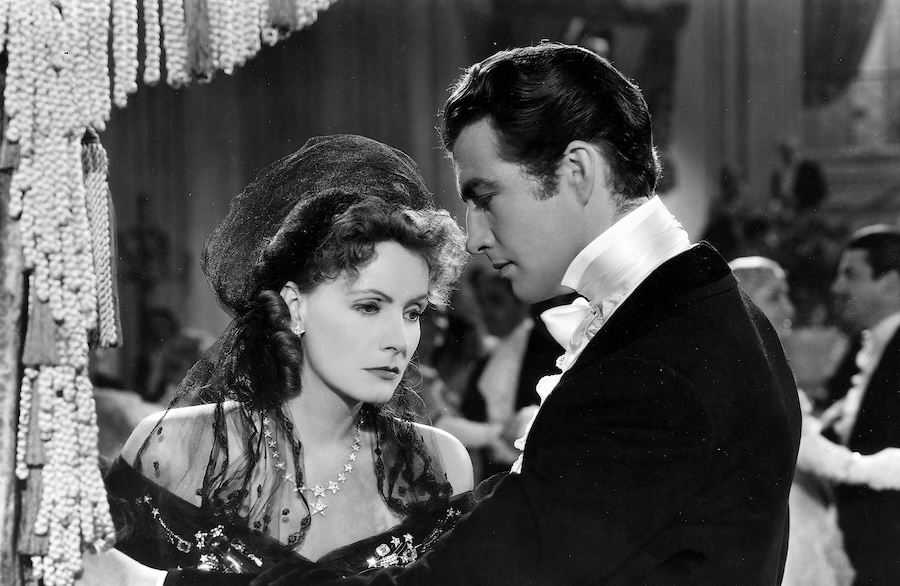
This adaptation of the classic Alexandre Dumas play and novel became one of Hollywood wunderkind Irving Thalberg’s last as producer. As in so many other cases, he seemed to have an unreal feel for what makes a great picture. He foresaw that this could perhaps be Greta Garbo’s definitive screen role. There was a moment when he and director George Cukor were watching the day’s rushes and he told Cukor that he had never seen Garbo so good. The director wasn’t equally convinced, challenging him: ”How can you possibly tell? She’s just sitting there”. Thalberg spotted a quality that Garbo projected in those scenes, a sense that she was completely unguarded and open.
The star received praise for her performance, along with an Oscar nomination. The 37-year-old Thalberg died just before the premiere of Camille, the film helping to cement his reputation as a genius struck down in his prime.
A mix-up at the theater
In 1850s Paris, courtesan Marguerite Gautier (Garbo) attends the theater, hoping to catch the attention of the Baron de Varville. She mistakenly assumes another person to be the aristocrat: Armand Duval (Robert Taylor). When the truth appears, Marguerite still values the charm and looks of Armand, but circumstances lead her to end up in the Baron’s (Henry Daniell) company. After all, the Duvals may be a good family, but it is the Baron who has a fortune.
Some time later, Marguerite is carelessly spending his money, trying to hide from the world the fact that she has consumption, an illness that is most likely to kill her sooner or later. Armand is still around and Marguerite is torn between him and the increasingly cold-hearted Baron.
No ordinary costume flick
Dumas’s story had been filmed many times before and Thalberg knew something had to change in this version. He wanted audiences to quickly understand that this was no ordinary, dusty costume flick. It was Thalberg’s assistant who came up with the idea that perhaps it shouldn’t be Marguerite’s past that threatens the happiness of her and Armand’s relationship, but his jealousy of the Baron. Thalberg liked the idea, and much of the film’s latter half focuses on those dark feelings within Armand; instead, it’s his father (Lionel Barrymore) who wants to see the love affair end because of Marguerite’s past. The film differs quite a bit from Dumas’s original work, but in both versions our sympathy for, and understanding of, Marguerite builds, and it’s also clear that there’s no real villain here. The Baron may treat her coldly, but it’s easy to see things from his perspective. The same is true of Armand who’s twice rejected by Marguerite under embarrassing circumstances.
The cast adds humor and liveliness to a drama that benefits greatly from Adrian’s costume design
In the latter case, love wins ultimately, albeit under a cloud of tragedy. After all, the consumption is introduced earlier for a reason; Garbo and Taylor’s last moments together are another reason why the film became a romantic classic. This was not Taylor’s most distinguished performance, but he does what’s expected of him; Garbo had recently made another talked-about literary adaptation, Anna Karenina, but she’s particularly good here as Marguerite – beautiful, vivid, and tragic, of course. On the whole, the cast adds humor and liveliness to a drama that benefits greatly from Adrian’s costume design and Cedric Gibbons’s attractive sets.
The film is also a superb illustration of the folly of women being forced to rely on men for their financial security, ruining both Marguerite and the Baron. That part of the film was still relevant to 1930s audiences, not just the crowds who saw Dumas’s play in the 1850s.
Camille 1936-U.S. 109 min. B/W. Directed by George Cukor. Screenplay: James Hilton, Zoë Akins, Frances Marion. Play, Novel: Alexandre Dumas (”The Lady of the Camellias”). Art Direction: Cedric Gibbons. Costume Design: Adrian. Cast: Greta Garbo (Marguerite Gautier), Robert Taylor (Armand Duval), Lionel Barrymore (Monsieur Duval), Elizabeth Allan, Jessie Ralph, Henry Daniell.
Trivia: The story was previously filmed in 1912, 1915, 1917, 1921 and 1926. John Barrymore was originally cast as the Baron; his brother Lionel was considered for the part.
Last word: “There was a problem: how should Garbo walk through this group of arrogant men? She was a courtesan, had a certain reputation and couldn’t walk through the crowd like a ‘respectable’ woman would. Garbo moved through them marvelously – she carried herself proudly. Almost slipped through as if to avoid their glances. Garbo invented this.” (Cukor, interview with Richard Overstreet)