

IT’S GREAT. GREAT STARS… A GREAT STORY… A GREAT AUTHOR!
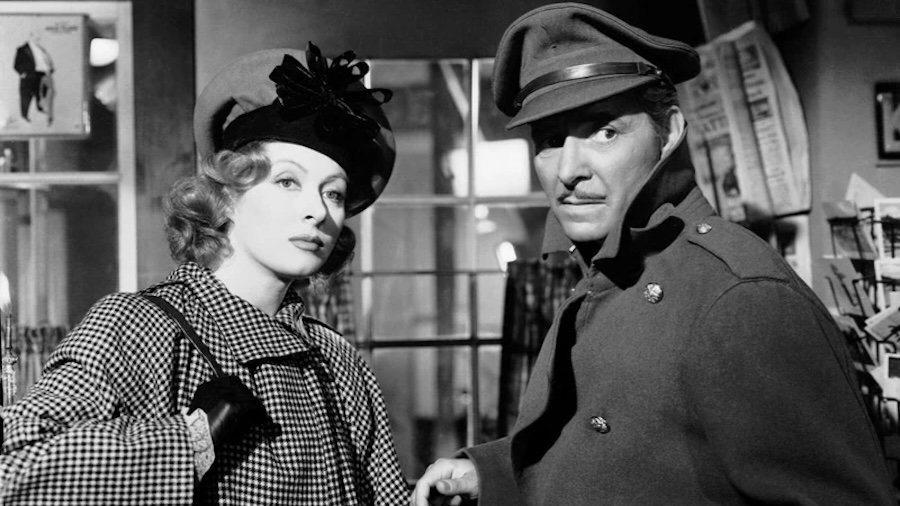
It didn’t take long for James Hilton’s novel to be filmed. After all, two previous books he wrote became highly successful movies, Lost Horizon (1937) and Goodbye, Mr. Chips (1939). ”Random Harvest” was published in December 1941 and the film came out a year later. The novel covered both world wars and their impact on Britain, but when screenwriters were hired for the adaptation they had their work cut out. Much of it had to be changed. After all, what worked to great effect in the novel simply couldn’t be done in a movie. What to do?
No recollection
As World War I draws to a close, a British officer (Ronald Colman) finds himself in an asylum. He has no recollection of who he is, his name or what he did before the war. One day, he simply wanders off and meets a woman (Greer Garson) in town. She calls herself Paula Ridgeway, explains that it’s not really her name, but she’s a performer with a traveling theater group. Paula gathers that the fellow who doesn’t know his name must come from the asylum, but she takes a liking to him.
Some time later, they’re a couple, with a newborn son. When disaster strikes in the shape of an accident in Liverpool, it changes their lives in a shocking way.
A completely changed structure
The ingredients of the story whose beginning I’ve described are there in the novel as well. But the structure is completely changed. We’ll try to avoid spoilers. Let’s just say that the twist in the novel hinges on the fact that we don’t see the characters. That can’t be done in a film, so what the screenwriters did was essentially write a new story using the same ingredients. The challenge lay in trying to create perhaps not a new twist, but at least something that comes as a great surprise. There’s a before and after that accident in Liverpool, where the war veteran wakes up only to learn that everything in his life has changed again, just as much as it did when he became shell-shocked in the war.
The writers did a terrific job, building something new out of the story, but maintaining much of its themes and emotional impact, even if this version ends before World War II and lacks the novel’s ambitious portrait of how the wars affected both London and the countryside.
Ronald Colman really is too old for his part, but still does a good job.
To a great extent, the film is an example of MGM excelling in the 1940s. Director Mervyn LeRoy is generally considered to have done his best work for Warner in the previous decade, but Random Harvest is one of his best films for MGM, his second one with Garson in the lead. She had a great year, also appearing in and winning an Oscar for Mrs. Miniver; here, she’s very good as Paula (charming in a musical number, ”She’s Ma Daisy”) and the subsequent Margaret, trusted assistant with a hidden agenda. Colman really is too old for his part, but still does a good job; Susan Peters is also worth a look as the young ”niece” who falls in love with him.
Production values are high throughout, and the film builds up to a moving finale – quite an achievement considering the fact that the story on the whole requires quite a suspension of disbelief. Audiences clearly were willing to go along with the fantasy as long as MGM could tell the story in a riveting way, as well as provide the right look, cast and feel for romance. The film also stands as a brilliant counter against the boring argument that a successful adaptation of a novel must be faithful to it.
Random Harvest 1942-U.S. 125 min. B/W. Directed by Mervyn LeRoy. Screenplay: Arthur Wimperis, George Froeschel, Claudine West. Novel: James Hilton. Music: Herbert Stothart. Cast: Ronald Colman (Charles Rainier/”Smithy”), Greer Garson (”Paula Ridgeway”/Margaret Hanson), Philip Dorn (Jonathan Benet), Susan Peters, Henry Travers, Reginald Owen, Una O’Connor.
Trivia: Inspired several Indian films.
Last word: “Playing the part of Paula was pure joy for me. Sometimes when working on a film, I come home utterly exhausted, but while playing this role I ended each day feeling fresh and lighthearted. The script flowed so beautifully, like a symphony. I would just sing going to the studio every morning. And that was at 4.45 AM!” (Garson, “A Rose for Mrs. Miniver: The Life of Greer Garson”)