
IT’S THE STORY OF A MAN, A WOMAN, AND A RABBIT IN A TRIANGLE OF TROUBLE.
This is one of my earliest memories of going to the movies. My dad took me to see it and I had recently started wearing glasses. Unfortunately, I forgot to bring them this time. I still managed, as I do now 30 years later, whenever I forget them. Watching a movie in a theater is an intense visual experience, so I do remember feeling a bit teary-eyed. I also recall some of the more adult aspects of this film, which are more obvious to me now many years later. Glasses or no glasses, Roger Rabbit remains a groundbreaking achievement.
How Eddie ended up hating toons
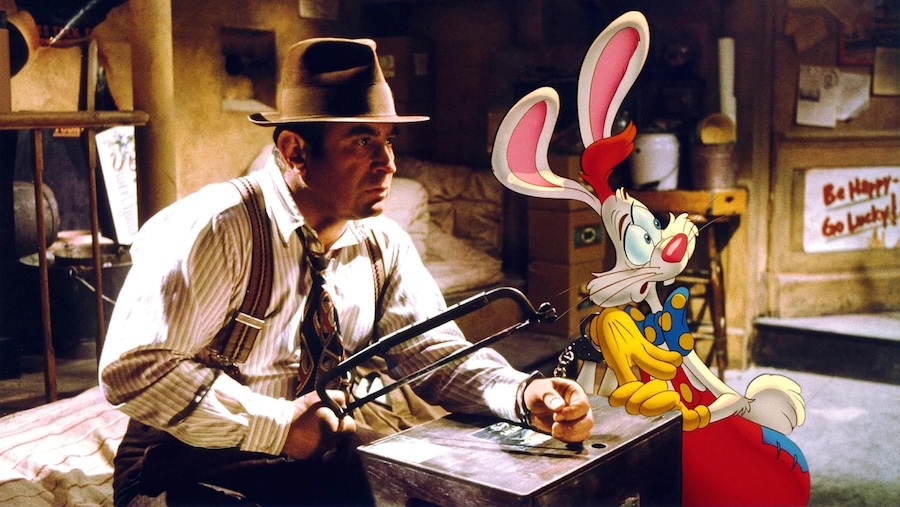
Los Angeles, 1947. Hollywood is an industry where humans and cartoon characters, called ”toons”, co-exist and share the silver screen. The toons are actors, just like everybody else… but far from appreciated in all corners. Private eye Eddie Valiant (Bob Hoskins) used to work with toons together with his brother, but when he was murdered by a toon who dropped a piano on him things changed. Eddie ended up hating toons, and turned to alcohol. One day he’s hired by the head of a movie studio to investigate if Jessica, wife of Roger Rabbit, one of the studio’s biggest stars, is having an affair with a businessman. Turns out there’s some truth to the rumor, and when the businessman is found murdered, Roger becomes a prime suspect.
Getting access to Daffy Duck
It may seem unlikely, but it started with a novel. In Gary K. Wolf’s version, Roger Rabbit was a comic-strip character, along with Dick Tracy, Beetle Bailey, Snoopy and others, and the story took place in the present. When Disney bought the rights, they saw a lot of potential but wanted something different. This was going to be an adventure set in the Golden Age of Hollywood animation, fusing cartoon characters with the ultimate movie genre of the 1940s, film noir. After some time, Steven Spielberg and his Amblin Entertainment were brought onboard and Spielberg started talking to Warner and other studios who made great animated shorts during the Golden Age, convincing them to let him and Disney borrow their iconic characters for appearances in the film. He was immensely successful, even if he couldn’t use famous characters like Popeye and Tom & Jerry; he still gained access to Daffy Duck, Woody Woodpecker, Bugs Bunny, Yosemite Sam, Tweety Bird, Betty Boop and many others.
Never before had actors mingled with animated characters in such a convincing and ambitious way
The film became a huge hit, part of Disney’s rebirth, along with The Little Mermaid (1989). The film wasn’t just a parade of animated cameos; this was quite a technical feat. Never before had actors mingled with animated characters in such a convincing and ambitious way; Roger Rabbit looked extraordinary then and retains much of its glory today. The screenwriters paid homage to 1940s Hollywood in a loving and meticulous way, having a lot of fun in the way they let the sexual and violent ingredients of the human film noir world seep into that of the toons. The idea for this film was bold in the extreme and it’s incredibly satisfying to see it succeed so well.
Hoskins is a treat as the surly private eye and Kathleen Turner gives Jessica the right kind of smoky voice; when I was a kid I found Christopher Lloyd intimidating as the villainous Judge Doom, and he’s still scary. The animated characters are voiced by both fresh talents and a few legends, all contributing to a lively movie that feels like it’s one-of-a-kind.
Composer Alan Silvestri created one of his most beloved scores for Robert Zemeckis’s Back to the Future (1985). This continued collaboration also spawned music that tickles our imagination, leaning heavily on jazz for that sultry noir feeling.
Who Framed Roger Rabbit 1988-U.S. Part Animated. 103 min. Color. Directed by Robert Zemeckis. Screenplay: Jeffrey Price, Peter S. Seaman. Novel: Gary K. Wolf (”Who Censored Roger Rabbit?”). Music: Alan Silvestri. Editing: Arthur Schmidt. Visual Effects: Richard Williams, Ken Ralston, Ed Jones, George Gibbs. Cast: Bob Hoskins (Eddie Valiant), Christopher Lloyd (Judge Doom), Joanna Cassidy (Dolores), Stubby Kaye, Alan Tilvern. Voices of Charles Fleischer (Roger Rabbit/Benny the Cab/Greasy/Psycho), Kathleen Turner (Jessica Rabbit), Lou Hirsch (Baby Herman), Mel Blanc, Mae Questel.
Trivia: Co-produced by Frank Marshall; co-executive produced by Steven Spielberg. Amy Irving provided Jessica Rabbit’s singing voice. Tim Curry was considered for the part of Doom; Terry Gilliam for directing duties; Chevy Chase and Eddie Murphy for the lead.
Oscars: Best Film Editing, Visual Effects, Sound Effects Editing (Williams also received a special Academy Award). BAFTA: Best Special Effects.
Last word: “We were there when that new regime came in, and they were full of energy, and they wanted to do it. I kept saying, and I sincerely say this, I do believe this, ‘I’m making Roger Rabbit the way I believe Walt Disney would have made it.’ The reason I say that is because Walt Disney never made any of his movies for children. He always made them for adults. And that’s what I decided to do with Roger Rabbit.” (Zemeckis, Deadline)