
A lot of people misunderstand documentaries as a film genre. They tend to view them as the truth, a journalistic endeavor where the filmmaker is fair and balanced, reporting on both sides of an issue without letting his own views get in the way. This may be the ambition for some documentary directors, but not so in most cases. These men and women are after all filmmakers; even if they are committed to a certain issue they want to debate, they will let you know their point of view, and preferably as artistically as possible.
Documentaries can push boundaries as much as any narrative feature film. You Can See Everything is not the first of its kind, but rarely has such a project been this successful.
Inviting a crew into their home
34 days before going to prison for defrauding her Theranos investors, convicted criminal Elizabeth Holmes and her boyfriend Billy Evans invite a documentary crew into their home. Why? Hard to tell, as it is with so much concerning Holmes, but perhaps they were thinking this is a chance to change the narrative surrounding Holmes. Now the public will get to see how outrageous it is to send a loving mother like Elizabeth to prison. As for the filmmakers, documentary director Lance Oppenheim and comedian/reality TV show creator Nathan Fielder in their first collaboration came to the house not really knowing what to do with the material they were about to shoot, but soon realized that this will be fodder for an interesting examination of Holmes’s psyche.
Impossible to reach
That’s one hell of a barrier to penetrate, and the duo never really succeed. That might be considered a failure, but in this case it becomes a fascinating piece of the puzzle where they, and we, ask ourselves if Holmes’s mental barrier was built consciously or subconsciously. In the movie, Fielder has several conversations with her, where he tries to make her understand how she’s perceived by the public and why she doesn’t make sense, at one point using Abbott & Costello’s most famous comedy routine as an example… but she’s impossible to reach, no matter how inviting and honest she initially appears to be. This becomes alarmingly clear in one of the final sequences when she’s confronted with one of the major issues that Fielder and Oppenheim discussed with Billy.
It’s absurdly funny at times
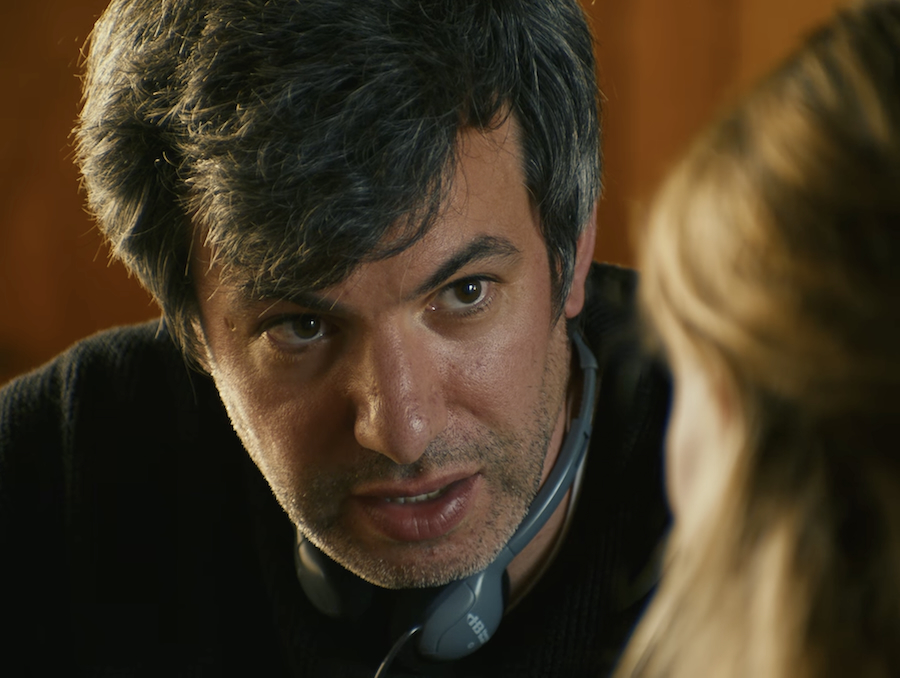
Fielder is an odd presence at times, lurking around the house and getting caught up in uncomfortable situations with Elizabeth and Billy – but we share in his amazement at what’s going on between the couple and what they’re saying on their own in front of a camera. It’s absurdly funny at times; the fact that David Bolen’s shadowy cinematography and composer Ari Balouzian’s score keep telling us that we’re actually watching a thriller adds to a very strange effect. Never letting us forget that it is a movie we’re watching, the camera crew is always visible.
After some time, we begin to wonder if three hours might be a little too much time to spend with the couple in their house, but that’s when a big change comes. Amanda Seyfried is introduced into the story. She won an Emmy for playing Holmes in the limited series The Dropout (2022). At first, she’s an observer, having the same reaction to the footage from the film’s first half as we did. Then she plays Holmes again, with Christopher Abbott as Billy, in a series of reenactments that ingeniously serve a real purpose in the film’s climax.
This could have been a stunt that collapsed the whole project. Instead, it’s a fascinating comment on the effect that movie stars and charismatic con artists can have on us. We easily fall for illusions created by a performer.
You Can See Everything 2026-U.S. 174 min. Color. Directed by Nathan Fielder, Lance Oppenheim. Cinematography: David Bolen. Music: Ari Balouzian.
Trivia: Co-produced by the directors.
Last word: “Nathan wasn’t on camera yet, but Elizabeth and Billy kept asking Nathan questions and almost seemed like they were drawing him from behind the camera, in front of the camera. And at the end of the first day, I was like, ‘Nathan, I’m sorry. I failed you, man. This doesn’t work. You’re right. We’ve got to do something new.’ So then we brought in two cameras, both on 25 to 250 lenses. We would identify parts of the house that could essentially give David Bolen, my DP, and Jonathan Mitchell, our camera operator who’s worked with Nathan on everything, a full range of possibilities of seeing and being able to capture almost everything.” (Oppenheim, GQ Magazine)