

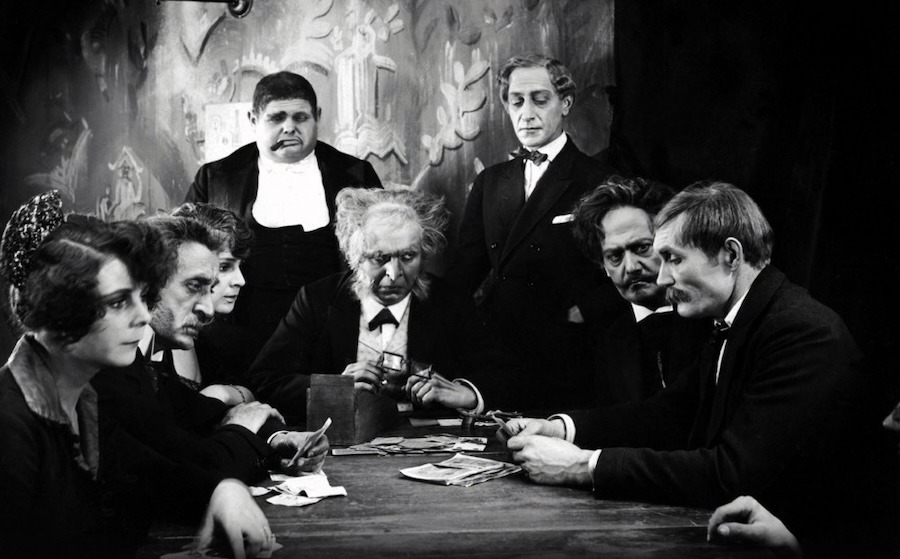
In 1922, two extraordinary films came out of the Weimar Republic. One was an influential horror movie, Nosferatu, an adaptation of Bram Stoker’s ”Dracula”. The other one was a spectacular sort of gangster movie that incorporated supernatural elements. Inspired by various literary figures, such as George du Maurier’s Svengali from the novel ”Trilby” (which also incidentally might have haunted Stoker’s mind when he wrote ”Dracula”), and Sax Rohmer’s mad genius Fu Manchu, Dr. Mabuse, the Gambler is a fascinating portrait of a nation in turmoil.
Brilliant opening sequence
The original epic was divided into two parts, the first one subtitled The Great Gambler: A Picture of the Time, the second one Inferno: A Game for the People of Our Age. The brilliant opening sequence shows the titular villain at work, introducing us to his home in Berlin from where he runs his empire of counterfeiting and gambling. He has a gang of assistants who serve different purposes, including cocaine-addicted manservant Spoerri (Robert Forster-Larrinaga) and the driver/assassin Georg (Hans Adalbert Schlettow); also connected to Mabuse’s crew is the dancer Cara Carozza (Aud Egede-Nissen), who’s devoted to him.
After organizing a heist in order to lay his hands on a valuable contract, Mabuse manages to create a panic in the stock market, which makes him even wealthier. When he also targets the son of an industrialist, using hypnosis to rip him off, Mabuse’s activities begin to attract the attention of state prosecutor Norbert von Wenk (Bernhard Goetzke), who goes undercover…
A German Lon Chaney
In the early 1920s, Fritz Lang was ready for Dr. Mabuse, especially after making the equally epic adventure film The Spiders, also released in two parts in 1919 and 1920. He had embarked on a romantic affair with a married woman, Thea von Harbou, a screenwriter whose husband was the actor Rudolf Klein-Rogge. When von Harbou left Klein-Rogge for Lang, there doesn’t seem to have been a huge rift between the three of them. The actor, who has been described as a German Lon Chaney thanks to his skill in disguising his appearance, came to play Mabuse and would continue to work with both Lang and his ex-wife.
Technically advanced scenes make it easy to forgive lulls at other times.
That talent of his came in handy for this film, obviously. Mabuse disguises himself in many ways throughout the film, making it easier for him to get close to his victims, including the state prosecutor, who in the film’s second half is tricked into almost killing himself, leading to a car chase late at night, a technically advanced sequence for its time. There are quite a few of them here, from the opening scheme to bring down the stock market to the final showdown, a Berlin street battle between Mabuse’s gang and the authorities. They make it easy to forgive lulls at other times, plot threads and supporting characters that are of minor importance in this four-and-a-half-hour endeavor.
Special effects include animation and superimpositions, very nicely done in sequences that elevate Mabuse’s hypnotic talents as well as in the final moments of the story when his victims come back to haunt him.
One can certainly view the film as a comment on the state of the Weimar Republic, where chaos easily spreads because of manipulation. Nazis in the audience viewed Mabuse as a Jewish figure, an invisible power behind financial markets. Those who feared and loathed Nazis saw an Adolf Hitler in Mabuse, a man who could talk the masses into anything; this became even more true as Hitler’s status grew in the coming years. There was something here for everyone to like, as they pondered Weimar’s woes.
Dr. Mabuse, the Gambler 1922-Germany. Silent. 268 min. B/W. Directed by Fritz Lang. Screenplay: Fritz Lang, Thea von Harbou. Novel: Norbert Jacques. Cinematography: Carl Hoffmann. Cast: Rudolf Klein-Rogge (Dr. Mabuse), Aud Egede-Nissen (Cara Carozza), Gertrude Welcker (Dusy Told), Bernhard Goetzke (Norbert von Wenk), Alfred Abel, Paul Richter.
Trivia: Original title: Dr. Mabuse, der Spieler. Also shown in a 101-min. version. Followed by two sequels, starting with The Testament of Dr. Mabuse (1933); five other films featuring Mabuse were also made in West Germany in the 1960s.