

WE BURY OUR SINS, WE WASH THEM CLEAN.
After the phenomenal Unforgiven (1992), the movie that won Clint Eastwood an Oscar as director, the aging director went on making a slew of films in the latter half of the decade that always had interesting ingredients but were generally speaking marred by an overly leisurely pace (with Bridges of Madison County (1995) as an irresistible exception). It wasn’t until he decided to take on best-selling crime author Dennis Lehane that he struck gold again. This time, he found a perfect balance between tension and melancholy.
Affected by childhood horrors
Boston, 1975. Three boys are playing hockey in the street when a car pulls up and two men introduce themselves as cops. After intimidating the boys, they make one of them get into the car. All the other boys can do is watch the men drive away with their friend. After being sexually harassed for four days, the boy escapes and the men are subsequently arrested.
Twenty years later, the boy, Dave Boyle (Tim Robbins), is a grown man whose entire life has been affected by the horrors that he suffered. His path crosses with his former friends, Sean Devine (Kevin Bacon) and Jimmy Markum (Sean Penn), when the latter’s 19-year-old daughter disappears and is later found murdered in a park. Devine is one of the cops working the case and even though he doesn’t believe that Dave had anything to do with it, there are circumstances that make him look suspicious…
Marriage between prose and a filmmaking style
Dennis Lehane has become the primary chronicler of Boston in popular culture; several other film adaptations followed in the wake of the commercial and critical success of Mystic River. It’s easy to see why. The writer obviously has first-hand knowledge of and a feel for the city and its less than glamorous streets, knows how to tell a good story and makes his characters come across (and talk) like real people.
The marriage between his prose (skillfully adapted by Brian Helgeland) and Eastwood’s filmmaking style turned out to be very fortunate indeed. The director always takes his time telling a story and this time the original novel has so much to offer that we need close to two-and-a-half hours to sort out the relationships between the three old friends and their family members. That they have chosen starkly different paths in life makes their reunion a collision, and the fact that the men randomly made Dave and not the other boys get into their car twenty years ago affects everything. Eastwood maintains great tension throughout, especially when cross-cutting between two scenarios near the end that reveal the murderer and highlights the lethal combination between stupidity, grief and a knack for dealing with problems as violently as possible.
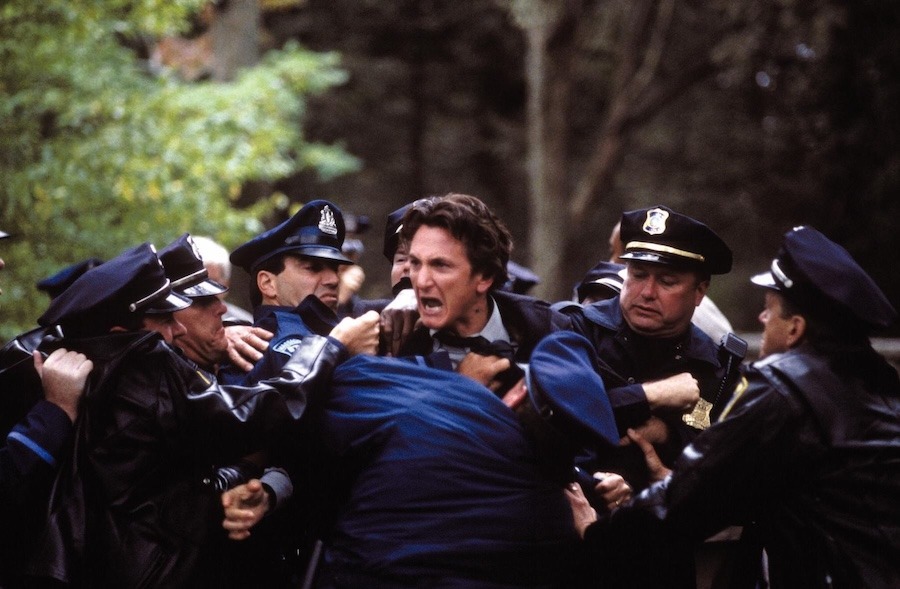
Sean Penn delivers a brilliant, forceful performance as the ex-con.
Penn delivers a brilliant, forceful performance as the ex-con whose mourning is virtually consuming him; Robbins is equally good as Dave whose troubled past and mental issues turn him into a constant victim, sad and full of grudges. Bacon also provides strength as the cop whose chances of satisfyingly closing the case look very slim.
Staying true to Lehane’s work, Eastwood shot the film in Boston, making great use of working-class neighborhoods. In a 2001 interview with January Magazine, Lehane talked about the symbolic meaning of the Mystic River in Massachusetts, mentioning the moody industrial look of Chelsea and Charlestown before gentrification set in. Judging from some of Eastwood’s earlier work, it should come as no surprise that he knows how to evoke all that.
Mystic River 2003-U.S. 138 min. Color. Widescreen. Directing, Music: Clint Eastwood. Screenplay: Brian Helgeland. Novel: Dennis Lehane. Cast: Sean Penn (Jimmy Markum), Tim Robbins (Dave Boyle), Kevin Bacon (Sean Devine), Laurence Fishburne, Marcia Gay Harden, Laura Linney, Emmy Rossum. Cameo: Eli Wallach.
Trivia: Co-produced by Eastwood. Michael Keaton was first cast as Devine, but dropped out.
Oscars: Best Actor (Penn), Supporting Actor (Robbins). Golden Globes: Best Actor (Penn), Supporting Actor (Robbins).
Last word: “I read a synopsis and loved the idea, and I had liked Dennis Lehane before – his detective novels. But this was a whole different ball game as far as I was concerned. The story from the very beginning, and from Dennis Lehane’s approach to it, was as this Americanised Greek, or Shakespearean tragedy because there is that moral ambiguity. I’ve always been fascinated with the stealing of innocence. It’s the most heinous crime, and certainly a capital crime if there ever was one. I think anything to do with crimes against children is something that’s very strong in my mind. So, that’s what attracted me to this story – the fact that it comes back in adulthood, and things keep coming around. I just liked the story and figured I had to do it.” (Eastwood, BBC Films)