

ON EVERY STREET, IN EVERY CITY, THERE’S A NOBODY WHO DREAMS OF BEING A SOMEBODY.
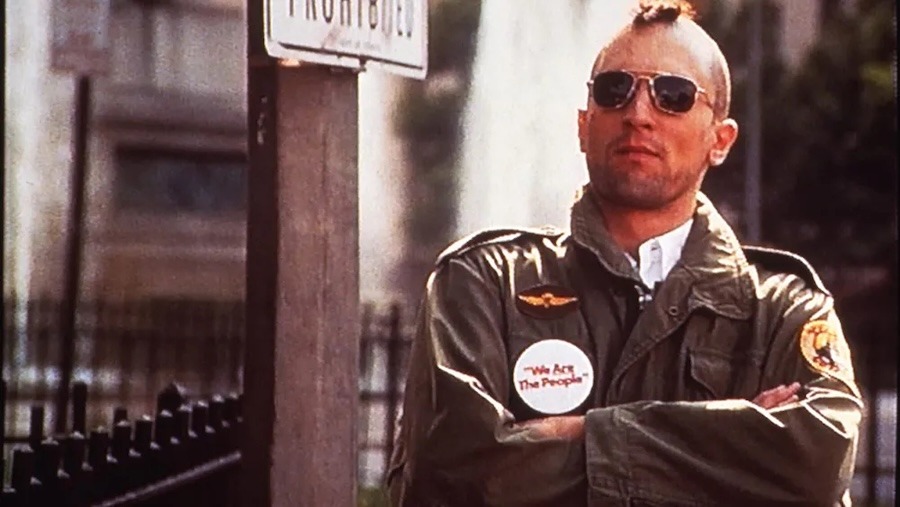
Travis Bickle can’t stand the streets of New York. He’s waiting for the rain that will wash the trash off the streets, all the thieves, murderers, queers, pimps, hookers. They’re all the same to him. He can’t sleep, which is why he gets a job as a cabbie. He may hate the streets but he doesn’t fear them – he’ll take you anywhere, any seedy address in the Bronx or Harlem. Travis is a Vietnam vet looking for a life and a purpose now that his military service is completed. He has no idea that he’s about to find a mission, a mission that will completely engulf him.
The one who must correct wrongs
It’s a complex character that writer Paul Schrader wrote. Bickle (Robert De Niro) cannot really be labeled a psychopath, but he definitely has psychological problems. He goes on a date but chooses to take the girl (Cybill Shepherd) to a nice little… porno theater. He gets involved in a presidential campaign, but ends up a security threat. No matter what he does, Travis can’t seem to adapt to people around him. But as the movie progresses, the mission slowly takes shape in his mind. He realizes that he is the one who must correct wrongs.
A 12-year old girl (Jodie Foster) who makes a living as a prostitute becomes the spark that ignites the fire burning inside Travis. He is the one who must rescue her from her pimp and johns. It’s going to be a little messy.
Dark, rainy and gritty
Director Martin Scorsese unleashed a film on the world in 1976 that isn’t pretty, but Taxi Driver remains an enduring classic. He shows us a New York looking like it was flushed down a toilet. Dark, rainy, gritty – the streets are about as mean as they can get. Accompanied by Bernard Herrmann’s unsettling score (his last), Scorsese creates a place that very well could give a dangerous person like Travis Bickle the incentive he needs to go berserk. But there’s also a kind of beauty about the whole thing – the title sequence, with its yellow cab slowly emerging from a cloud of steam, is stunning. Scorsese intended to capture a a mood between asleep and awake, and he does it with aplomb.
One obvious reason why the film is so memorable is De Niro’s performance. His character starts out as a restless young man and ends up a determined avenger with a Mohawk hairdo and an obsession with firearms – he is utterly convincing every step of the way. The famous sequence where he’s talking to an imaginary foe in the mirror, and points a gun at him, shows a man about to fall off a cliff. The supporting cast is pure perfection. Shepherd is charming as the girl Travis tries to woo and Albert Brooks fun as the guy who has a crush on her. Young Disney star Foster took a chance playing the child prostitute and her performance reveals a star in the making; her scenes with De Niro ring true.
The shootout in the ending is raw and terrifying.
The shootout in the ending, where Travis finally delivers the rain in his attempt to save the poor child, is raw and terrifying. It may not be tasteful or very well directed but it’s hard to forget. The epilogue, where Travis has become a hero after killing all those people, has been interpreted in different ways, including as a fantasy by a feverish mind about to die.
Taxi Driver is controversial and there are people who can’t stand it. Depressing to behold, the film is also fascinating. Much like other 1970s movies about anti-heroes and vigilantes, it makes you sympathize with and, eerily enough, understand a human being that you don’t really want to understand.
Taxi Driver 1976-U.S. 113 min. Color. Directed by Martin Scorsese. Screenplay: Paul Schrader. Cinematography: Michael Chapman. Music: Bernard Herrmann. Cast: Robert De Niro (Travis Bickle), Cybill Shepherd (Betsy), Harvey Keitel (Sport), Peter Boyle, Jodie Foster, Albert Brooks… Martin Scorsese.
Trivia: John Milius and Irvin Kershner were considered for directing duties; Dustin Hoffman, Al Pacino and Jeff Bridges as Bickle. Rock Hudson was reportedly considered for the part of the presidential candidate. In 1981, after seeing Foster in this film, John Hinckley shot President Ronald Reagan in an attempt to impress her.
BAFTA: Best Actress (Foster), Film Music. Cannes: Palme d’Or.
Quote: “You talkin’ to me? You talkin’ to me? You talkin’ to me? Then who the hell else are you talking… you talking to me? Well I’m the only one here. Who the fuck do you think you’re talking to? Oh yeah? OK.” (De Niro talking to himself in the mirror)
Last word: “In 1973, I had been through a particularly rough time. My marriage broke up and I had to quit the American Film Institute. I was out of work; I was out of the AFI; I was in debt. I fell into a period of real isolation, living more or less in my car. One day, I went to the emergency room in serious pain, and it turned out I had an ulcer. While I was in the hospital talking to the nurse, I realised I hadn’t spoken to anyone in two or three weeks. It really hit me, an image that I was like a taxi driver, floating around in this metal coffin in the city, seemingly in the middle of people but absolutely, totally alone.” (Schrader, Sabotage Times)