

THE INCREDIBLE STORY OF AN ORDINARY RUSSIAN TEACHER WHO EXPOSED PUTIN’S PROPAGANDA MACHINE.
There is no substantial resistance against Vladimir Putin in Russia. The majority of people in that country, especially the rural population, are so used to being ruled by a dictator in either St. Petersburg hundreds of years ago, or Moscow in modern times, that it’s all they know. Real democracy is an alien concept to them. That may sound condescending, but most experts on Russia would agree.
So, is there any point in making films about Russians who resist Putin? This documentary was attacked by some critics who believed the struggle against Putin is better served by maintaining focus on his victims: the people of Ukraine, who are fighting for their survival.
An enthusiastic videographer
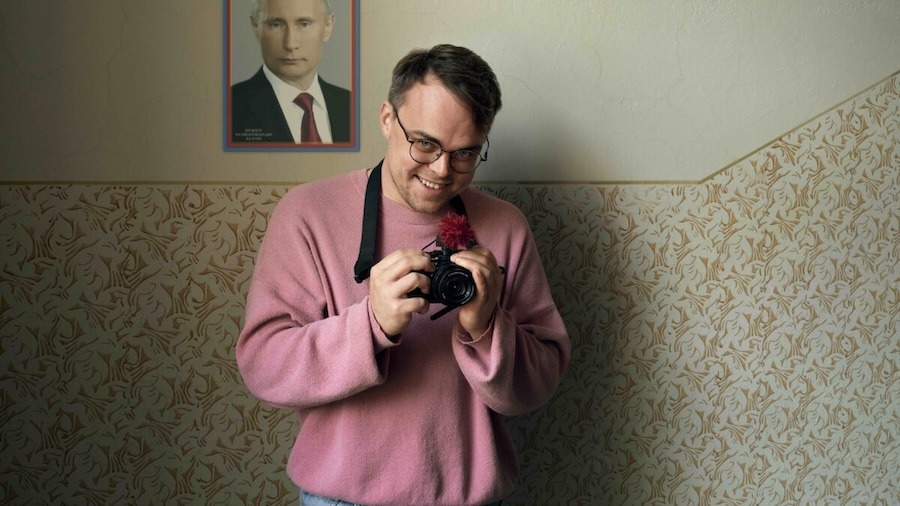
We are introduced to Pavel ”Pasha” Talankin, a teacher at Karabash primary school who is also an enthusiastic videographer. The film is entirely based on his footage, and as we can see he maintains a friendly relationship with the students. His mother also works there, at the school library, an no-nonsense figure who makes sure that the well-used books are properly taped together. In February, 2022, Putin attacks Ukraine. Suddenly, the school finds itself under new orders. There’s a new emphasis on patriotic displays and exercises, which must be filmed and sent to the authorities as evidence of loyalty. This becomes Talankin’s job.
Some of the teachers go through the motions, others do it because they believe in the cause. Talankin feels sick at heart, and considers quitting… until he makes contact with foreign filmmakers who talk him into staying for a while and document what the authorities are doing to the children.
Escaping Russia
The filmmaker who Talankin talked to was David Borenstein, an American living in Copenhagen. With his help, Talankin finally escaped Russia in the summer of 2024, as his situation there became increasingly risky, with local police watching him. In March 2026, they both accepted Oscars for this film, which must have been emotional, considering everything they went through. There’s a bittersweet feeling to their success. We end up wondering what happened to the kids in Karabash, and Talankin’s mother. There are many moments during the film where we in the audience watch the children and realize with sorrow that they’re not built to resist the lies from Putin’s powerful propaganda machine. Some of the older ones are being prepared for slaughter, as soldiers in the war on Ukraine. There’s a horrifying sequence where members of the Wagner Group appear in school to lure the children into their way of thinking. These men may be war criminals and murderers… but the boys don’t know that and they get to play with all the cool guns. Maybe a future in the Russian military is an adventure?
Watching this film is a painful and frustrating experience.
Watching this film is a painful and frustrating experience, but what makes it so effective is also its warmth and sense of humor, turning its ”cast” into real human beings, not caricatures.
Back to that question of whether or not this documentary serves a purpose. First of all, none of us benefit from viewing each and every Russian as a villain. Secondly, that it shows an apathy or unwillingness among the Russian people to resist Putin is not a weakness here; it’s simply a fact. Apart from everything else that’s great about this movie, it’s an illustration of how hard it is to negotiate your way out of a war where the enemy is ready to sacrifice its children for land.
Mr Nobody Against Putin 2025-Denmark-Czech Republic-Germany. 90 min. Color. Directed by David Borenstein, Pavel Talankin. Screenplay: David Borenstein. Photographed and narrated by Pavel Talankin.
Oscar: Best Documentary Feature Film. BAFTA: Best Documentary.
Last word: “We couldn’t have anyone in the film who was even vaguely critical of Putin — other than Pasha. That wasn’t manufactured — it is a genuine reflection of what people are like in Karabash. There is no distortion of the facts in the film. But there were times when people might make a joke or a teacher might say to the children something sarcastic. But we wouldn’t allow those comments in because… if you talk to a foreign broadcaster that’s treason and you are going to prison. If you make a comment — as a joke — they will take it seriously and you will go to prison. We didn’t want to expose anybody. So we didn’t allow anything even vaguely critical.” (Lucie Kon, BBC Storyville editor, Global Investigative Journalism Network)