

ROMANCE… IN A MOST UNLIKELY PLACE.
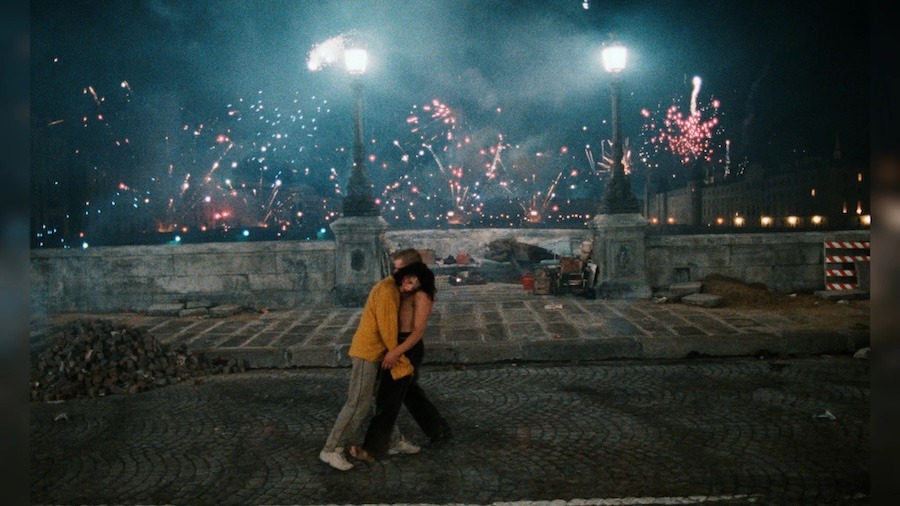
It’s the kind of troubled film project that generates not one but two different documentaries telling the story of how it was made; both of them were also released in 1991. Making The Lovers on the Bridge went through three different shoots over several years. A full-scale model of the Pont Neuf, complete with many surrounding details, was built by production designer Michel Vandestien in Lansargues in southern France. The project was frequently hindered by a lack of funds, before finally going way over budget, earning a (disputed) reputation as the most expensive movie in French history.
Throughout all the troubles, both director Leos Carax and Juliette Binoche, who were also lovers for some time, fought hard for the film, even contacting Steven Spielberg and showing him some of the footage on VHS. They had his support, but it sure was a battle – that continued among critics once the complete film premiered.
Two lost souls
The story throws together two lost souls: alcoholic street performer Alex (Denis Lavant) and Michèle (Binoche), an artist who’s losing her sight and feels miserable after an unhappy relationship. They are both homeless and find themselves securing spots on Pont Neuf together with Hans (Klaus Michael Grüber), another vagrant who’s not pleased with Alex inviting Michèle into their doomed lives. The bridge is currently closed for renovations and in a shabby state. Still, there’s plenty of beauty in the lives of Alex and Michèle who fall in love while Paris prepares for its bicentennial celebration of the French Revolution. When Michèle’s eyesight deteriorates further, she becomes more dependent on Alex, and there comes a time when he has to make a difficult decision…
Huge, costly undertaking
Depending on which critic you asked, The Lovers on the Bridge was either an example of pure folly, empty and exhausting, or a visual masterpiece that showed a unique filmmaking talent. It’s ironic that a director who started out with much simpler projects like Boy Meets Girl (1984) and Mauvais Sang (1986) was suddenly involved with a huge, costly undertaking like this… but The Lovers on the Bridge was true to Carax’s style, another troubled, thorny love affair among broken people that just happened to need a full-scale Pont Neuf model.
Leos Carax succeeds in creating a both disturbing and moving effect.
The reason why this movie garnered so much attention at home and abroad (even if it took almost a decade for it to reach American shores) is surely because of its moving romance, dedicated performances and grandiose, arresting visuals. Perhaps a sense of national pride in the case of France had something to do with it. The film sort of memorized the bicentennial with its unforgettable sequence showing fireworks in the background while Alex and Michèle dance around before stealing a speedboat and water-skiing on the Seine. Binoche did her own stunts there and nearly drowned. Both she and Lavant paid a price for their hard work; at one point, he badly injured his hand. They are perfectly cast as two people who can’t live without each other and the film illustrates the depth of that love. We can’t sympathize or understand what they share and its horrible consequences, but Carax succeeds in creating a both disturbing and moving effect.
There’s no telling where reality ends and fantasy begins in this film, but that’s intentional – it’s the size of a filmmaker’s balls, the stunning look of the final results and intense emotion that counts in this case.
The Lovers on the Bridge 1991-France. 125 min. Color. Written and directed by Leos Carax. Cinematography: Jean-Yves Escoffier. Editing: Nelly Quettier. Production Design: Michel Vandestien. Cast: Juliette Binoche (Michèle Stalens), Denis Lavant (Alex), Klaus Michael Grüber (Hans), Marion Stalens, Chrichan Larsson.
Trivia: Original title: Les amants du Pont-Neuf. Released in Australia as Lovers on the Pont Neuf on cable and Lovers on the Ninth Bridge on video (the latter a mistranslation of the French title).
European Film Awards: Best Actress (Binoche), Cinematographer, Editor.
Last word: “In the first one – Bad Blood – we didn’t know each other. I wanted him to like me and I did everything for him. In the second, The Lovers on the Bridge, it was very different: we lived together and he wrote the script while I painted alongside him. I wanted to be less idealized, closer to reality. And there were more confrontations, because of the problems in our relationship and because it was a very long and difficult shoot. […] What really happened is that I nearly died during that shoot. I almost drowned while filming a scene. That’s when I realized that my life was more important than any movie, no matter how good it was. I learned to say no. Being a young actress, I couldn’t, or didn’t know how.” (Binoche on working with Carax, El País)