
BERLIN, 1945. A NATION AWAITS ITS DOWNFALL.
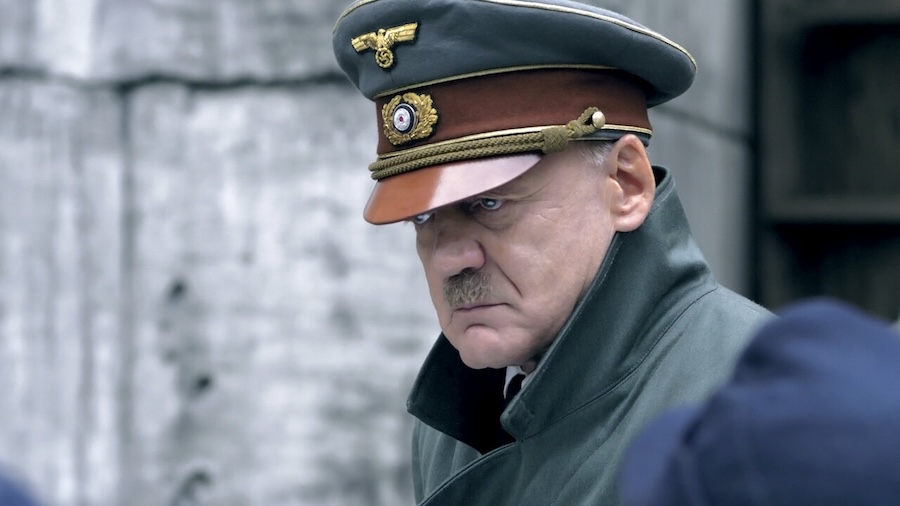
The man who emerges from a back room to pick his next secretary is a kind, grandfatherly man who treats the young aspirants with respect and warmth. Finally he picks 22-year-old Traudl Junge who is ecstatic about working for the great leader of her country. 1942 was still a fairly good year for Adolf Hitler and Nazi Germany. Fast-forward three years and everything has changed. Germany is losing the war, Berlin is in ruins, the Russians are coming and the desperate German leadership is holed up inside a bunker. The kind, grandfatherly man has turned into a sickly, weak, insane figure who can barely walk straight.
This is the story of Hitler’s final days and strangely enough there was controversy surrounding director Oliver Hirschbiegel’s impressive work.
No fantasy figure
Some critics argued that portraying Hitler as an ordinary human being was not a good idea. The man killed six million Jews and plunged the world into a devastating war. The problem with that reasoning is that Hitler was not the Devil, some kind of fantasy figure with hooves and a tail, but a person who had a mother and father. Refusing to understand why a human being turns into someone like Hitler and why so many are prepared to believe what he’s saying and commit acts as heinous as those that took place in Auschwitz, only leads to new Hitlers all over the world. Downfall does not serve as an excuse for this dictator, it merely attempts to portray in a historically accurate way what these people were thinking and doing near the end of their lives. This it does very well; the film shows what kind of fruit this tree of a sick ideology was bearing.
There is plenty of violence in the film (an impressive amount of suicides) but no scene is more terrifying than the one where Magda Goebbels lovingly kills her children because she doesn’t want them to live in a world without National Socialism. Talk about a poisonous cocktail of insanity and misguided nationalism.
A claustrophobic experience
Before watching Downfall I was certain that the filmmakers would get the historical details right, and the acting for sure. I did worry about the budget not being generous enough to allow a believably horrifying depiction of Berlin as a battlefield. I was wrong. Those scenes won’t let anyone down but the filmmakers have also succeeded in recreating what must have been a claustrophobic experience living in that bunker, not being able to get a breath of fresh air but for a few minutes at a time. That feeling of isolation underscores how detached Hitler was from reality, planning military advances with armies that no longer existed and a future for a “Germania” that would never rise from the ashes. Traudl Junge, who died in 2002 but appears in an epilogue, is young and attractive, someone viewers can easily sympathize with as a contrast to most others in the bunker; she is well played by Alexandra Maria Lara.
Bruno Ganz had his doubts about his ability to effectively and appropriately portray Hitler, but nevertheless accepted the challenge. And what a performance this is. He looks like Hitler, has worked hard to learn how the man spoke in private and is a frightening presence in those sequences that demand the Fuehrer to rave and rant; one of those scenes became an oft-repeated meme years later. At times when he speaks calmly and softly, he manages to be almost likable but you can always sense the insanity beneath; we believe in the spell Hitler has cast on everyone close to him, the Goebbels and Eva Braun in particular.
Witnessing this complete downfall of humanity is not something to fear, but a lesson worth learning.
Walking out from the theater I felt like taking a shower. But witnessing this complete downfall of humanity is not something to fear, but a lesson worth learning.
Downfall 2004-Germany-Italy-Austria. 155 min. Color. Produced and written by Bernd Eichinger. Directed by Oliver Hirschbiegel. Books: Joachim Fest (”Inside Hitler’s Bunker“), Traudl Junge, Melissa Müller (”Bis zur letzten Stunde“). Cinematography: Rainer Klausmann. Cast: Bruno Ganz (Adolf Hitler), Alexandra Maria Lara (Traudl Junge), Corinna Harfouch (Magda Goebbels), Ulrich Matthes, Juliane Köhler, Heino Ferch, Thomas Kretschmann.
Trivia: Original title: Der Untergang. Ganz studied Parkinson’s patients as a way of preparing to play Hitler. The events were also depicted in the films The Last Ten Days (1955), Hitler: The Last Ten Days (1973) and The Bunker (1981).
Last word: “The biggest obstacle for me was that I, as a director, couldn’t really see how this could work, because I would have to direct Adolf Hitler, which is something you joke about when you are asked about your profession. You have to get inside these characters; you have to get inside the whole tale to make it believable and honest. That’s what you have to do. But it’s one thing joking about it, and then [another thing] having to do it. Eventually I realized that it could work. It was a very good thing to have Bruno on board after having seen him in his moustache and his haircut, because he had done his homework already. Even he [at first] didn’t believe [in] it, [either]. But he came out in the casting studio as Adolf Hitler, and I knew if he gave me a yes, this would work.” (Hirschbiegel, About Film)