

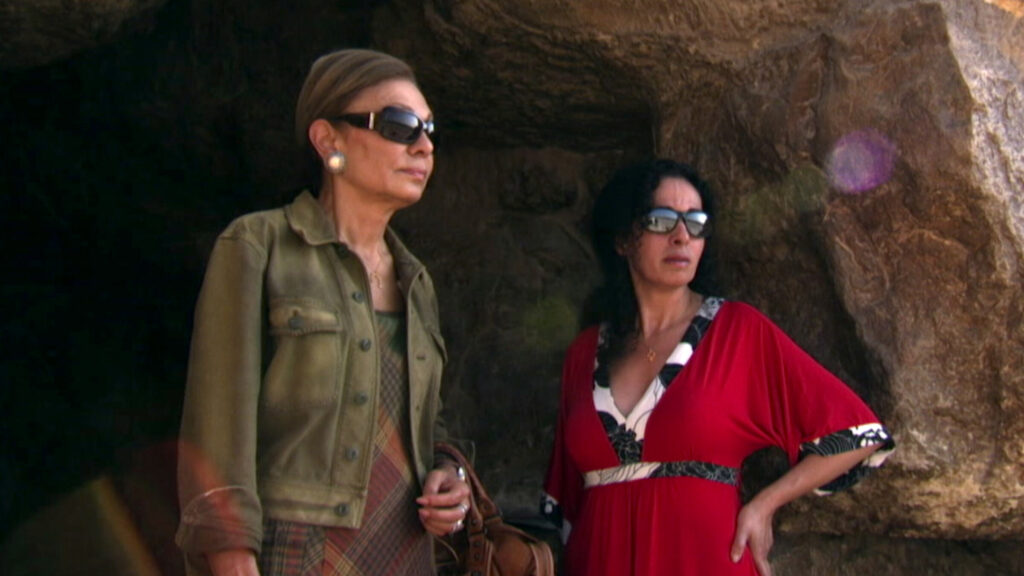
Nahid Persson Sarvestani grew up in the town of Shiraz, Iran in the 1960s and ’70s. Life was simple, but as a young girl she used to watch TV and fantasize about Queen Farah who seemed to live a fairy-tale life. As a teenager, her fascination with the Shah’s wife was replaced with a hatred for a regime that executed dissenters. Together with family members, Nahid participated in the struggle against the Shah, ending in 1979 with the Iranian royal family fleeing abroad and the beginning of Ayatollah Khomeini’s reign as new head of state. Iran became a theocracy and to the horror of Nahid it didn’t take long for her and the Iranian people to realize that one dictatorship had been replaced with something even worse.
30 years later, Nahid is a Swedish documentary filmmaker who’s won awards (and Iranian condemnation) for her film Prostitution: Behind the Veil (2004)… but Queen Farah’s fairy-tale figure still looms large.
Living in Paris
The former Queen of Iran now lives in a swank apartment in Paris and when Persson Sarvestani contacts her she agrees to see a fellow countrywoman to talk about her film project. When Farah’s secretary learns that Persson Sarvestani was active in the fight against the Shah in the 1970s, this fragile collaboration runs into its first obstacle. Farah wishes to end the project, but when she sees a short trailer of what Persson Sarvestani filmed, the queen agrees to see the director again. This won’t be the first time where Farah hesitates, but Persson Sarvestani also has doubts about the path forward for this project…
Easily relatable emotions
The audience is there with the director from the beginning of her journey and her emotions are easily relatable. Queen Farah is a charming, sophisticated person, committed to charity causes, who’s often stopped in the streets of Paris by admirers and Iranians who wish to express their respect. Nahid and Farah cultivate what actually begins to look like an honest friendship and enjoy each other’s company, in spite of political differences.
The film shows how time and the experiences of the current brutal regime in Iran heal wounds between old enemies
At the same time, there has to be a point in making this film and there are uncomfortable questions about the Shah’s dictatorship that Persson Sarvestani wants to ask… but she’s nervous about making that move and increasingly confused about the direction of the film. That hesitation is understandable, because we learn the thrilling story (assisted by archival footage) of the royal family’s dramatic escape, and the film shows how time and the experiences of the current brutal regime in Iran heal wounds between old enemies and unite freedom-loving Iranians. The two women are also united in grief; Nahid’s brother was executed by the mullahs and Farah’s clinically depressed daughter killed herself in London 2001, as a result of what happened in 1979.
Does Persson Sarvestani get any answers out of the former queen? Yes, in an evasive way that illustrates Farah’s refusal to acknowledge the fact that her husband was responsible for a dictatorship. Still, she admits that had the Shah instituted reforms the Islamic revolution could have been prevented. She’s undeniably a fascinating woman, sort of cocooned within a circle of people (helped by a fat bank account) that makes it possible for her to maintain an illusion of monarchy, even if there’s no real power or influence.
Persson Sarvestani’s claim that she’s become a fan of Farah, but still refuses to become a royalist, covers their relationship in a clear-eyed but somewhat moving way. The fairy tale is still there, but context is added.
The Queen and I 2009-Sweden-Finland-Germany-Japan. 90 min. Color. Directed by Nahid Persson Sarvestani. Screenplay: Zinat S. Lloyd, Nahid Persson Sarvestani. Edited and narrated by Zinat S. Lloyd.
Trivia: Original title: Drottningen och jag.
Last word: “As you can see in the film, I criticize her husband a lot but at the same time I was so curious about that woman. The film is not about the Shah, it is about Farah Pahlavi […] We wish we could go back to Iran. It doesn’t matter if she was former queen and married to a dictator, or if I was a communist, now we have the same problem, we have the same enemy.” (Persson Sarvestani, BBC)