

A TORNADO OF HUMAN EMOTIONS.
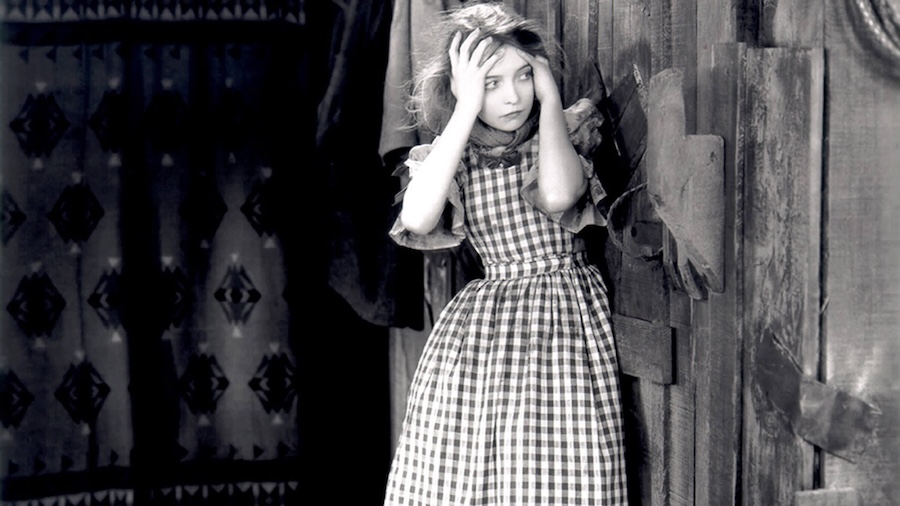
One of the last masterpieces of the silent era, The Wind is set in a Texan landscape that almost looks like science fiction. But Sweetwater is a real place and they have learned how to harness the power of the wind. Today, whether President Trump likes it or not, Sweetwater depends on it. Called the ”Wind Turbine Capital of Texas”, thousands of jobs can be found in that industry. In Victor Sjöström’s film, the climate of this place takes on mythical powers, making it stand apart from conventional tragedies of the day.
A new life in Sweetwater
We are in the early 1880s and the Texas and Pacific Railway has just connected with Sweetwater. Letty Mason (Lillian Gish) leaves her home in Virginia for a train ride to her cousin Beverly (Edward Earle) who lives on a ranch with his family. Letty is hoping for a new life in Sweetwater and meets a fellow passenger, cattle buyer Wirt Roddy (Montagu Love), who tells her that the relentless wind is known to drive women crazy.
After the journey, Letty is picked up by two men, Lige Hightower and Sourdough (Lars Hanson, William Orlamond) who live (relatively) close to Beverly. Fighting their way through a desolate landscape of sand and wind, they finally reach the ranch. Letty is warmly received by Beverly, but faces a number of challenges in Sweetwater, including Beverly’s wife Cora (Dorothy Cumming), who is suspicious of her, and the fact that Wirt, Lige and Sourdough all think of her as their next wife.
Changing times
Sjöström’s last prominent film in Hollywood also became a farewell for Hanson. The advent of sound made him realize that his thick Swedish accent would be a liability in Hollywood. The changing times had its effect on The Wind, a film that was shot long before the premiere of The Jazz Singer. When it was finally released, the studio added sound effects to make it look sort of like a talkie, even though there was no audible dialogue. That didn’t seem to be enough for audiences who stayed away. Many critics also failed to understand what they were witnessing, but the film was met with greater appreciation in Europe.
Lillian Gish is very good as a woman who learns how to master the tempests in a foreign climate.
Over the years, The Wind became a classic. Presumably, Gish saw something special in Dorothy Scarborough’s novel, because she was the one who brought it to MGM and made sure that she was reunited with the Swedish talents; together with Sjöström and Hanson, Gish had made The Scarlet Letter (1926) and appreciated the director’s skill. This film turned out to be one of her best; she’s very good as a woman who learns how to master the tempests in a foreign climate, the real ones as well as those in her mind. Some of it was filmed in the Mojave Desert. The storms are staged with great force and impressive special effects, as in an absurd scene where a party is interrupted by a tornado only to continue once it has passed, and early in the film, where the symbolism is obvious, as Letty hears about an indigenous myth and sees a phantom horse in the sky, among the dark clouds.
The psychology of this unbeatable wind reaches its climax near the end, just as Wirt predicted. But is this woman going crazy, or is she just doing her best to survive?
The story may look simple, but ultimately there are no real villains here. In the novel, Letty reached her devastating destiny. In the case of this film, the studio demanded a happier ending. Neither Sjöström nor Gish approved of it, but still made it work beyond expectation. The finale is irresistibly romantic, with unforgettable images… but MGM also got their ”happy ending” served with a hint of dark delusion.
The Wind 1928-U.S. Silent. 78 min. B/W. Directed by Victor Sjöström. Screenplay: Frances Marion. Novel: Dorothy Scarborough. Cinematography: John Arnold. Cast: Lillian Gish (Letty Mason), Lars Hanson (Lige Hightower), Montagu Love (Wirt Roddy), Dorothy Cumming, Edward Earle, William Orlamond.
Trivia: Originally shown in a 95-min. version.
Last word: “It is without the slightest doubt the most unpleasant picture for me that I ever have made. It’s so uncomfortable. I don’t mind the heat so much, but working before the wind machines all of the time is nerve-racking. It isn’t very hard for me to enter into the state of mind of the character I’m playing, I can assure you. You see, out here the wind blows the sand all the time, bxut they didn’t think that was enough, so they added sawdust. And then that didn’t give quite the desired effect, so they added smoke pots to the mixture. I’m glad to report that none of the flying cinders have gotten into my eyes yet, although a few have burned my hands.” (Gish, The New York Times in 1927)