

A GREAT AND HAUNTING BOOK POURS ITS “HEART” OUT ON THE SCREEN!
Betty Smith, or as she was known at the time of her birth, Elisabeth Lillian Wehner, was born in the 1890s in Williamsburg, Brooklyn. At the time, this was a place of poverty and Elisabeth was the daughter of German immigrants. Many years later, she turned her experiences into a story that she called ”They Lived in Brooklyn”. In 1942, it gained some attention and an editor helped Betty expand the story into a novel that Harper &Brothers published the following year. The new title was ”A Tree Grows in Brooklyn” and it became a massive bestseller, inspiring generations of readers. The film adaptation jump-started Elia Kazan’s career.
Scrubbing floors
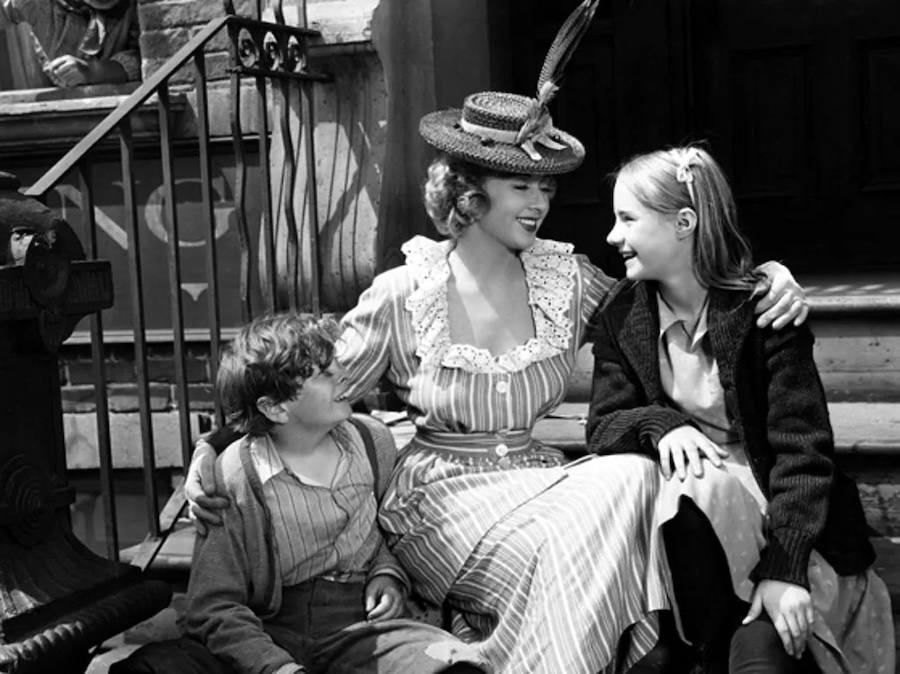
The year is 1912 and we are introduced to the Nolan family in Williamsburg. Katie’s (Dorothy McGuire) job is to scrub the floors of her tenement building and collecting rags for sale, while her husband Johnny (James Dunn) wastes time on his drinking addiction, failing most of the time to find employment. Katie is careful to label his drunkenness as a ”sickness” when she’s talking to their kids; a correct term today, but she’s covering for her husband.
There are two children in the Nolan household: 13-year-old Francie (Peggy Ann Garner) and 12-year-old Neeley (Ted Donaldson). Francie is close to her father, in spite of his flaws, and dreams of a future where she can raise herself out of the squalor.
The tree is a symbol
The story takes place over several months, as the Nolans try to make ends meet. There are several other engaging characters, including Katie’s sister Sissy (Joan Blondell) who is the subject of gossip in the neighborhood; she’s on her third husband and, even if her behavior embarrasses Katie, her taste for independence endears her to her niece and nephew. There’s also a friendly neighborhood police officer in the shape of McShane (Lloyd Nolan), who just might be a little lonely. Symbolism comes in the shape of a tree that grows in the backyard; much like Francie, it keeps growing, reaching for the heavens.
The film obviously deals with social issues and Kazan was the right man to take them on; it would be a signature theme for him. This was his feature-film debut, made even more poignant by the fact that he also came to the U.S. as an immigrant around the time when this film was set. In 1945, he was already an established and lauded director in theater; as his movie career took off, he would also build the Actors Studio, where Lee Strasberg developed the Method. Kazan coaxes great, sensitive performances out of the cast, including McGuire as a woman who carries a heavy burden because someone in the family has to; Dunn, very moving as a drunk who’s a hopeless husband but still a decent man; and Garner who’s strikingly effective as young Francie.
A beautiful, very well directed drama, with an elaborate, convincing set.
There are many other brilliant supporting performances, but Kazan also shows great promise as a filmmaker, together with cinematographer Leon Shamroy; it’s a beautiful, very well directed drama, with an elaborate, convincing set (complete with an authentic tree) and memorable visuals, not least as Johnny makes a final attempt to find a job and the family deals with the consequences. Certain ingredients in the story may be perceived as clichés now, but it’s still a powerful portrait of a working-class struggle to have a fulfilling, functioning life while also striving for a better outcome.
The last time I was in Williamsburg, I enjoyed a lobster roll while taking in the hipster scene. Things have changed a lot since 1912. The film may be heartwarming, but doesn’t shy away from the realities of the period.
A Tree Grows in Brooklyn 1945-U.S. 128 min. B/W. Directed by Elia Kazan. Screenplay: Tess Slesinger, Frank Davis. Book: Betty Smith. Cinematography: Leon Shamroy. Cast: Dorothy McGuire (Katie Nolan), Joan Blondell (Aunt Sissy), James Dunn (Johnny Nolan), Lloyd Nolan, James Gleason, Ted Donaldson, Peggy Ann Garner.
Trivia: Nicholas Ray worked on the film as a dialogue coach. Alice Fay and Gene Tierney were considered for the part of Katie. Remade as a TV movie in 1974; the story was also turned into a stage musical.
Oscar: Best Supporting Actor (Dunn); Garner also received a special juvenile award.
Last word: “That was one piece of scenery construction they did nicely. It reminded me of New York. I was separated from my wife and children at the time, and my own feelings of nostalgia helped me with the picture. That longing to be back with my family. All that was truthful and I had that going for me. When I put my early films down, it’s because I think I did better, more independent and more hardboiled work after 1952 […] But real sentiment is good.” (Kazan, “Kazan: The Master Director Discusses His Films”)