

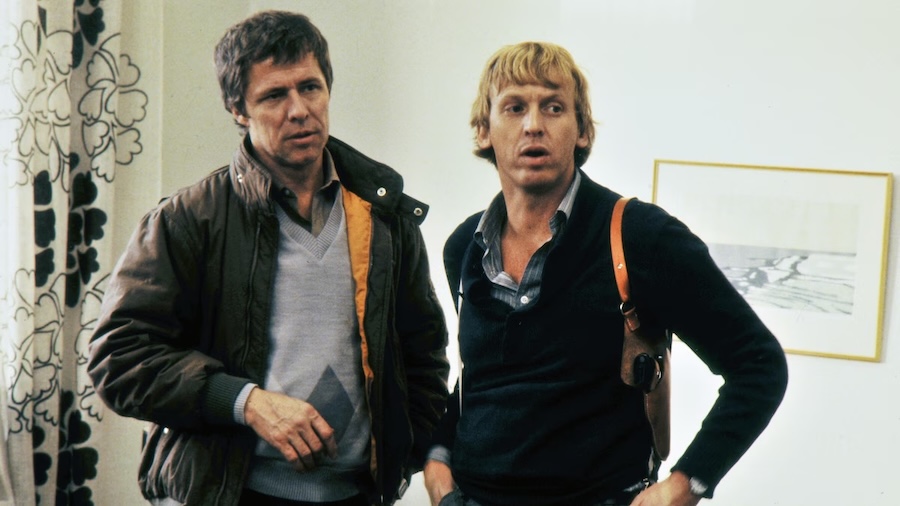
This film would make a good double bill together with Call Girl (2012). Sharing a similar look, they would appeal to an audience that enjoys ’70s or ’80s nostalgia combined with an older Stockholm vibe. They also address the same scandal, the Geijer affair, involving prostitutes and potential security leaks in the government. Unlike Call Girl director Mikael Marcimain, Bo Widerberg avoids the messiness of getting too close to what actually happened. The Man from Majorca is a work of fiction – but altogether believable.
Two seemingly unrelated deaths
When a robbery takes place in a Stockholm post office, detectives Bo Jarnebring and Lars Martin Johansson (Sven Wollter, Tomas von Brömssen) are nearby and go after the criminal, but lose track of him. Some time later, two deaths occur that seem unrelated – a young guy is run over and an alcoholic former reporter is found murdered. It turns out that both men saw the robber at different occasions. When the reporter’s apartment is searched, a photo is found that deepens the connection.
”Janis” and ”Johan” realize that they may be looking for a colleague and start working with the chief (Ernst Günther) of the violent crimes section. Unfortunately, the suspect seems to have powerful friends…
The first adaptation of a Persson novel
There’s a scene in the film where Johansson gripes about having no influence. Ironic to anyone who’s read Leif G.W. Persson’s novels, where this character would subsequently become one of the leading chiefs of police, even solving the real-life 1986 murder of Prime Minister Olof Palme. The Man from Majorca was the first adaptation of a Persson novel, “Grisfesten”. According to the author, he wrote it as an allegory of a Sweden where powerful men become too dependent on each other. Persson’s own career ran into a roadblock when he was identified as a source during the Geijer affair, but it’s fair to say he’s been richly compensated as an author of crime fiction over the years.
Sven Wollter and Tomas von Brömssen are a pleasure to watch, and so is Ernst Günther; great dialogue and there’s a lot of fun and action.
His novel provided a solid foundation for this film. Widerberg, who hadn’t made a movie in five years, presents a depressingly wintry and dirty Swedish capital with whores, crime and lawless cops. But it’s done with enthusiasm, a sense of humor – and action. The car chase in the film’s midsection looks dangerous because the filmmakers took risks while shooting it.
Wollter and von Brömssen are a pleasure to watch, and so is Günther. There are technical and thematic similarities with the director’s formidable Man on the Roof (1976), but the films are unrelated. At times, Widerberg loses his grip of this story and it begins to feel talky and convoluted. But the discomfort of how powerful men protect each other, depicted even more convincingly in Call Girl, is tangible here as well. Having respected Swedish historian Hans Villius play the justice minister, who sort of looks like Geijer, is surprisingly effective.
The Man from Majorca 1984-Sweden-Denmark. 107 min. Color. Written, directed and edited by Bo Widerberg. Novel: Leif G.W. Persson (“Grisfesten”). Cast: Sven Wollter (Bo Jarnebring), Tomas von Brömssen (Lars Martin Johansson), Håkan Serner (Andersson), Ernst Günther, Thomas Hellberg, Ingvar Hirdwall, Tommy Johnson, Hans Villius, Nina Gunke, Margreth Weivers… Johan Widerberg, Gert Fylking.
Trivia: Original title: Mannen från Mallorca. Carl-Gustaf Lindstedt was considered for a role. Wollter returned as Jarnebring in I lagens namn (1986) and also played the part in a miniseries, Profitörerna (1983).
Guldbagge Award: Best Actor (Wollter).
Last word: “I was immediately excited by Persson’s book and felt I had to turn it into a movie. It’s also part of a profitable genre. If I didn’t want to have a conversation with a big audience I might as well have started printing pamphlets. But no more cop movies after this. My next project is making a film out of Torgny Lindgren’s ‘The Serpent’s Way’. I don’t want to see another cop in twenty years. At least.” (Widerberg, Aftonbladet)