

ALL OF THEM WONDERED WHILE ONE OF THEM WANDERED!
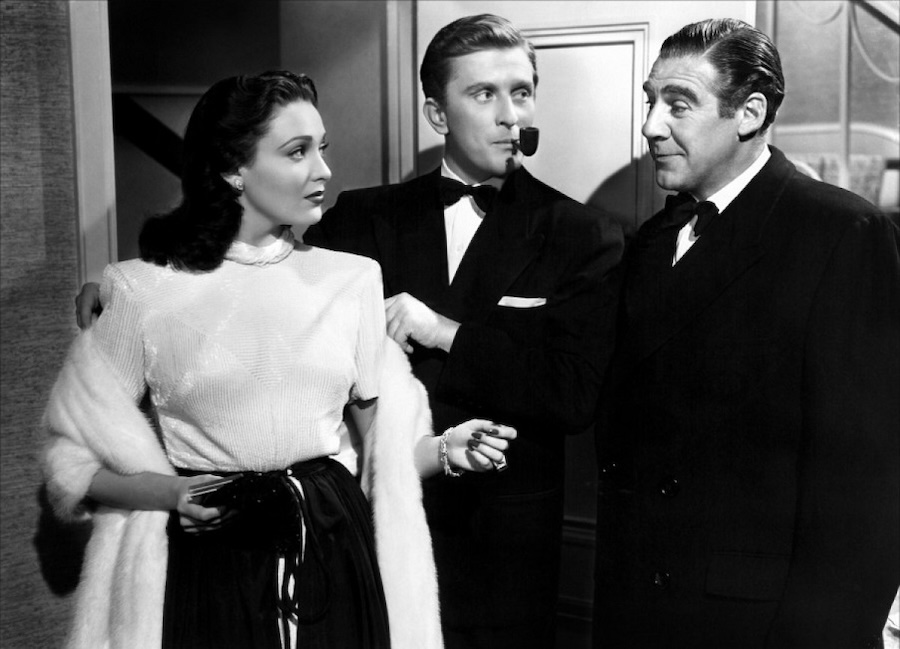
Love that tagline! If you’re a fan of Desperate Housewives, this classic might already be on your radar. The film begins in the same manner as the ABC TV series. A never-seen female narrator takes us to a lush neighborhood and introduces us to a group of women. She seems to know all about them, and they know who she is. But the narrator also knows all the secrets and she’s getting ready to spill the beans, as soon as we in the audience have been properly introduced to the characters. The set-up had audiences hooked right from the start, in a film that became director Joseph L. Mankiewicz’s major breakthrough.
Out on a riverboat
Deborah Bishop (Jeanne Crain), Rita Phipps (Ann Sothern) and Lora Mae Hollingsway (Linda Darnell), three housewives who are good friends, are taking their children out on a riverboat when they receive a message from Addie Ross, a woman who’s also part of their social clique. In the message, Addie claims that she has left town together with her lover, who also happens to be one of their husbands. The note doesn’t say which one.
Unable to contact anyone from the riverboat, the three women spend the journey asking themselves the same question: could it be my husband, and why?
From five to three wives
A perfect opening and conundrum for a soap opera. In 1947, Mankiewicz was immediately intrigued when a screenplay landed in his hands. Written by mystery writer Vera Caspary (of Laura fame), it was an adaptation of a novel called ”A Letter to Five Wives” and Mankiewicz must have seen an opportunity to turn it into a series of witty and sharp, cocktail-enhanced scenes in living rooms and at parties among people who belong to a certain, comfortable class of society. Mankiewicz dropped one of the wives in the process, and after having read the latest version of the script, Fox head Darryl Zanuck suggested another one should go. Three wives would have to suffice.
It was Caspary’s original idea to make Addie Ross unseen in the film, a clever move that allows the audience to conjure their own favorite version of the alluring woman who has a great effect on everybody in town. The structure of the script covers the background of all three women, how they got to know each other – and how they met their future husbands. We learn that Deborah struggled to find her place among her husband Brad’s (Jeffrey Lynn) friends; Rita writes stories for radio soaps and married George (Kirk Douglas), an English teacher; and Lora Mae decided that the man in her life should be Porter (Paul Douglas), the older owner of a department store where she worked.
There’s glamor and fun, but also a fair degree of acid in Mankiewicz’s portrait of men and women.
Class is ever present; both Lora Mae and Deborah came from simpler circumstances and had to get used to new lives, not always smoothly. The film paints a portrait of a suburban post-war America that’s well-off and focused on a bright future rather than war. There’s glamor and fun, but also a fair degree of acid in Mankiewicz’s portrait of men and women. He takes us through the story with great skill; along with the cast, he gives the three women terrifically distinctive personalities. Kirk Douglas is also worth a look as the husband who can’t stand his wife’s employers, a rigidly conservative couple.
The film is like a well-balanced meal, satisfying in most aspects, even if Mankiewicz would outdo himself with the even smarter and funnier All About Eve (1951). The only thing I wondered afterwards is what exactly Addie got out of her behavior. She remains an enigma, for good or bad.
A Letter to Three Wives 1949-U.S. 103 min. B/W. Written and directed by Joseph L. Mankiewicz. Novel: John Klempner (”A Letter to Five Wives”). Cast: Jeanne Crain (Deborah Bishop), Jeffrey Lynn (Bradbury ”Brad” Bishop), Linda Darnell (Lora Mae Hollingsway), Paul Douglas, Ann Sothern, Kirk Douglas, Thelma Ritter. Voice of Celeste Holm.
Trivia: Ernst Lubitsch was considered as director; Maureen O’Hara, Anne Baxter and Gene Tierney for leading roles. Remade as a TV movie, A Letter to Three Wives (1985).
Oscars: Best Director, Screenplay.
Last word: “I felt – I sensed – I knew that Joe had a big talent. His greatness is just beginning; yes, it is just beginning. I knew that it was a matter of his finding himself – and of finding the right story. Actors, sets, direction, camera work – that is all decoration. There must be a story. Now Joe has found himself and he has found his kind of story – things like Letter and Eve – what I call ‘bitter comedy’.” (Zanuck in 1951, Life Magazine)