

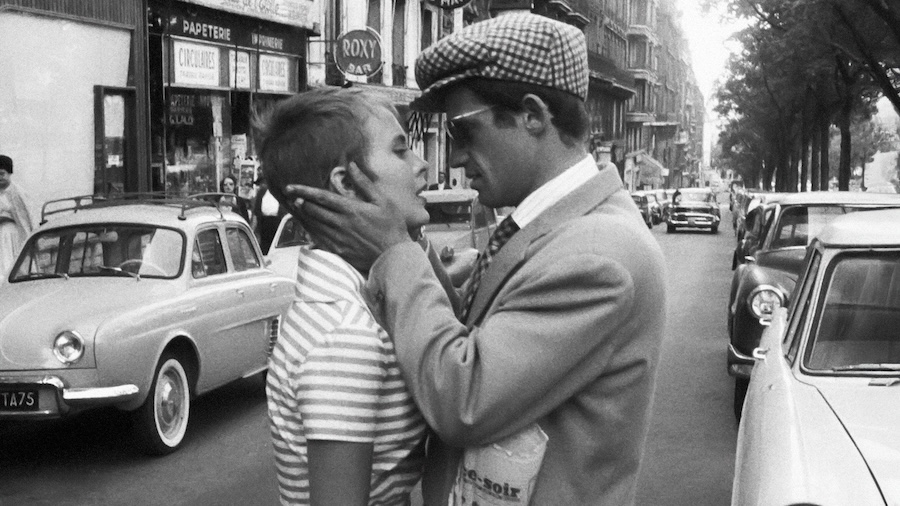
The kind of movie you see in film school and then you make a decision – either I love it or I merely respect it for its achievements. I definitely belong in the latter category and the years haven’t changed my mind. It’s funny, because Jean-Luc Godard remains somewhat of a mystery for me. Undoubtedly one of the giants in cinema history, I’ve never seen anything from him that I’ve fallen in love with (granted, I have a few landmark films of him left to see, but I’ll catch up). Still, Breathless was more than a groundbreaking technical exercise at its premiere – people did fall in love when they saw it.
Hiding in Paris
Michel Poiccard (Jean-Paul Belmondo) steals a car in Marseille. Confronted by a policeman, he shoots and kills him. Michel then goes back to Paris and does his best to avoid the police who are looking for him. Once again, he hooks up with an American girl, Patricia Franchini (Jean Seberg), a student who lives there and earns extra cash by selling the New York Herald on the streets. Michel hides out in her apartment and they begin to talk about a future together…
The most influential of the French New Wave films
The most famous of Godard’s movies, Breathless came after The 400 Blows (1959) and Hiroshima, Mon Amour (1959), but this is arguably the most influential of the French New Wave films, serving as a strict blueprint. François Truffaut, who had directed The 400 Blows, originally worked together with Claude Chabrol on a movie inspired by the story of a French criminal and his American girlfriend. Nothing came of the project, but Godard read the treatment and decided that this should be his first feature film. He was still writing the script when he started shooting the movie, resulting in many improvised scenes. Godard followed the tenets of the movement – locations were authentic and the crew used a handheld camera. In the editing room, the frequent use of jump cuts added to the chaotic, messy feel of the film.
When the studio wanted Godard to make his movie shorter, he chose to brutally trim scenes rather than cutting whole sequences. There was a method to his madness; the audience was always reminded that they’re watching a movie. They had been used to being spoon-fed the old way of telling a story onscreen, but this film showed how it was possible to do things differently.
A cocky and childish criminal, an unlikable figure made compelling by Jean-Paul Belmondo’s performance
Breathless became a pop-culture phenomenon, with a jazz score contributing to the breezy air of the film. Godard’s story seems to have been partly inspired by a few French classics from the 1930s, but it’s obvious that he also looked to Hollywood. Not to learn how to tell a story, but to create visuals and icons. Belmondo, who got his breakthrough here, plays a gangster who admires Humphrey Bogart. This is a cocky and childish criminal, an unlikable figure made compelling by Belmondo’s performance. Seberg is also good as the American girl who’s overseas on an adventure, but eventually realizes that this thing with Michel can’t go on for much longer. Their scenes together in the apartment is an example of where the improvisation becomes an endurance test, with little sense of direction, even though I’m sure they have an appealing romantic feel to some fans of the film.
Breathless becomes much more alive out in the streets, with a constantly moving camera and a sense of authenticity, leading up to the memorable final confrontation between Michel and the police.
Breathless 1960-France. 89 min. B/W. Written and directed by Jean-Luc Godard. Cinematography: Raoul Coutard. Music: Martial Solal. Cast: Jean Seberg (Patricia Franchini), Jean-Paul Belmondo (Michel Poiccard), Daniel Boulanger (Vital), Liliane David, Jean-Pierre Melville… Jean-Luc Godard, Gérard Brach, Jacques Rivette.
Trivia: Original title: À bout de souffle. The shooting of the film was depicted in Nouvelle Vague (2025). Remade in the U.S. as Breathless (1983).
Berlin: Best Director.
Last word: “Jean-Luc fed [the actors] their lines as we were shooting and they repeated them after him. That’s why their delivery is a little jerky – there’s a slight time-lapse all the way through the film. We rehearsed the actors’ moves without their knowing what they were going to say. He wanted everything to be very fresh, so he’d just tell them what movements they had to do. For example he’d say, ‘Jean-Paul [Belmondo], at this point you light a cigarette or you go over to the phone and pick it up,’ but they’d only be given their exact dialogue as we were actually shooting. Generally we did only one take of each scene unless something went wrong, in which case we’d do a second or a third take. We didn’t shoot much footage.” (Coutard, The Telegraph)