

A HAPPY-GO-LUCKY HITCH-HIKER ON THE HIGHWAY TO HAPPINESS! HE WANTED TO SEE THE WORLD… BUT WOUND UP IN LOVER’S LANE!
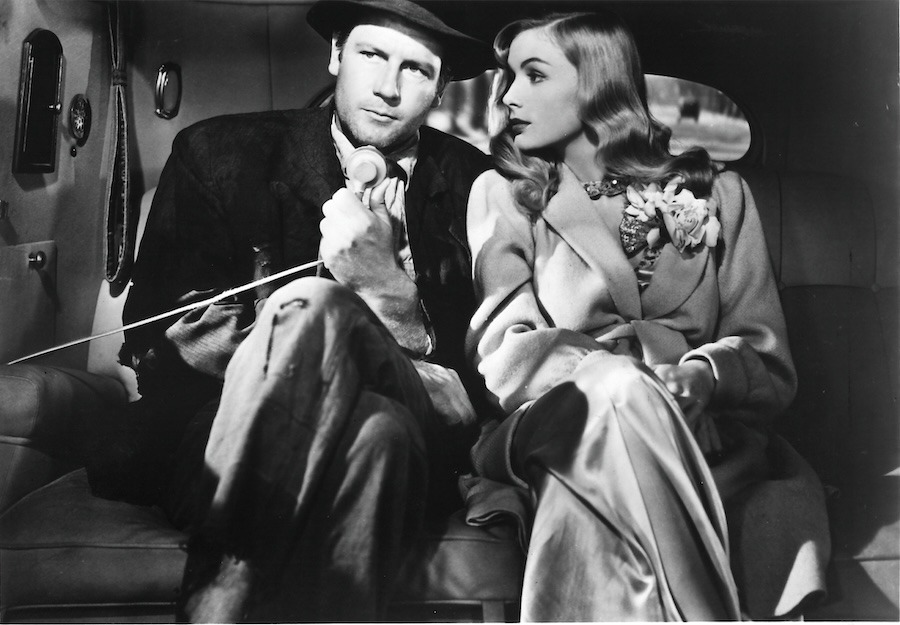
At the time of this film’s premiere, Preston Sturges was riding a wave of success. Established as a screenwriter, he made his directing debut in 1940 with The Great McGinty (and would win an Oscar the following year for the script), and reached some kind of creative zenith with The Lady Eve and Sullivan’s Travels in 1941; both films would be selected for preservation in the U.S. National Film Registry. The latter did have its admirers already at the premiere, but it would take some time before it was considered more or less a masterpiece, influencing later films like the Coen’s O Brother, Where Art Thou? (2000) and Mel Brooks’s Life Stinks (1991).
Yearning to do something serious
John L. Sullivan (Joel McCrea) has it made it in Hollywood thanks to the success of his comedies. But he’s yearning to do something serious, exploring the lives of the not-so-fortunate fellow man in a drama he’d like to call ”O Brother, Where Art Thou?”. The studio bosses are not happy about it and also question what Sullivan knows about the subject. After all, they may be his superiors, but they actually came from poor circumstances and worked their way up; Sullivan, a college boy, had a more privileged upbringing. Sensing that they have a point, Sullivan decides to go undercover, dressing up as a tramp and getting to know people in the streets and hobos on the trains.
At first, he’s accompanied by a studio entourage keeping their eye on him, but he manages to lose them. Instead, he meets a girl (Veronica Lake) who’s trying to make it as an actress…
Celebrating those who make us laugh
When Sturges sat down to write this screenplay, he had a target in sight. He felt that many recent comedies had abandoned fun in favor of a message. Perhaps he was thinking of Frank Capra. Sturges wanted to make a movie that celebrated all those who simply make us laugh (especially then as the war in Europe was raging), be it a clown or your average buffoon.
But he sort of walked into a trap, because even if Sullivan’s Travels makes us laugh, it is most definitely a message movie where one of the best scenes, a tribute to the cinema and how it can be a place where a bunch of strangers laugh together, also has powerful symbolic value, telling us that Hollywood can bring us together regardless of class and race. I am of course talking about the scene where Sullivan watches a Disney cartoon in a Southern Black church. Even if Sturges just wanted us to laugh, the scene was so emotional and effective it compelled civil rights activist Walter White to write him a letter, thanking him for how he depicted Black people in the film.
As Hollywood satire the movie has a lot to offer.
That said, so much here is noteworthy for far less lofty reasons. The wild chase where Sullivan convinces the studio staff to stop following him around made me laugh, and as Hollywood satire the movie has a lot to offer, aided by sharp dialogue, where the filmmakers have fun with the comforts and shallowness of Tinseltown… but, again, Sturges’s social conscience provides depth in other scenes, especially the ones that take place among the homeless, which are beautifully directed.
Sturges wrote the movie for McCrea, but was less sure about Lake, who had gotten her breakthrough the same year in I Wanted Wings. Apparently, she and McCrea did not get along during the making of Sullivan’s Travels, but we can’t really tell. McCrea is excellent as the cocky director, and Lake is even better as the disillusioned young talent who joins him on his experiment.
Sullivan’s Travels 1941-U.S. 90 min. B/W. Written and directed by Preston Sturges. Cast: Joel McCrea (John L. Sullivan), Veronica Lake (The Girl), Robert Warwick (Mr. LeBrand), William Demarest, Franklin Pangborn, Porter Hall.
Trivia: Barbara Stanwyck and Frances Farmer were considered for the part of The Girl.
Quote: “There’s a lot to be said for making people laugh. Did you know that that’s all some people have? It isn’t much, but it’s better than nothing in this cockeyed caravan.” (McCrea)
Last word: “I wasn’t a quick study. We came on the set one morning for Sullivan’s Travels, and Sturges said, ‘Wouldn’t it be interesting doing it all in one take, nine pages? Then we could go home.’ I said, ‘You didn’t hire Jack Barrymore. You know my limitations.’ We did two takes, and Sturges said, ‘Why didn’t you think you could do it?’ We did that one picture, and he insisted on two more.” (McCrea, Bright Lights)