

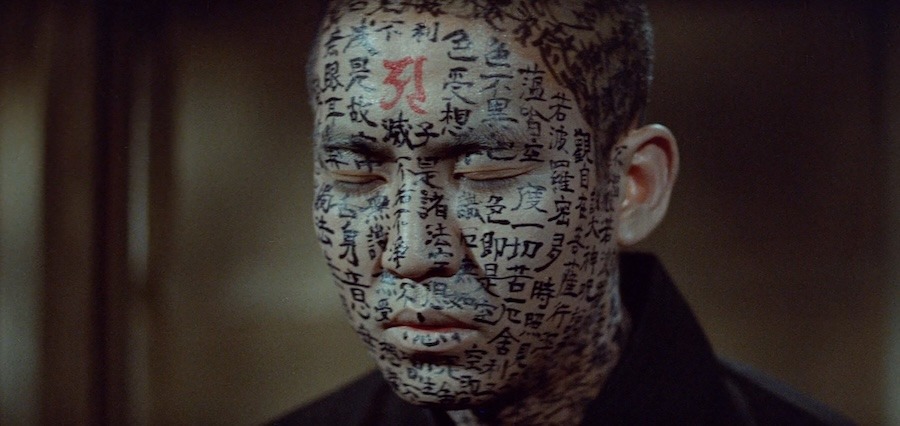
There were two massively influential Japanese horror films released in 1964. Onibaba put an unsettling hanniya mask at the center of a grim civil war story; Kwaidan is an anthology epic about vengeful spirits. Both films are eye-poppingly gorgeous, one in color, one in black-and-white, and played a part in the education of prominent Western filmmakers as well as later, successful Japanese ghost movies, like Ringu (1998).
Regretting his divorce
Four stories play out over three hours. The first, ”The Black Hair”, has a Kyoto swordsman (Rentaro Mikuni) divorcing his wife (Michiyo Aratama) and marrying another woman, only to regret it. When he returns to his first wife, he’s in for a creepy shock. The second story, ”The Woman in the Snow”, has an 18-year-old woodcutter (Tatsuya Nakadai) encountering a yuki-onna spirit during a snowstorm. She kills his colleague but spares the 18-year-old’s life, making him swear never to tell anyone about what happened. The third one is called ”Hoichi the Earless” and follows a blind musician (Katsuo Nakamura) who likes to sing a song about a battle during a famous war in Japan in the 1100s… but his talent catches the attention of a samurai spirit who takes him to the court of the dead Emperor who fought in the battle.
Lastly, there’s ”In a Cup of Tea”, about Kannai (Kan’emon Nakamura) who sees a strange face in his tea cup one day and is startled when the man suddenly appears in the flesh. There will be other ghosts visiting.
A Greek-Irish writer staying in Japan
Kwaidan, meaning ghost stories, was based on a 1904 book by a Greek-Irish writer, Patrick Lafcadio Hearn, who went to Japan in 1890 and stayed there for the rest of his life, becoming a Japanese citizen and taking the name Yakumo Koizumi. As a writer, his work would introduce Western audiences to Japanese culture, especially in the shape of ghost stories, but his books are also read by Japanese audiences looking for stories about a long-lost feudal Japan. Collected in ”Kwaidan” are many more tales than the ones chosen for this film adaptation, as well as a section on insects (!), of particular interest to Koizumi.
It looks spectacular, its color scheme and visuals carefully chosen and controlled.
Director Masaki Kobayashi became interested in adapting the book as a movie in the 1950s, but it would take years before the project finally happened. When Kwaidan premiered, it was one of the most expensive films made in the country, and its lackluster box-office bankrupted the production company. One reason for the expanded budget was Kobayashi’s decision to build bigger sets in a hangar in Kyoto. Artistically, it paid off in spades. Everything you see in the movie was shot on a stage, complete with snow storms and sea battles – and it looks spectacular, its color scheme and visuals carefully chosen and controlled. One theme that binds the stories together is the vengeful spirit, a ghost that appears in different guises, but always intends to punish humans who’ve crossed its path and somehow betrayed it.
The film is at its best in the beginning, with ”The Black Hair” playing an undeniably important role in later horror films. The beauty of his wife’s black hair prevents the swordsman from seeing the truth, until it’s too late. The pace slows down a bit in the third tale, with its ties to actual Japanese history, but it’s still a good story. ”In a Cup of Tea” serves as an intriguing dessert near the end of the film.
Much of Kwaidan isn’t really horror in the traditional sense, if you’re looking for shocks, but it nevertheless lives up to its title. The spirits are there to teach us about the illusion of life: it’s never as permanent as we tend to believe.
Kwaidan 1964-Japan. 183 min. Color. Widescreen. Directed by Masaki Kobayashi. Screenplay: Yoko Mizuki. Book: Yakumo Koizumi. Cinematography: Yoshio Miyajima. Music: Toru Takemitsu. Cast: Rentaro Mikuni (The Samurai), Tatsuya Nakadai (Minokichi), Katsuo Nakamura (Hoichi the Earless), Kan’emon Nakamura (Kannai), Michiyo Aratama, Osamu Takizawa.
Cannes: Special Jury Prize.
Last word: “I hate to sound self-aggrandising, but watching my films today, they don’t feel dated. What this means is that I really spent time on the editing, but also spent a lot of time working on the whole sound of the film, including the music. So when I finished a film, it was really complete. Normally, others might spend about three days on the final edit. But I’d spend two weeks, even more in the case of Kwaidan. The fact that I was able to fully complete my films, with no regrets, is a significant factor in why, watching them today, they don’t feel dated, they remain relevant.” (Kobayashi, interview with Peter Grilli)