

THIS STRANGE CREATURE IS STILL IN JAPAN. MAYBE.
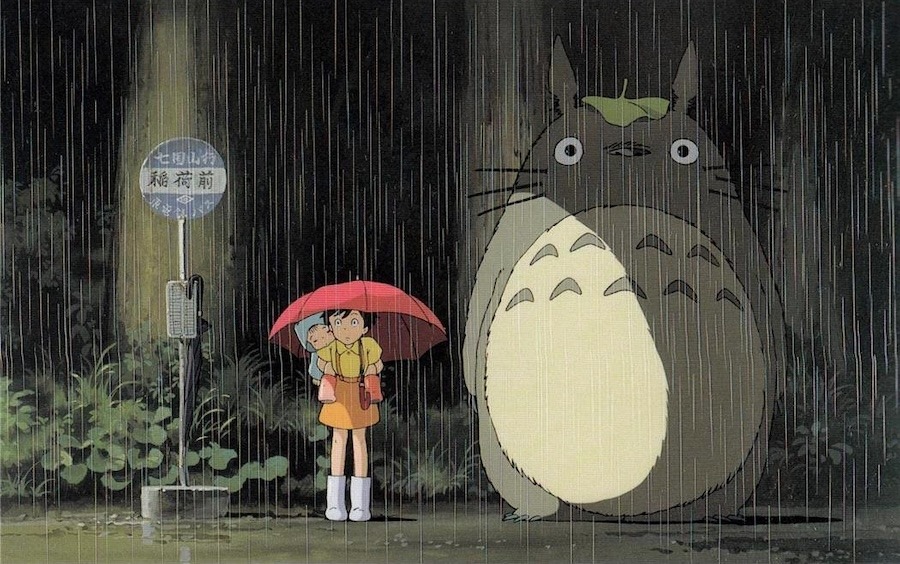
When it came to animation, 1988 was an interesting year. In the U.S., Disney released Oliver & Company, an animated take on ”Oliver Twist” that earned a profit but far from rave reviews. It was the last animated film the studio produced before its great revival the following year, when The Last Mermaid was released, ushering in a new era. In Japan, Hayao Miyazaki had won acclaim with Castle in the Sky (1986), but the film he released in 1988 would be a milestone in the history of his fledgling Studio Ghibli.
A huge tree near the house
The film is set in 1950s Japan, where university professor Tatsuo Kusakabe and his two children, 10-year-old Satsuki and four-year-old Mei, rent a house close to the hospital where the children’s mother is recovering from an illness. The house is inhabited by spider-like creatures who turn out to be spirits, but the family is told not to worry, they’re harmless and will eventually move on. The kids soon learn that there are other, much larger spirits in their vicinity. A huge camphor tree grows near the house and Mei finds her way inside it where she comes across a furry, sleeping creature she names Totoro.
Her sister and father are not sure they believe her, but perhaps Totoro will reappear when he’s needed?
Inspired by his childhood
Miyazaki was inspired by his own childhood when he wrote this story; the part with the ailing mother was particularly emotional for him. The spirits are intriguing but never scary, serving as protectors and a comfort for children who are afraid to confront the fact that their mother could die from the illness. Kids and adults alike should enjoy this short and simple film, which can be viewed solely as a fantasy but also offers depth if you’re looking for it. The tone is nostalgic, with irresistibly lush rural landscapes, perhaps serving as a contrast to the bombed-out cities of postwar Japan; the style was created, in collaboration with Miyazaki, by art director Kazuo Oga, and it has served as a kind of template for later Ghibli films.
The portrait of the girls is realistic, honest and charming, especially that of the curious Mei. And then there’s the spirits, all part of animism, the belief that even objects can have a spiritual essence. The spider-like house spirits would reappear in Spirited Away (2001), but it is of course the soft and harmonious Totoro who has remained in everybody’s hearts, to the degree that comparisons have been made with Paddington. Totoro has become the symbol of Studio Ghibli, an icon frequently sold as plush figures and seen on key chains, coffee mugs, pillows and what not. But we shouldn’t forget about the Catbus, another spirit summoned by Totoro. As you might guess, it is a cat that also serves as a bus. Questions on that?
The music is yet another ingredient that elevates the film.
Oliver & Company had music going for it, at least. In the case of My Neighbor Totoro, the music is yet another ingredient that elevates the film. Joe Hisaishi had become a go-to composer for Miyazaki and two of his tracks from the score, ”Path to the Wind” and the endearing end theme, are great contributions that should send you off cheerfully humming or whistling.
My Neighbor Totoro 1988-Japan. Animated. 86 min. Color. Written and directed by Hayao Miyazaki. Music: Joe Hisaishi. Voices of Noriko Hidaka (Satsuki Kusakabe), Chika Sakamoto (Mei Kusakabe), Shigesato Itoi (Tatsuo Kusakabe), Sumi Shimamoto (Yasuko Kusakabe), Hitoshi Takagi, Naoki Tatsuta.
Trivia: Original title: Tonari no Totoro. When the film was dubbed for American audiences in 2005, Dakota and Elle Fanning provided voices for Satsuki and Mei. Later a stage play. In 2003, Miyazaki released a 13-minute sequel called Mei and the Kittenbus.
Last word: “There was a house that was the splitting image of Kanta’s house [in the film]. When we were making the film, I went there with the background artist Kazuo Oga to check it out, it was surrounded by all these levee protection works, and the scenery had changed. I was disappointed, but Mr. Oga said, ‘I get the vibe.’ He put his imagination to work and reconstructed the feeling.” (Miyazaki, “Totoro no Umareta Tokoro”)