

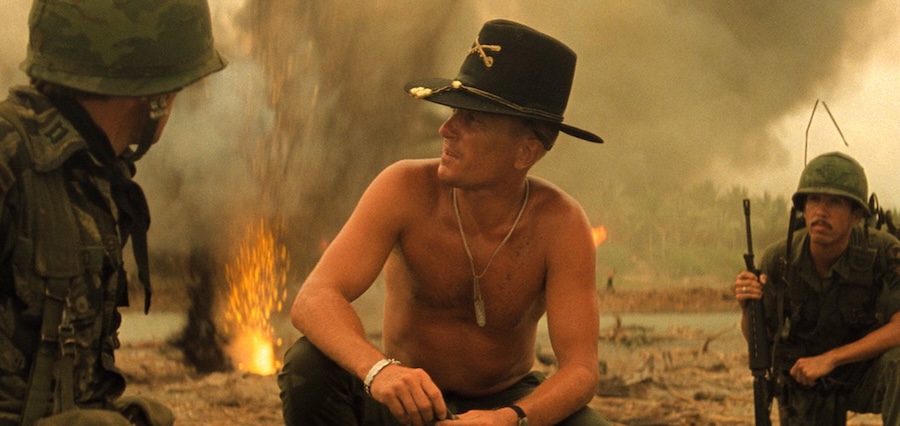
Francis Ford Coppola began his 1970s by winning an Oscar for writing the five-star film Patton. He went on to win more Oscars by creating the first two Godfathers, some of the best movies ever made. And he closed this decade by going back to war, delivering yet another five-star film. One of the most astounding achievements Coppola made was surviving the making of it.
An unusual mission
In 1969, Captain Benjamin L. Willard (Martin Sheen) is summoned to his superiors in Nha Trang and receives a highly unusual mission: find Walter Kurtz (Marlon Brando), a brilliant Special Forces colonel, who’s gone rogue somewhere in the jungle, and ”terminate his command”. Willard understands what he’s ordered to do, and joins a river patrol boat along with a small crew, headed up to Kurtz’s outpost in Cambodia.
Along the journey, Willard reads up on Kurtz’s background and becomes intrigued by this strange, grand figure. He also witnesses the absurd consequences of war and how easy it is to cross lines of decency.
Inspired by Conrad and Herzog
I remember reading Joseph Conrad’s ”Heart of Darkness” in school, or as it was better known among the general public then and now, the story behind Apocalypse Now. Unlike the film, which is one of many to portray the brutality of the Vietnam War, Conrad’s story stands on its own as a unique exploration of the unimaginable horrors of the Belgian reign in the Congo Free State in the late 1800s. No wonder John Milius was tempted to transfer the shocking and mysterious effect of the story, as well as the depiction of colonialism, to the Vietnam War. Coppola found his own inspiration in Werner Herzog’s Aguirre, Wrath of God (1972), even if I’m sure he never intended the production to be equally troubled. Or worse, in fact.
What makes much more of an impact is the illustration of war as a maze you lose yourself in.
The intended five-month shoot began in March 1976, but would be extended to well over a year, due to a wide range of problems, from storms destroying sets to Sheen suffering a heart attack. Watching a conversation between Coppola and Sheen among the extras on the Bluray, where they happily swap war stories from the shoot, makes it clear what a difference 30 years makes; on location in 1976-1977, it must have been harrowing for them both. But a movie did come out of it – and what a movie. The story isn’t what matters the most, even if Milius brings many ingenious details to his script, such as the helicopters attacking to the tune of Wagner’s ”Ride of the Valkyries”. What makes much more of an impact is the illustration of war as a maze you lose yourself in. You have your drugs to soften what the bloodshed does to you, even if it doesn’t help much – but then there are men like Kurtz, and Lieutenant Colonel Bill Kilgore (brilliantly played by Robert Duvall, who delivers the film’s most famous line), who sort of find themselves in war and wouldn’t want to live any other way. Our guide and observer into this hellscape is Willard; Sheen is very good as a man who initially may come across as reliable, but who’s really lost (not unlike how he felt in real life at the time as well).
The last third of the film, when Kurtz is located, becomes too muddled for its own good… but Brando’s magnetic presence (to some extent, saved in editing) compensates, and that final sequence (”the horror, the horror”) is just as unforgettable as the opening.
Perfect combinations of sound and visuals. Vittorio Storaro won an Oscar for his cinematography and the dark beauty of his presentation of the Vietnam War in this film – all inferno, all madness – takes your breath away. Music is also key, from Wagner to The Doors to the cues written by father and son Coppola.
Apocalypse Now 1979-U.S. 147 min. Color. Widescreen. Directed by Francis Ford Coppola. Screenplay: John Milius. Novella: Joseph Conrad (”Heart of Darkness”). Cinematography: Vittorio Storaro. Music: Carmine Coppola, Francis Ford Coppola. Cast: Marlon Brando (Walter Kurtz), Robert Duvall (William ”Bill” Kilgore), Martin Sheen (Benjamin L. Willard), Albert Hall, Frederic Forrest, Sam Bottoms, Laurence Fishburne, Dennis Hopper, Harrison Ford, Scott Glenn… R. Lee Ermey.
Trivia: George Lucas was initially set to direct. Steve McQueen, Robert De Niro and Al Pacino were considered for the part of Willard; Harvey Keitel was first cast. Orson Welles and Lee Marvin were considered for the part of Kurtz. The making of the film was depicted in the documentary Hearts of Darkness (1991). Also released in a 202-min. version called Apocalypse Now Redux, and in a 182-min. version.
Oscars: Best Cinematography, Sound. BAFTA: Best Direction, Supporting Actor (Duvall). Golden Globes: Best Director, Supporting Actor (Duvall), Original Score. Cannes: Palme d’Or.
Quote: “I love the smell of napalm in the morning.” (Duvall)
Last word: “I always thought the perfect anti-war film would be a story in Iraq about a family who were going to have their daughter be married, and different relatives were going to come to the wedding. The people manage to come, maybe there’d be some dangers, but no one would get blown up, nobody would get hurt. They would dance at the wedding. That would be an anti-war film. An anti-war film cannot glorify war, and Apocalypse Now arguably does. Certain sequences have been used to rev up people to be warlike.” (Coppola, The Guardian)