

HOUSTON, WE HAVE A PROBLEM.
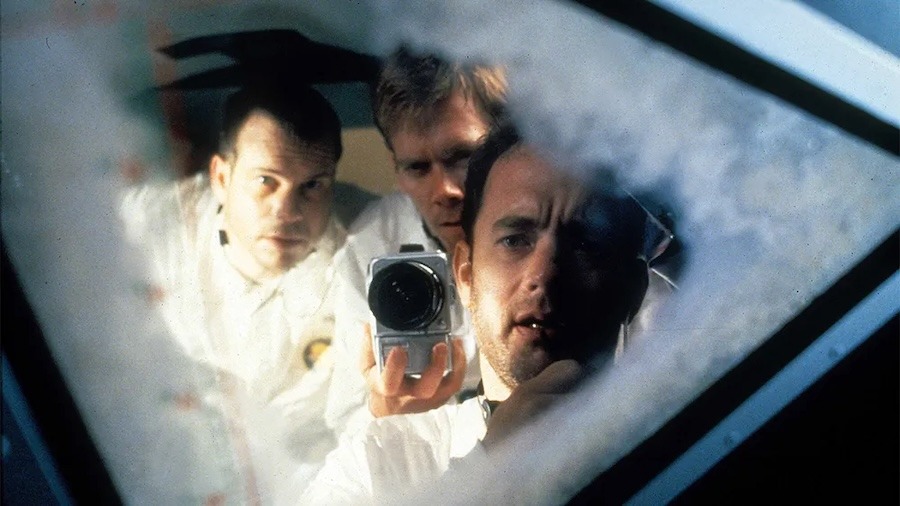
When producer Brian Grazer and director Ron Howard decided to turn the story about the ill-fated 1972 Apollo 13 mission into a movie, they found a lot of support from NASA. The space agency, likely eager to exploit the goodwill surrounding the rescue of the mission’s three astronauts, even offered Howard a chance to film the Mission Control sequences in the actual facilities in Houston, Texas. The spacecraft interiors were designed in Kansas by the same manufacturers who worked on the original Apollo 13 command module. The actors were given access to the Space Camp in Alabama and the Johnson Space Center in Houston. So, is this merely NASA propaganda?
Jaded with lunar expeditions
Three years after Neil Armstrong’s first steps on the moon, the American public has grown jaded with lunar expeditions. By the time Jim Lovell (Tom Hanks), Fred Haise (Bill Paxton) and Ken Mattingly (Gary Sinise) are cleared for the Apollo 13 mission, there is no real excitement. Lovell’s wife Marilyn (Kathleen Quinlan) has bad dreams about the expedition and just wants it over. Then, unfortunately, it turns out that Mattingly has been exposed to the measles, and since NASA can’t take any chances, he’s replaced by Jack Swigert (Kevin Bacon).
A few days after liftoff, a liquid oxygen tank explodes and another turns out to be leaking. It is soon clear that the crew of Apollo 13 and NASA are going to have to forget about the moon and focus on how to get the spacecraft back to Earth in one piece…
Technically believable and dazzling
“Lost Moon”, Lovell and Jeffrey Kluger’s chronicle of the Apollo 13 accident and rescue, provides much of the backbone of this technically believable and dazzling film, one of the best ever to portray a historical space program event. It’s easy to think of Apollo 13 as a failure, but in light of the horrific Challenger and Columbia disasters in 1986 and 2003, it is amazing how those astronauts were brought back to safety. Everything in the film, from the smallest 1970s period details to the meticulously constructed modules to the visual effects that bring the Apollo 13 liftoff to life, looks impressive.
As for that last part, the sequence may have its flaws to modern audiences, but it still provides one of the absolute highlights of the film because of the tension that Howard builds and the stirring emotions of James Horner’s music. As the Saturn V rocket lifts to the sky with great thunder and the camera targets one of the astronauts’ wives whose intense fear is relieved with a tear, I felt the hairs on my arms stand up. Nothing that follows is equally powerful, but still very engaging, which is quite a feat considering how technically complex each problem that befell Apollo 13 were. The filmmakers are very good at conveying just how claustrophobic and eerie it must have been up in the module, with the embracing cold and darkness.
James Horner’s score is one of the composer’s best.
Ed Harris delivers a forceful performance as Gene Krantz, the Flight Director whose white vest became so legendary it is now an item at the National Air and Space Museum in Washington; he’s more than ably aided by a terrific cast that also includes some of Howard’s closest family. Horner’s score is one of the composer’s best, including the end title track that features special vocals by Annie Lennox.
What about that initial question I posed? The answer is, yes, this is perfect PR for NASA… but it’s also one of those times where the collaboration serves a higher purpose. The artistic qualities of Apollo 13 would have suffered without NASA’s involvement.
Apollo 13 1995-U.S. 139 min. Color. Widescreen. Directed by Ron Howard. Screenplay: William Broyles, Jr., Al Reinert. Book: Jim Lovell, Jeffrey Kluger (“Lost Moon”). Cinematography: Dean Cundey. Music: James Horner. Editing: Mike Hill, Daniel P. Hanley. Production Design: Michael Corenblith. Cast: Tom Hanks (Jim Lovell), Bill Paxton (Fred Haise), Kevin Bacon (Jack Swigert), Gary Sinise (Ken Mattingly), Ed Harris, Kathleen Quinlan. Narrated by Walter Cronkite. Cameo: Roger Corman.
Trivia: Released in a 116-min. IMAX version in 2002. Brad Pitt and John Cusack were considered for parts; John Travolta asked for one, but was turned down.
Oscars: Best Film Editing, Sound. BAFTA: Best Production Design, Special Effects.
Quote: “We’ve never lost an American in space, we’re sure as hell not gonna lose one on my watch! Failure is not an option.” (Harris)
Last word: “One of the real highlights of my career, on so many levels. Interfacing with so many people who were involved in the space program. And being able not only to tell that story but also let people understand what the Apollo era was about, and how these people achieved so much with so little, technologically, during that period. At mission control, at home and in the capsule. It was an honor and such a tremendous filmmaking opportunity full of challenges, some physical, some technical and some narrative.” (Howard, Deadline)