

THE DRAMA AND THE PASSION OF ONE OF THE EPIC EVENTS OF THE TWENTIETH CENTURY!
There was a time in my youth when I believed in a solution in the conflict between Israel and the Palestinians. After the fall of the Soviet Union, so much in the world seemed possible. Germany was headed for reunification, Russia looked like it could thrive as a democracy, and we saw Arafat and Rabin shake hands outside the White House. Everybody seemed to agree that a two-state solution was the only path forward. Today, I no longer believe in a solution for either Israel or Palestinians, but in a waltz of death between the two sides that will simply continue for the foreseeable future.
Differences between novel and film
On both sides, there have always been extremists, hell-bent on grabbing as much land for their people as possible, killing whomever stands in the way. For Palestinians, there has never been any sense of success, only suffering. For the Jews who came to the area known as Palestine before the creation of the state of Israel, there has certainly been suffering, but a much greater degree of success. This film tells the story of the struggle for the creation of Israel, from the Israeli viewpoint; along with Leon Uris’s book, Exodus convinced many Americans of the need to support the fledgling nation.
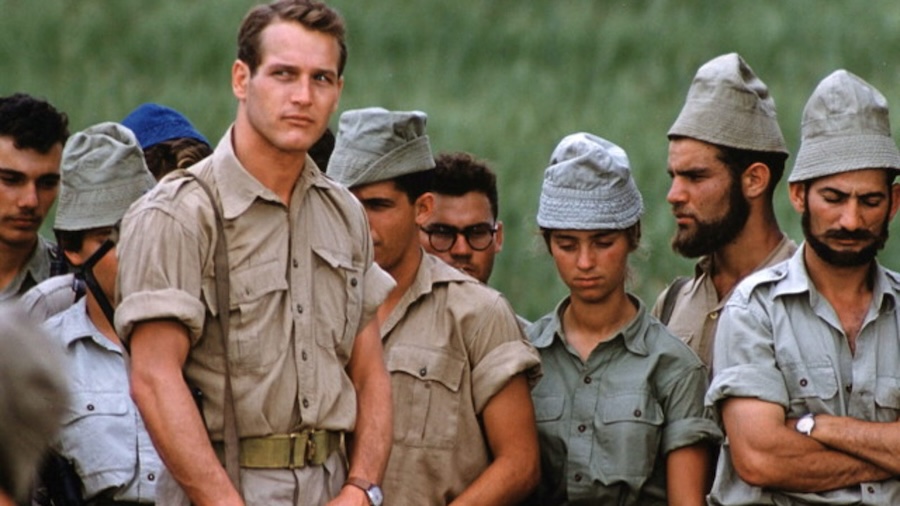
There are differences between novel and film, changes made that Uris disapproved of, but which serve the movie well. In Uris’s original screenplay, there was too much focus on the history of the Jewish people and too much resentment against both the British and Arabs, which led producer-director Otto Preminger to hire brilliant but banned screenwriter Dalton Trumbo, a decision that helped end Hollywood’s blacklisting practice. Trumbo made sure the story primarily focused on three ingredients: the ship Exodus, full of Jewish survivors, breaking a British blockade in Cyprus and making its way to Palestine; a love affair between Haganah fighter Ari Ben Canaan (Paul Newman) and American nurse Kitty Fremont (Eva Marie Saint); and the internal conflict between Jewish terrorists and more moderate forces in their struggle to create a new nation.
White-washing to some people
Today, far-left activists are using the term Zionist as a simplistic sign of evil. Zionism is a form of nationalism, meaning what’s bad tends to come with what’s good. Nationalism helps shape a unifying culture of a nation, but can easily tip over into a false and racist sense of superiority, which became painfully obvious during Israeli Prime Minister Benjamin Netanyahu’s blood-soaked regime, a union with fascists. Exodus will always be Zionist white-washing to some people, and there are certainly downsides to the film, including a degree of naiveté in the portrait of all sides; dramatically, the film is less effective in its first half, and asking us to accept Newman as a Jewish rebel fighter takes some effort.
Ernest Gold’s main theme became an instant classic.
But there’s a lot here that remains exciting and interesting. The film uses its locations in Cyprus and Israel very well, Sal Mineo is memorable as a hate-filled Auschwitz survivor and terrorist wannabe who harbors a humiliating secret, and Ernest Gold’s main theme became an instant classic.
There’s also a genuine desire to show Jews and Arabs as willing to do the only thing that can be done with Palestine: share the land and co-exist. Alas, the conclusion of this epic points to the grim reality: a forever war. I would love to be proven wrong.
Exodus 1960-U.S. 208 min. Color. Widescreen. Produced and directed by Otto Preminger. Screenplay: Dalton Trumbo. Cienmatography: Sam Leavitt. Novel: Leon Uris. Music: Ernest Gold. Cast: Paul Newman (Ari Ben Canaan), Eva Marie Saint (Kitty Fremont), Ralph Richardson (General Sutherland), Peter Lawford, Lee J. Cobb, Sal Mineo, John Derek, Hugh Griffith.
Trivia: Hayley Mills was considered for the role of Karen.
Oscar: Best Original Score. Golden Globe: Best Supporting Actor (Mineo).
Last word: “It was no great masterpiece, but it was at least half of a damn good movie. Preminger had the locations, the starting date, the contracts, everything but a script. He called me on the sixteenth of December. I read the book in two days. It weighed 14 pounds and had 390 characters. I told Otto he had better know what he wanted. He did. I followed him like a dog through the construction. If a scene wasn’t working, I’d jump ahead to something I knew I could write.” (Trumbo, RogerEbert.com)