

LENNY SAID IT. “HOT HONEY” DID IT. TOGETHER THEY SHOCKED AMERICA.
In 2004, Comedy Central put together a list of the 100 greatest standup comedians of all time. Richard Pryor, George Carlin and Lenny Bruce made top three. They all have one thing in common: dancing close to the fire, unafraid to offend. The story of Bruce has one man standing up against a government that decides which sexual words are obscene. Today, the battle of freedom of speech usually stands between the comedian who offends and a public that has the choice of ”canceling” somebody, based on something that is either said or done.
Often, it’s not the courts that deliver verdicts, but all of us through social media. This film takes us back to a simpler conflict.
A double act at a burlesque club
Based on a successful Broadway play, Lenny jumps back and forth between a few periods in Bruce’s life. In the 1950s, he started making a name for himself in comedy clubs. After giving it a shot in New York City, he came to Los Angeles together with Honey, a stripper he had fallen in love with and married. They had a double act at a burlesque club; in between introducing strippers, Bruce had plenty of time to work on his material and learned that the more he ignored conventions and what was considered ”decent”, the more he talked about what people were actually doing in their bedrooms, the greater success he had as a comedian. Uttering the word ”cocksucker” on stage leads to his arrest, the first of many obscenity charges.
Causing a sensation
This film doesn’t actually show us just what kind of a rock star Lenny Bruce became in the ’50s and ’60s, releasing popular comedy albums, causing a sensation when visiting countries like Britain and Australia, and generating huge media attention because of his arrests. The 1964 obscenity trial had influential artists like Woody Allen, Norman Mailer, Bob Dylan and James Baldwin expressing support for him. To some extent, you can tell that the documentary-like film was based on a play, because the locations are mostly centered squarely on characters; the camera focuses on them, be it Lenny and Honey, or the people in their lives who are being interviewed and provide context, supposedly by some journalist after Lenny’s death in 1966. Are we in New York or L.A.? It doesn’t really matter.
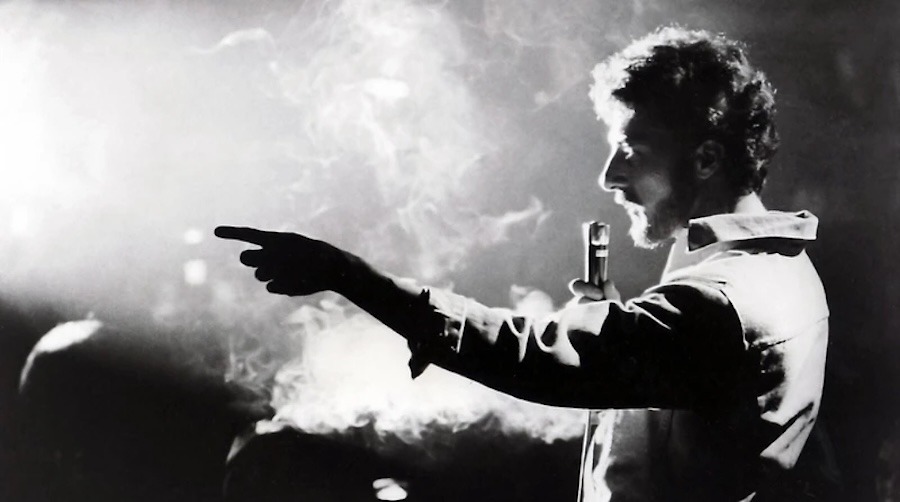
A dark movie visually, where cinematographer Bruce Surtees composes images in striking black-and-white.
Making this film was both an unusual and natural choice, I imagine, for director Bob Fosse. He had won an Oscar for Cabaret (1972), which was a big movie; Lenny is much smaller by comparison. But much like Cabaret, it’s also a very dark story about people who go up on a stage and push the envelope. Thematically, yes, because the film chronicles the tumultuous relationship between Lenny and Honey, their drug abuse (especially Lenny, who only got worse near the end of his life) and the frequent court battles that took a toll on his mental health (and also made his comedy routines suffer). But it’s also a dark movie visually, where cinematographer Bruce Surtees composes images in striking black-and-white, especially Lenny’s standup acts.
There really isn’t much to laugh about here, but we do get a clear picture of how groundbreaking Lenny Bruce was, also as a social commentator. Hoffman gives a tour-de-force performance, strongly assisted by Perrine as a woman who didn’t exactly prosper from being married to him, but fought for his legacy after his death.
Lenny 1974-U.S. 111 min. B/W. Directed by Bob Fosse. Screenplay, Play: Julian Barry. Cinematography: Bruce Surtees. Cast: Dustin Hoffman (Lenny Bruce), Valerie Perrine (Honey Bruce), Jan Miner (Sally Marr), Stanley Beck, Rashel Novikoff, Gary Morton.
Trivia: Bruce’s life was also chronicled in the documentary Lenny Bruce: Swear to Tell the Truth (1998).
Cannes: Best Actress (Perrine).
Last word: “I didn’t have to do much, because Bobby [Fosse] did our own version of a woman who would contend with a man like Lenny, rather than what Honey did. Honey’s still alive and has script approval and all that jazz, so we couldn’t do the real Honey.” (Perrine in 1975, The Retriever)