

SOME MEMORIES ARE BEST FORGOTTEN.
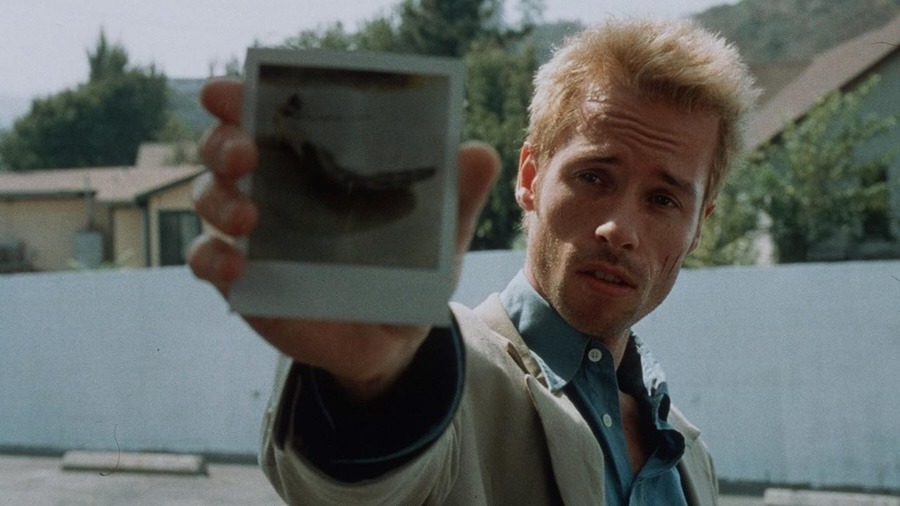
It opened at the Venice Film Festival in September 2000 and then continued playing the festival circuit. Its American premiere was in January 2001 at the Sundance Film Festival. Critics debated the film’s merits, audiences admired the way the filmmakers played with time. It didn’t cost much, but in the end Memento did make some money, snatched a few Oscar nominations and launched the career of its director, Christopher Nolan. But the one who deserves the most praise is Guy Pearce.
Starting at the end
The film starts at the end. We see the main character, Leonard Shelby (Guy Pearce), realize that the man he’s been after is the guy who at first appeared to be helping him, John Gammell (Joe Pantoliano). Leonard pulls out a gun and tries to shoot him. That’s the end of the story but certainly not the film. Step by step, Nolan takes us back to the beginning and we slowly learn that Leonard is an insurance investigator who, as a result of having suffered a blow to his head, has virtually no short-term memory. He’s now looking for the man who raped and murdered his wife (and also caused his condition). It’s not an easy thing to do when every day you wake up somewhere, you have no idea where you are or how you got there.
Leonard has a few tricks to help him, but as the story progresses we see how easily manipulated he is, including by the sleazy Mr. Gammell and a barmaid called Natalie (Carrie-Anne Moss).
Simply not thrilling enough
All in all, this thriller works pretty well. Telling a story backwards is not an easy thing, but Nolan and his team came up with a clever way of doing it. The story was divided into sequences that end with the beginning of the preceding sequence. As a bridge between each sequence of events, he’s using black-and-white footage of Leonard sitting in a motel room, telling someone on the phone about another man who suffered from the same condition as Leonard. Reversing the timeline is wonderfully creative idea, but there are plenty of moments when the story simply isn’t thrilling enough, when the jumbled way of telling it appears to be little more than just a gimmick.
The film has its share of secrets, like Donnie Darko of that same year, but I’m not sure a second look at Memento would make me think harder about what’s going on. However, with this concept Nolan has managed to instill in the viewer the same kind of confusion that Leonard is going through every morning, and that fits the movie really well.
Guy Pearce is a major reason why we stay with Leonard till the end/beginning of the film.
Pearce is a major reason why we stay with Leonard till the end/beginning of the film. We feel sorry for him because of the condition that makes him such a target. We sympathize with his mission and Pearce succeeds in creating a real human being, rather than a stereotypical hero. We need that to overcome those parts of the movie that are forgettable (pun intended).
Memento 2001-U.S. 113 min. Color-Black/White. Widescreen. Written and directed by Christopher Nolan. Editing: Dody Dorn. Cast: Guy Pearce (Leonard Shelby), Carrie-Anne Moss (Natalie), Joe Pantoliano (John Edward Gammell), Mark Boone, Jr., Stephen Tobolowsky, Jorja Fox, Thomas Lennon.
Trivia: Brad Pitt, Alec Baldwin and Charlie Sheen were considered for the part of Leonard. The screenplay was based on a story by Nolan’s brother, Jonathan.