

THE MOST DARING FILM IMPORT EVER… FROM JAPAN!
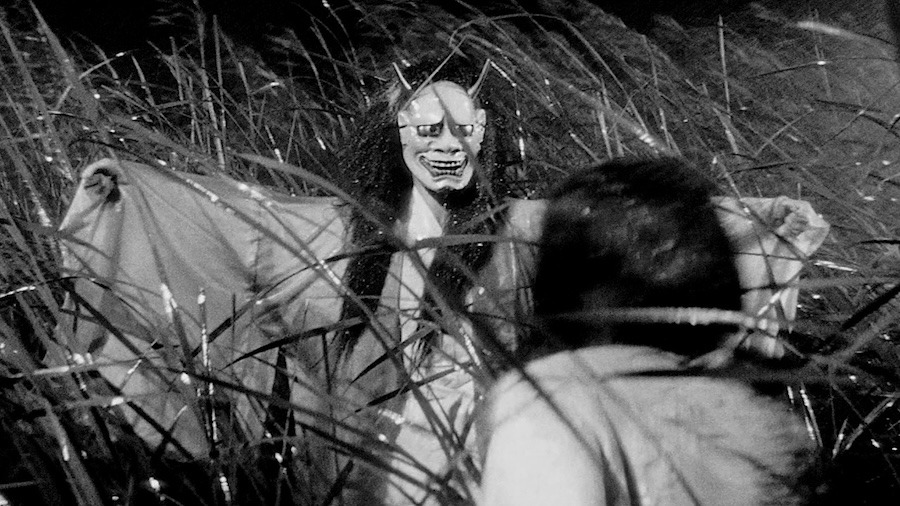
Reading about how director Kaneto Shindo was criticized early in his career for lacking a distinctive visual style seems ironic once you’ve seen one of his most famous films, Onibaba. This is a multilayered movie whose look is a huge reason why you can’t take your eyes off of it. William Friedkin was allegedly inspired by its use of a demon mask when he made The Exorcist (1973)… but Onibaba really defies a genre label.
A 14th-century civil war
We’re somewhere in Japan in the 14th century during a civil war. Two women, an older one (Nobuko Otowa) and her younger daughter-in-law (Jitsuko Yoshimura), survive by ambushing soldiers in a huge field of tall reeds. After killing them, the women strip them of clothes and weapons, items they can sell to a merchant. The bodies are dropped into a seemingly bottomless pit in the field.
One day, a neighbor, Hachi (Kei Sato), returns from the war and tells the women that he deserted along with their son/husband, who was subsequently killed. In spite of this devastating piece of news, life goes on for them all. The older woman tells her daughter-in-law to stay away from Hachi who’s clearly attracted to her. But the young woman is seduced and embarks on a passionate affair with Hachi. The older woman fears what will happen the day when her partner-in-crime decides to leave…
The arrival of a samurai
A solution arrives in the shape of a samurai who’s wearing a hannya mask, a white-painted, grinning face with unsettling eyes and protruding horns. He tells the older woman that he’s lost, but she has little sympathy for him or anyone participating in a war that took away her son. That mask and its haunting qualities become a crucial part of the film; the director was inspired by a Shin Buddhist tale about a mask that had a grimly punishing effect on anyone wearing it. These ingredients are the reason why many critics and scholars have described Onibaba as a horror movie. The samurai is an intimidating presence and his appearance is clearly reminiscent of the Noh theater, the dance drama that has been performed in Japan since the 14th century, using masks to represent different roles, not least ghosts.
But it’s not all about the mask. Along with cinematographer Kiyomi Kuroda, Shindo creates a superbly eerie atmosphere out there in the field, where you can never be sure of what lies waiting among the tall, swaying reeds. Sound plays an important part, along with Hikaru Hayashi’s music score, a combination of fierce drums and jazz. The film is also an erotic drama, quite challenging for its time. Both Hachi and the young woman are full of lust and defy the older woman’s conservative views; her daughter-in-law can’t understand why she shouldn’t have sex whenever she feels like it. Their conflict develops into a resounding showdown between generations (and family members). This is in line with Shindo’s frequent attempts to portray women and sexuality, often set in rural, poverty-stricken environs.
It’s hard to forget those sweaty nights in the tall grass.
It’s a frank, compelling and thought-provoking film where Shindo even makes clever allusions to the atomic bombing of Hiroshima, the city where he was born; again, it’s all in the mask, or behind it.
The pit where all the soldiers end up is an obviously thrilling part of the story, but also its most predictable, especially near the end as the older woman realizes the horrifying mistake of wearing that cursed mask. But even if the ending is nowhere as powerful as everything else in the film, it isn’t a liability. All in all, it’s hard to forget those sweaty nights in the tall grass where passion quickly turns to horror.
Onibaba 1964-Japan. 102 min. B/W. Widescreen. Written and directed by Kaneto Shindo. Cinematography: Kiyomi Kuroda. Music: Hikaru Hayashi. Cast: Nobuko Otowa (Older Woman), Jitsuko Yoshimura (Younger Woman), Kei Sato (Hachi), Taiji Tonoyama, Jukichi Uno.
Last word: “My main historical interest focuses on ordinary people… their energy to carry themselves beyond the predicaments they encounter daily. I wish to describe the struggles of the so-called common people which usually never appear in recorded history. This is why I made Onibaba. My mind was always on the commoners, not on the lords, politicians, or anyone of name and fame. I wanted to convey the lives of down-to-earth people who live like weeds.” (Interview with Joan Mellen)