

MORE TITANIC THAN ANY STORY EVER TOLD!
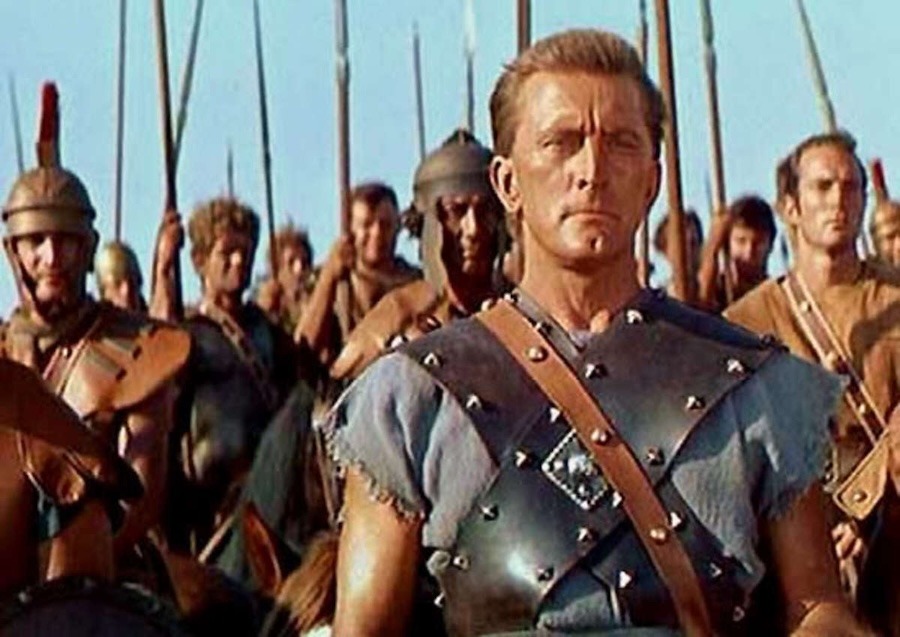
This is a story about freedom. Our hero was born without it and died without it. It is easy to see what Dalton Trumbo saw in the titular character in Howard Fast’s novel. Trumbo’s own freedom was taken away when he was blacklisted during the dark McCarthy years. I bet he was itching to show the world how an idea worth fighting for, like freedom or democracy, can survive no matter how many of its supporters totalitarian forces try to subjugate. That spirit is very much alive in this epic.
Director Stanley Kubrick reunited with Kirk Douglas after Paths of Glory (1957) for this film; Douglas executive-produced it and hired Kubrick after firing the original choice, Anthony Mann. It became Kubrick’s first and only huge Hollywood epic, perhaps an impersonal but slickly made slice of cinema.
Saved from his execution by a slave trader
The story takes place a century before the birth of Christ and details the rise and fall of a slave rebellion against the Romans. A Thracian slave called Spartacus (Douglas) is saved from his own execution by a slave trader, Batiatus (Peter Ustinov), who sees gladiator potential in the fiercely proud and strong man. He brings Spartacus home to his gladiator school where he is trained to become one of the best. When Marcus Licinius Crassus (Laurence Olivier), a ruthless Roman senator, and his family visit Batiatus and demand to see two gladiators fight to the death, the incident sparks a rebellion among the gladiators that quickly spreads to other parts of the Roman hemisphere. Spartacus soon finds himself in command of a slave army headed for Rome. At the same time, Crassus and his main rival in the senate, Gracchus (Charles Laughton), are competing for the power and glory of Rome.
Music is a key ingredient
For a traditional Hollywood epic, there are unusual ingredients. The ending is dark and realistic, there are sly hints at political realities in the U.S., and one of the film’s most famous scenes is a bizarre bath involving Crassus and a slave, Antoninus (Tony Curtis), where the subtext is obviously gay. A senator declaring his lust for both “oysters and snails”? I have to assume that the scene was included to make Crassus look as untrustworthy and immoral as possible.
The opening credits are grand; Alex North’s music matches Saul Bass’s design.
There’s a romance of course. Spartacus has never had a woman until he meets Varinia (Jean Simmons) at the gladiator school and it’s love at first sight. When the rebellion begins, the couple enjoy every minute of their doomed freedom before it’s too late. This becomes a fairly engaging part of the film and Alex North’s beautiful love theme helps it immensely. His music is a key ingredient, adding powerful emotion to the story. The opening credits are grand; North’s music matches Saul Bass’s design, featuring imaginative close-ups of majestic statues. Cinematographer Russell Metty makes sure on-location footage works seamlessly with scenes shot on a soundstage.
Douglas gives a solidly reliable performance as the stubborn slave leader and Ustinov won an Oscar for his entertaining portrayal of the slave trader who doesn’t mind groveling as long as there’s something in it for him. Olivier and Laughton are both terrific as two very different players in the Roman senate, one of them icy and incredibly dangerous, the other more humane, not callous enough.
Having Tony Curtis as a half-naked slave who gives Laurence Olivier a sponge bath is a playfully campy ingredient, a quaint touch to a film that is almost an equal to Ben-Hur (1959) – technically dazzling, with some performances rising above the spectacle, and it knows how to use its three hours without outstaying its welcome.
Spartacus 1960-U.S. 184 min. Color. Widescreen. Directed by Stanley Kubrick. Screenplay: Dalton Trumbo. Novel: Howard Fast. Cinematography: Russell Metty. Music: Alex North. Production Design: Alexander Golitzen. Art Direction: Eric Orbom. Costume Design: Valles, Bill Thomas. Cast: Kirk Douglas (Spartacus), Laurence Olivier (Marcus Licinius Crassus), Jean Simmons (Varinia), Tony Curtis, Charles Laughton, Peter Ustinov, John Gavin, Nina Foch, Herbert Lom, John Ireland.
Trivia: Douglas’s decision to hire Trumbo helped break the blacklist. At first, this film faced competition from a rival project, The Gladiators, starring Yul Brynner; there was talk of merging the films, but it didn’t happen and the Brynner project was eventually canceled. David Lean was considered for directing duties; Jeanne Moreau as Varinia. The film was restored in 1991, with Anthony Hopkins dubbing Olivier’s voice in the bathing scene. Remade in 2004 as a miniseries.
Oscars: Best Supporting Actor (Ustinov), Cinematography, Art Direction-Set Decoration, Costume Design. Golden Globe: Best Motion Picture (Drama).
Quote: “My taste includes both snails and oysters.” (Olivier declaring his bisexuality to Curtis)
Last word: “My company, Bryna, produced [Spartacus] and I wanted to get the best writer. The best writer was Dalton Trumbo, who had served a sentence in jail and then moved to Mexico. But when he came back, he wrote the script in secret under the name Sam Jackson. He was a wonderful guy, and it was terrible that he had to hide his name. I think because I was young enough I had more guts – when you’re older, you have more to lose. I got a call from Otto Preminger, who said, ‘You’re working with a blacklisted writer!’ He was very mad at me. I said ‘I don’t care’, and he hung up.” (Douglas, Interview Magazine)