

I remember turning on my TV early on the morning of August 31, 1997. CNN was just telling the world that Princess Diana had died in a car crash in Paris. She had turned into a beloved icon and it was hard to believe that she was gone at the tender age of 36. Still, it was also difficult to predict just how the British people would react. Even a person who had been queen for over 40 years failed to comprehend just how powerfully her people would mourn the loss.
The first meeting with Blair
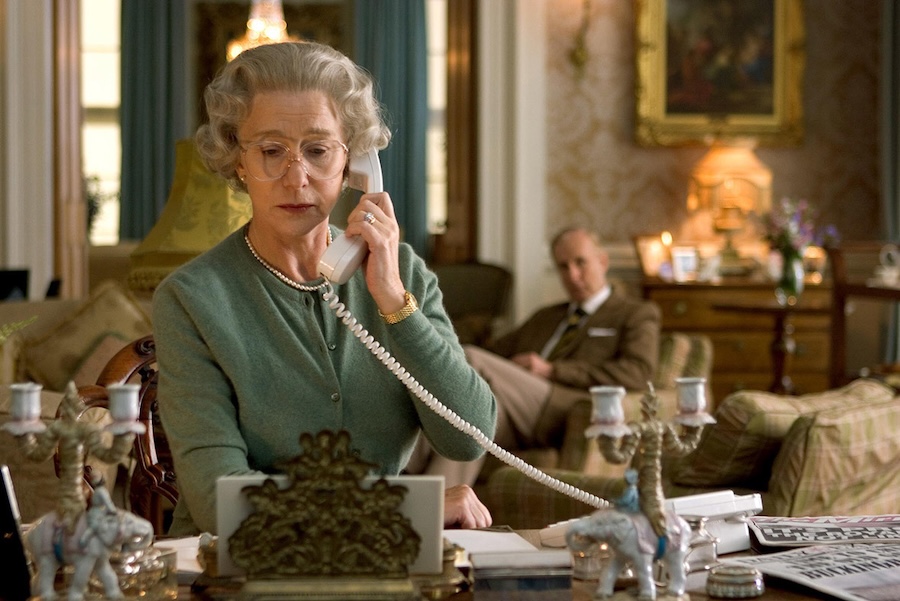
In one of the first sequences with Queen Elizabeth II (Helen Mirren), she is preparing to have her first formal meeting with the new Prime Minister, Tony Blair (Michael Sheen). The meeting is cordial; the Queen points out to Blair that he is her tenth prime minister (Churchill was the first) and he is genuinely grateful to receive advice from such an experienced head of state. A few months later, while the royal family is resting at Balmoral Castle in Scotland, Diana is killed in Paris. The Prime Minister asks the Queen if she intends to make a statement, but she doesn’t. She considers the mourning to be a private matter and expects the people to understand. She also leaves the funeral arrangements to Diana’s family and there are no plans on a public ceremony.
But the people are not prepared to let go. The nation is in an extraordinary state of shock and grief and soon the mountain of flowers is completely blocking the entrance of Buckingham Palace. Fueled by the media and the general perception of the royal family as uncaring in all Diana-related matters, the public angrily demands the family to end their vacation. The Prime Minister realizes that if he doesn’t get the Queen to listen to him, the monarchy will face its greatest challenge ever.
A shared responsibility
It’s a juicy story and writer Peter Morgan makes the most of it. He has the Queen telling Blair that she will advise him, but in the end it is the freshman Labour Prime Minister’s words of wisdom to the veteran monarch that saves the day. But Morgan also lets the Queen have the last word as she tells Blair, the man who would destroy his legacy with an ill-advised war in Iraq, that he too should expect and prepare for the day when he’s no longer the most popular man in Britain. Those are ironies in a film that displays a robust sense of humor, especially in its take on Prince Philip (Cromwell), a man who comes across as completely insulated in the royal life.
Helen Mirren looks slightly too young to play the Queen, but overcomes that and turns in a performance that’s even moving.
The relationship between Blair and Elizabeth becomes captivating. The Prime Minister’s wife is the first to tell him that the Queen is turning into a mother figure to him. Perhaps it’s the shared responsibility of running the country that makes him sympathize with Elizabeth. Sheen doesn’t exactly look like Blair, but he certainly talks like him and is very effective. So is Mirren in one of her most lauded roles; she looks slightly too young to play the Queen, but overcomes that and turns in a performance that’s even moving. Her portrait convincingly shows the monarch’s mental process leading up to her decision to come back to London.
The screenplay is down to earth, effectively showing the contrasts between the absurd life of royalties and the unpretentiousness of the Blair household, with fish sticks and all. The film is a reminder that the monarchy must remember its place and ponder its purpose.
The Queen 2006-U.K.-France-Italy-U.S. 101 min. Color. Directed by Stephen Frears. Screenplay: Peter Morgan. Music: Alexandre Desplat. Cast: Helen Mirren (Elizabeth II), Michael Sheen (Tony Blair), James Cromwell (Prince Philip), Helen McCrory, Alex Jennings, Roger Allam.
Trivia: Frears previously directed a TV movie about the rise of Tony Blair, The Deal (2003); Sheen played him then as well and returned to the part in another TV movie, The Special Relationship (2010).
Oscar: Best Actress (Mirren). Golden Globes: Best Actress (Mirren), Screenplay. BAFTA: Best Film, Actress (Mirren). Venice: Best Actress (Mirren), Screenplay. European Film Awards: Best Actress (Mirren), Composer.
Quote: “Have we shown you how to start a nuclear war yet?” (Mirren to Sheen)
Last word: “I have no idea if we got it right. For all I know she’s very very stupid but we choose to present her as an intelligent woman who realizes the incongruity of her position. Quite simply, there’s a contradiction between monarchy and democracy and she has made it work. It’s the only time in my lifetime that she’s ever been criticized or appeared to get something wrong. But, of course, in getting it wrong, she revealed her humanness.” (Frears, The Evening Class)